TMU math professor’s new book brings networks and graph theory to a wider audience
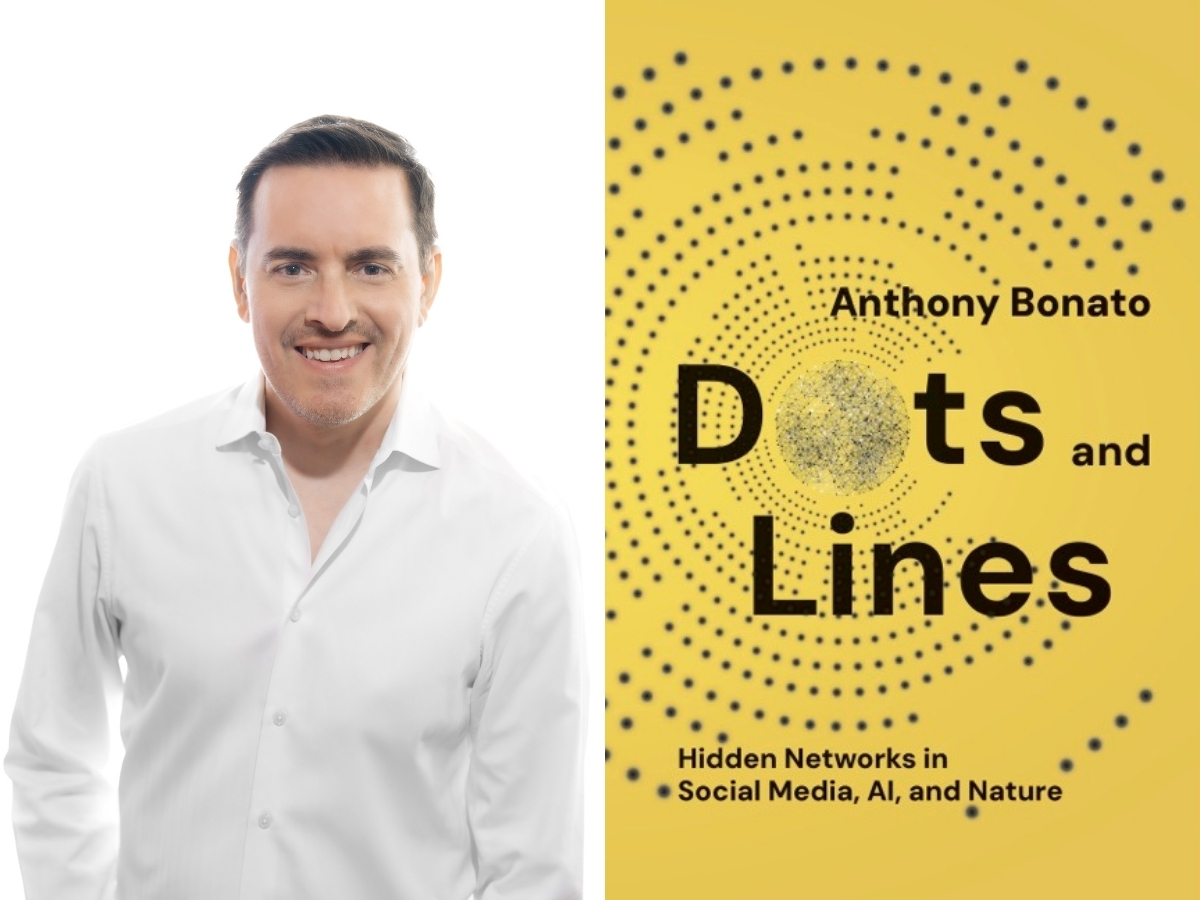
Professor Anthony Bonato and his book, Dots and Lines: Hidden Networks in Social Media, AI, and Nature.
Network: In recent decades, the word has become increasingly commonplace as we discuss connections on social media, the spread of colds during the fall flu season, or the degrees of separation between contacts in our professional networks. But did you know there are also networks in nature? Food webs, for example, represent the connections between prey and predators. Inside our cells, protein molecules interact biochemically.
TMU mathematics professor Anthony Bonato sees networks everywhere. Now he is sharing that view with the world in his latest book, Dots and Lines: Hidden Networks in Social Media, AI, and Nature (Johns Hopkins University Press, 2025). With chapters on topics from the spread of memes to the voting networks of the game show Survivor to the network of characters in Game of Thrones, his range is abundant.
Yet beneath all these contemporary topics, like the healthy vegetables covered by tasty spaghetti sauce, are the more scholarly topics that are central to Bonato’s academic field, from hypergraphs to graph colouring. With such an engaging treatment, it’s no wonder the book got an excellent review in the Wall Street Journal (external link) .
So why did Bonato decide, with seven books already authored, to use his eighth to open the world of graphs to a general audience? A pandemic project inspired by the increased visibility of contact networks by epidemiologists, Bonato began to research the prominence of networks everywhere. “Networks come up in all different fields, not just in science, but also in literature, history and others,” says Bonato, noting that this is despite network science being only a couple of decades old as a field. “Networks are still an emerging topic within science, within mathematics, but they're becoming a very powerful lens to reveal a lot of new things. They are a tool that allows us to see a little deeper, a little further.”
Bonato was furthermore inspired to write for a popular audience because he wanted to dispel the notion that mathematics is inaccessible. “One thing I've heard when I go to a party or I meet a person for the first time socially is ‘I hate math.’ People often say this with a great deal of confidence or zeal. They don't meet an English professor and say, ‘I hate words,’ but for whatever reason, math engenders quite a strong negative reaction. The book was an attempt, in part, to explain what I do in this burgeoning area to people without a lot of math background.”
In practical terms, Bonato connects with his readers by incorporating personal anecdotes and relatable images. For example, he opens with a scene from Toronto’s annual Caribbean Carnival parade, where he reflects on his position as part of a social network of fellow attendees. For a complex topic like network embedding, he begins by recalling pondering the stars and constellations in the night sky as a boy, a widely relatable moment. Even before the book, Bonato had already been writing articles accessibly for years. He encourages fellow scholars to share their work with a broader audience, including the average reader. “It’s really important. Even if we took just a small percentage of our time as academics to talk about what we do to the general public, I think it would go a long way to help ease that math anxiety.”
That’s why Bonato also likes teaching graph theory to incoming students, as he has been for the 30 years of his career. “Students come to university, they're not quite sure what they're going to get out of a math course. Discrete mathematics and graph theory are different than topics like calculus or linear algebra, which are taught in every university. The barrier to entry is lower, so we get students right into these interesting questions,” he says. Bonato himself was drawn to mathematics because of its relative accessibility, in that you only needed a pen and paper to start exploring. “Mathematics felt like something that was so beautiful and something a little beyond, kind of, ordinary life,” he says.
Besides promoting the new book in places such as the Breaking Math podcast (external link) and the New Books Network (external link) , Bonato continues with his own research, which includes a focus on “burning” (covered in Chapter 4), modelling memes and how they spread. Bonato’s contribution includes developing the burning number conjecture, posing that there’s an upper bound to how large the burning number of a network can become. It has been difficult to prove, but in 2023, he and his collaborators, including Dr. Shahin Kamali at York University, made significant progress toward resolving the conjecture (external link) .
Bonato has also conducted research on an adjacent field called cooling, which aims to slow down rather than speed up the burning process, and liminal burning in between. Burning and cooling have numerous practical applications, for example, to estimate the network proximity prescribed during the pandemic to maintain six feet of distance, or to determine the interaction levels between tables in a restaurant, or even in nature to examine the spread of fungus in an orchard.
As for his own working network, Bonato says he’s happy that the field of mathematics itself has become more collaborative over the years. He’s also keen to be part of the TMU network, where he sees a lot of energy and excitement. “There's an openness and a welcomeness to experiment and to go in interesting directions. Innovation is something that's really driven me, and I feel very much at home at TMU. My research can flourish here.”