Celebrating math with the next generation
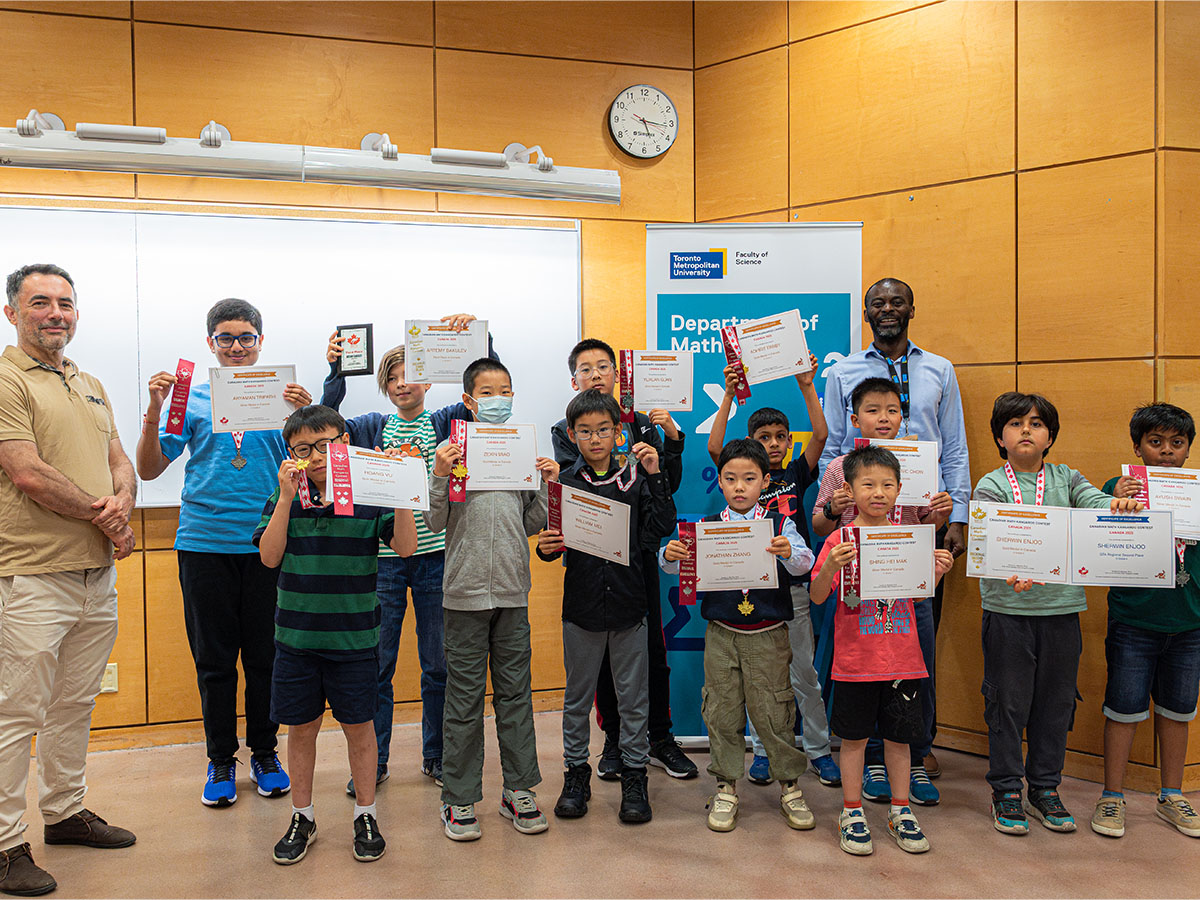
Mathematics professors Dejan Delic and Francis Duah with the 2025 finalists of the TMU-hosted 2025 Canadian Math Kangaroo Contest.
When Toronto Metropolitan University served as a host for the 2025 Canadian Math Kangaroo Contest (external link) on March 23, the numbers told a story about the joy of mathematics in action.
Originating in France in 1991 with the aim to boost interest in math among youths, Math Kangaroo has evolved into a global initiative involving 111 countries. Canada began hosting the contest in 2010, and this year’s edition attracted 6,832 contestants from across the country, with 6,010 participating in person and 822 writing online. TMU was one of 56 higher education institutions or other sites from across the country, and one of 26 in Ontario, to serve as a contest host.
A record 199 children in grades 1 to 12 participated in the contest at TMU. An unprecedented 16 medals, including 8 golds, were awarded to those who scored in the top 10% nationally. But the number of participants whose experience may have inspired them to study math at post-secondary school is what most interests Faculty of Science professor Francis Duah.
“I want young people to know that mathematics is a profession worth exploring. It’s such a beautiful field,” says Duah, a professor and pedagogy researcher in the Department of Mathematics who has been voluntarily organizing the event since TMU became a host in 2023.
On contest day, Duah was supervising the proceedings along with Department of Mathematics chair Dejan Delic. Meanwhile, a team of 25 students from across TMU, including five from the Faculty of Science, served as volunteer invigilators.
Participants solved age-appropriate math problems in multiple choice form in grade clusters of 1-2, 3-4, 5-6 and 7-12. The youngest cohort wrote for up to 45 minutes while kids in the most senior grades were allotted 75 minutes. The questions aligned with the Ontario Ministry of Education’s math curricula and were designed to engage participants’ basic computational skills, logical thinking, perseverance and imagination.
“Both the students and their parents were quite happy and excited to be involved,” says Duah about the mood of the participating families.
This year’s 199 contestants at TMU represented a 128% increase over the 87 who took part in 2023. As for their results, the 16 medalists represented a fourfold increase over the 2023 winners. On June 10, TMU held an awards reception on campus to celebrate the winning students and their families.
Following the contest, Duah took part in the national contest debrief workshop in May at the Banff International Research Station for Mathematical Innovation and Discovery. The topics discussed included comparing the math curricula of different provinces, expanding participation among youths, examining AI’s implications for the contest, and better engaging underprivileged students.

Duah met with educators from across the country to debrief the contest and discuss how to better engage students in mathematics.
For his part, Duah has observed the absence of some ethnicities among contestants, and has also noticed the relatively lower participation of girls compared to boys in the contest as an area of concern. Duah says part of the vision of the Department of Mathematics is to reduce inequities and diversify participation in the discipline of mathematics.
To achieve this goal, Duah plans to develop a math outreach program in which TMU math students would deliver engaging lessons to local youths from communities who are underrepresented in math. The effort aligns with his scholarly interest in understanding what constitutes effective math learning and teaching at the high school level.
“I hope to entice more youths from parts of Toronto to explore math,” Duah says. “Math is often perceived as boring, but it is fun, and it is used to solve most of our society’s problems.”