EDIA Resource Hub
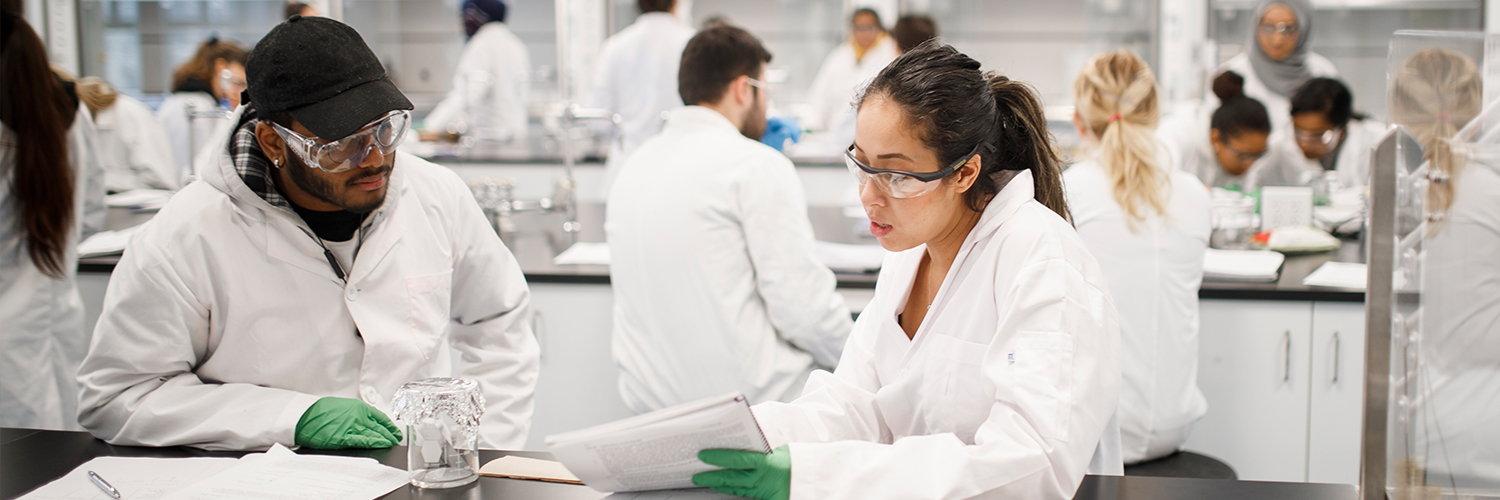
Welcome to the EDIA (Equity, Diversity, Inclusion and Accessibility) Committee website for the Department of Chemistry and Biology (CaB) at TMU. Our committee is committed to fostering a department where everyone—students, staff, and faculty—feels a strong sense of belonging, safety, and opportunity.
This website serves as a living hub of resources and information to support and inspire our departmental community as we work together to make science more equitable and inclusive. Feel free to send us your best practices, as we welcome everyone's suggestions and input.
We’re glad you’re here.
Grounded in the diverse lived experiences of our community, our work focuses on removing barriers to participation, amplifying underrepresented voices in science, and advancing inclusive teaching, learning, and research practices. Here, we are curating examples of best practices for inclusive curriculum design, strategies to increase access to experiential learning, and ideas for buildings community through accessible programming and mentorship.
Our Objectives

Create and maintain a living repository of EDIA resources

Foster a culture of belonging within the department

Empower students, staff, and faculty through capacity building

Remove barriers to participation and advancement in science

Model transparent and responsive EDIA leadership
2026 EDIA Committee
- Imogen Coe - sabbatical
- Stefania Impellizzeri
- Stephanie Grouios
- Nicala Jenkins
- Bryan Koivisto - sabbatical
- Shawn McFadden
- Stephanie Melles
- Krystal Nunes
- Bryant Serre
Contact Us
Here are the (word file) terms of reference for the committee. If you have any questions, ideas, areas of concern, or are interested in joining the committee as a full member or active participant please contact any of the members, or the Chair of the department (Costin Antonescu).
TMU Recommendation nine, from the Standing Strong Task Force (SSTF) report, mandates that all academic programs incorporate mandatory learning opportunities about Indigenous history and Indigenous-colonial relations for all students. This recommendation (opens in new window) is a key part of Toronto Metropolitan University's (TMU) commitment to reconciliation and decolonization.
"It is precisely because education was the primary tool of oppression of Aboriginal people, and miseducation of all Canadians, that we have concluded that education holds the key to reconciliation." - Justice Murray Sinclair, Chair of the Truth and Reconciliation Commission of Canada
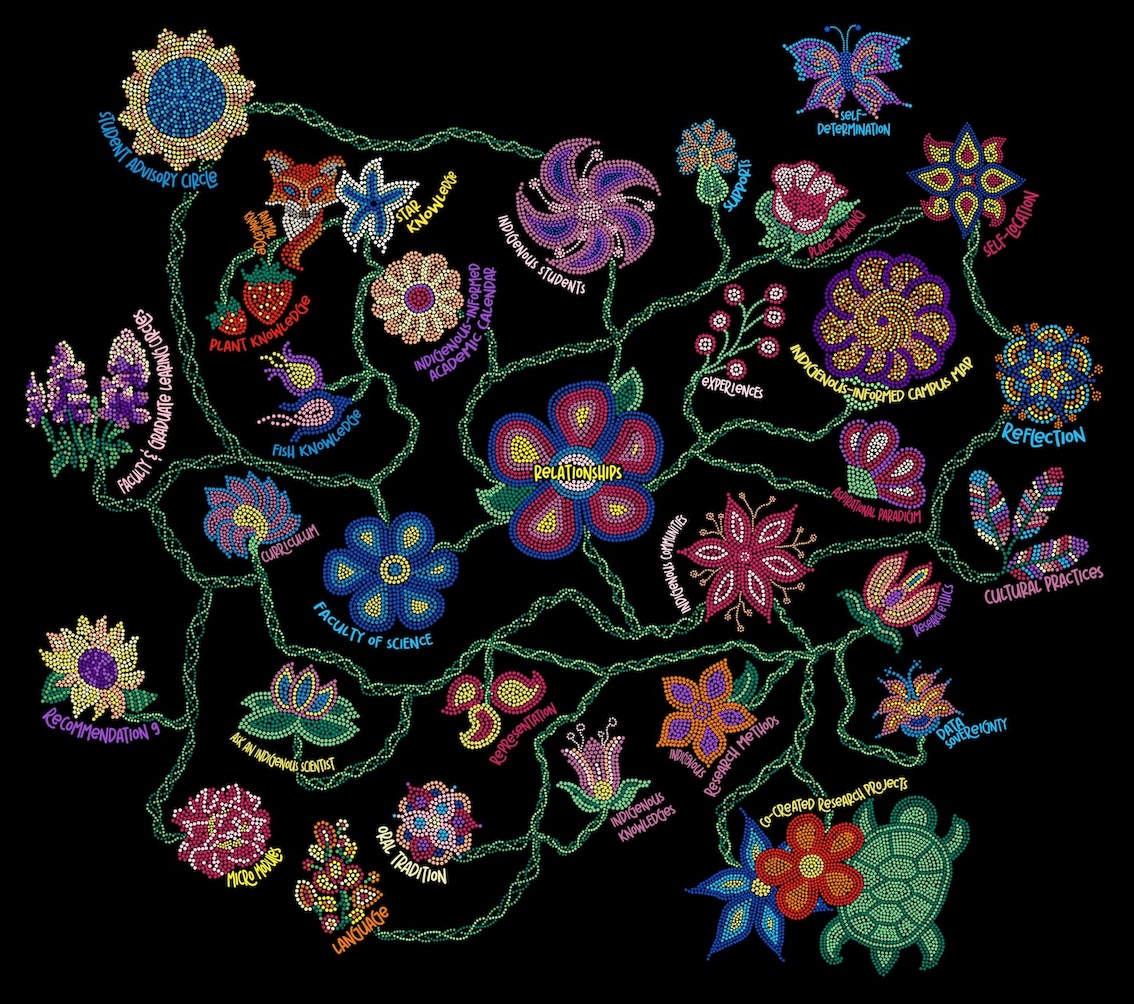
Originally created for the Faculty of Science Research Symposium (June 2023), this poster (above) represents an Indigenous research design and the foundations through which it developed. Relationships are positioned at the centre, encircled by Indigenous Students, the Faculty of Science, and Indigenous Communities, with interconnected concepts extending outward. It presents the work as a living, evolving process that grows in response to Indigenous Community while remaining grounded in the Relationships at its core.
This visual style draws inspiration from Métis beadwork painting, particularly the work of Christi Belcourt, and Ojibway-Cree artist Alley Yapput.
Websites/Resources of Interest
| Title | Description |
| Acknowledging the Land | A TMU specific guide for giving meaningful land acknowlwedgments |
| (PDF file) Musings on Re-storying Relationship with Education | a reflective resource that highlights how Indigenous Knowledges, positionality, reciprocity, and justice can inform more inclusive and ethical approaches to research design and teaching. An excerpt from Filsinger, B & Sühring S. (2025). The Importance of Justice and Decolonization Questions in Science Education. In M. Panitch, S. Wehbi, & J. Pimentel Machado (Eds.), Interrupting Innovation : Centring the Social (pp. 126-41). Fernwood Publishing |
| Indigenous Pedagogies & Curriculum | A excellent set of guidlines from CELT at TMU |
| The National Centre for Collaboration in Indigenous Education (NCCIE) (external link) | A K-12 Teaching Resource Centre with lots of Canadian Content |
| Indigenous Protocol and Artificial Intelligence Working Group (external link) | An excellent resource for AI within Indigienous scholarship |
| Indigenizing Our Courses (external link) | A Resource Collection – UBC Indigenous Chemistry Connections |
Embedding EDIA in Our Classrooms
At the Department of Chemistry and Biology, we believe that equitable, inclusive, and accessible learning environments are essential for student success. Our goal is to ensure that every student—regardless of background, identity, or lived experience—feels welcome, supported, and empowered to thrive, while getting a fulsome exposure in Science.
In collaboration with faculty, staff, and students, we have developed guiding principles for integrating Equity, Diversity, Inclusion, and Accessibility (EDIA) into our courses. These principles help us:
- Foster a respectful and inclusive classroom culture.
- Embed diverse perspectives and voices into course content.
- Design flexible and accessible learning activities.
- Extend science beyond its traditional curriculum and increase appreciation for Indigenous Knowledges
- Actively address barriers and bias in science education.
This is not a checklist to be completed once but a continuous commitment to creating learning spaces where every student belongs, and where EDIA is an integral part of scientific teaching and discovery.
Websites/Resources of Interest
| Title | Description |
| (PDF file) Transforming undergraduate STEM education | National academies of Sciences, Engineering and Medicine |
| A set of principles and practical suggestions for equitable fieldwork in biology (external link) | A PNAS paper that is an excellent resource for fieldwork |
| Disrupting Ableism and advancing STEM (external link) | A downloadable book chapter on strategies to overcome ableism in the STEM workforce |
| The EDIA teaching toolkit (external link) | A higly visual teaching toolkit for EDIA in your classroom courtesy of our Carleton University friends - and excellent starting point for your classroom |
| Theme | Scholarly Literature |
| Resources for Inclusive Course Design |
|
|
|
Inclusive research design is an approach to creating research studies that actively consider and integrate equity, diversity, inclusion, and accessibility (EDIA) principles at every stage of the research process. The goal is to ensure that research is fair, representative, and meaningful to all relevant populations, particularly those who are historically underrepresented, marginalized, or excluded in traditional research frameworks.
1. Key Characteristics of Inclusive Research Design
Feature |
What It Means |
Representative sampling |
Recruiting participants from diverse backgrounds (e.g., gender, ethnicity, age, socioeconomic status, ability). |
Equitable access |
Minimizing barriers to participation (cost, location, language, digital access, etc.). |
Cultural relevance |
Ensuring research questions, tools, and interpretations respect cultural and community contexts. |
Accessible methods |
Using methods, tools, and language that are accessible to participants of different abilities and literacy levels. |
Shared power |
Collaborating with communities and stakeholders rather than treating them as passive subjects. |
Bias mitigation |
Identifying and addressing researcher bias in study design, data collection, and interpretation. |
Ethical reflexivity |
Continuously reflecting on how the research may reinforce or reduce inequities. |
2. Why It Matters
- Improves validity and generalizability → Diverse data leads to more robust findings.
- Reduces systemic exclusion → Prevents research that unintentionally reinforces inequities.
- Enhances innovation → Diverse perspectives often yield novel research questions and solutions.
- Fosters trust → Inclusive approaches can increase community buy-in and participation.
3. How to Implement Inclusive Research Design
Stage |
Inclusive Practice |
Research Question |
Co-create questions with affected communities; ensure relevance beyond majority populations. |
Study Population |
Use recruitment strategies that reach marginalized groups; avoid convenience sampling bias. |
Data Collection |
Provide language translation, accessible survey formats, and flexible participation methods. |
Analysis |
Disaggregate data (e.g., by gender, ethnicity, SES) to identify inequities; avoid overgeneralization. |
Interpretation |
Include stakeholder or community advisory boards to provide context for findings. |
Knowledge Sharing |
Share results in accessible formats (plain language summaries, community workshops). |
4. Examples
- STEM Education Research: Designing surveys that are accessible to first-generation students and international students.
- Medical Research: Including diverse genetic backgrounds in clinical trials to avoid Eurocentric bias in drug efficacy.
- Environmental Science: Involving Indigenous communities in co-developing research questions about land use or water management.
Websites/Resources of Interest
| Title | Description |
| (PDF file) Positionality Statements | Positionality statements are very important at recognizing your own biases in your scientific approaches. It is also a common Indigenous methodology, that also identies your relationship to place and your connections |
| (PDF file) Codes of Conduct | Some examples of codes of conducts for research lab, conferences, and courses. |
| Striving for Inclusive Excellence in Science and Engineering Research (external link) | A highly visual published Pocket Guide from our Friends at Carleton University - a great staring point for research leaders |
| (PDF file) Mentors as Allies for Disabled Scientists | An important resource on how to disrupt ableism in research |
Other Literature Resources of Interest
We recognize that our work in Chemistry and Biology at TMU takes place on the traditional territory of many Nations, including the Mississaugas of the Credit, the Anishnabeg, the Chippewa, the Haudenosaunee, and the Wendat peoples. This land, now home to many diverse First Nations, Inuit, and Métis communities, is covered by Treaty 13 and the Williams Treaties (external link, opens in new window) .
We acknowledge this not as a formality, but as a reminder of our responsibilities—as researchers, educators, and members of a scientific community—to learn from Indigenous ways of knowing, to reflect on the legacies of exclusion in science, and to contribute to more just, reciprocal relationships with the land and its peoples (past, present and future).