Math + Storytelling Wins Prize at Graduate Thesis Competition
Sean Leizerovich, Mathematics master's student won third place prize in the Three-Minute Thesis Competition (3MT).
It’s late at night. You and your lover have ascended a spire to hold a romantic tryst. Eventually, you’re roused from slumber by a burning smell and the sound of crackling wood. A fire has erupted and the two of you need to escape! But the air is so thick with smoke, you can no longer see. How do you and your beloved find the door and escape the burning spire?
Is this a romantic novel? Action movie trailer? No, it was part of the mathematics presentation that earned master’s student Sean Leizerovich third place prize in the Three-Minute Thesis Competition (3MT) at the 14th Annual Ottawa Mathematics Conference (external link) . And for good reason according to the judges, who praised Leizerovich’s ability to weave the story into his science communication.
Early Results, Good Promise
Leizerovich’s academic path leading to the 3MT win has been quick and impressive. After earning his undergraduate degree in chemical engineering last year from Ryerson, he pivoted into mathematics, and began working immediately on a research theme over the summer — months before his master’s program even began.
By the fall, he’d already produced remarkable results which are now the basis for his thesis under the supervision of Konstantinos Georgiou, a professor in the Department of Mathematics. Their research paper is now under review in a competitive international conference.
Leizerovich’s 3MT Competition win may well prime him to present at higher stakes, and Georgiou wouldn’t be surprised. “Being able to effectively communicate mathematical findings to specialists, i.e. your thesis committee, is one thing,” says Georgiou. “But selling them to a general mathematics audience is a whole different challenge, and Sean nailed it at the 3MT Competition.”
Prize-Winning Search Optimization Research
Leizerovich’s midnight tryst story was an example of an evacuation problem — a type of search game to find the optimal trajectory for reaching a target. They were first used for defence operations during World War II, and have since been applied to economics, biology, and computer science.
In Leizerovich’s spire scene, the most intuitive solution for two lovers trapped in the centre would be this: walk together straight toward the spire wall, split up in different directions, scale the circular wall to find the door, and when found, call out for the lover to cross the room, and then exit together.
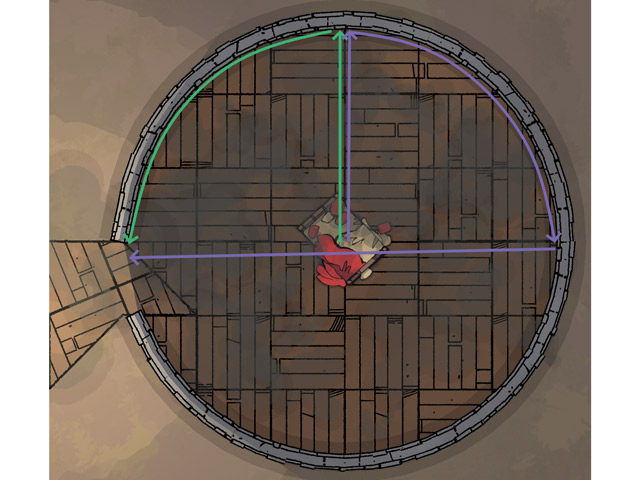
Optimal evacuation trajectory in a Euclidean world
That works best in a Euclidean world, where circles actually look like circles, and distances are measured in the way we’ve been told since elementary school.
But strange things happen if you measure distances differently — in what’s called non-Euclidean metric spaces. Leizerovich’s work is the first known so far to examine a certain type of search problem in these metric spaces.
Leizerovich explains: “In my presentation slides, you see what looks like squares and other shapes. But in various metric spaces, they’re actually still circles. The distances from the centre to the perimeter of these “circles” are not all equal in the Euclidean world, but they are equal in the underlying metric space. Moreover, trajectories that may look efficient in the Euclidean world may not be efficient in the new metric space and, in fact, they are not. So, the optimal trajectories to evacuate from them are different in each metric space.”
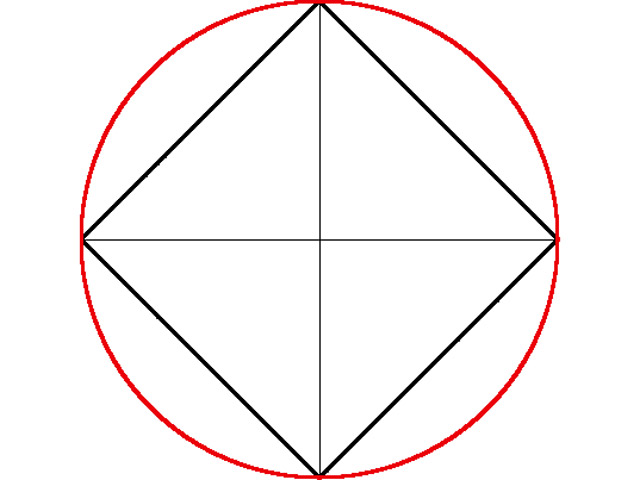
Both shapes are circles, but strange properties emerge in different metric spaces, such as the black, non-Euclidean 'square-looking' circle with greater perimeter than the red Euclidean circle.
Together with Georgiou, Leizerovich looked at worst-case scenarios for the evacuation problem, and designed optimal algorithms/solutions in these metric spaces. For each case, they also showed how the solution should be adjusted as a function of the particular metric space.
Effective Science Communication Wins
Leizerovich was already confident in presenting engineering models, but he admits that explaining abstract mathematics can be tough. But success in the 3MT Competition demanded not only research results, but also communications savvy — such as capturing audience attention, conveying enthusiasm and avoiding unnecessary technical jargon.
“When I came into the math world, I was really struggling with how to translate math ideas,” he says. “Days before the competition, I still had no idea what I was going to do. But I’d heard that telling a story is effective — and that’s when I came up with the idea of a midnight tryst between lovers.”
Leizerovich’s approach obviously worked. The 3MT judges were impressed, and awarded Leizerovich third place, just after two PhD students. Leizerovich is now on track to complete his master’s program this fall.