Sustainability Design Challenge sees two innovative teams winning a shot at incubation
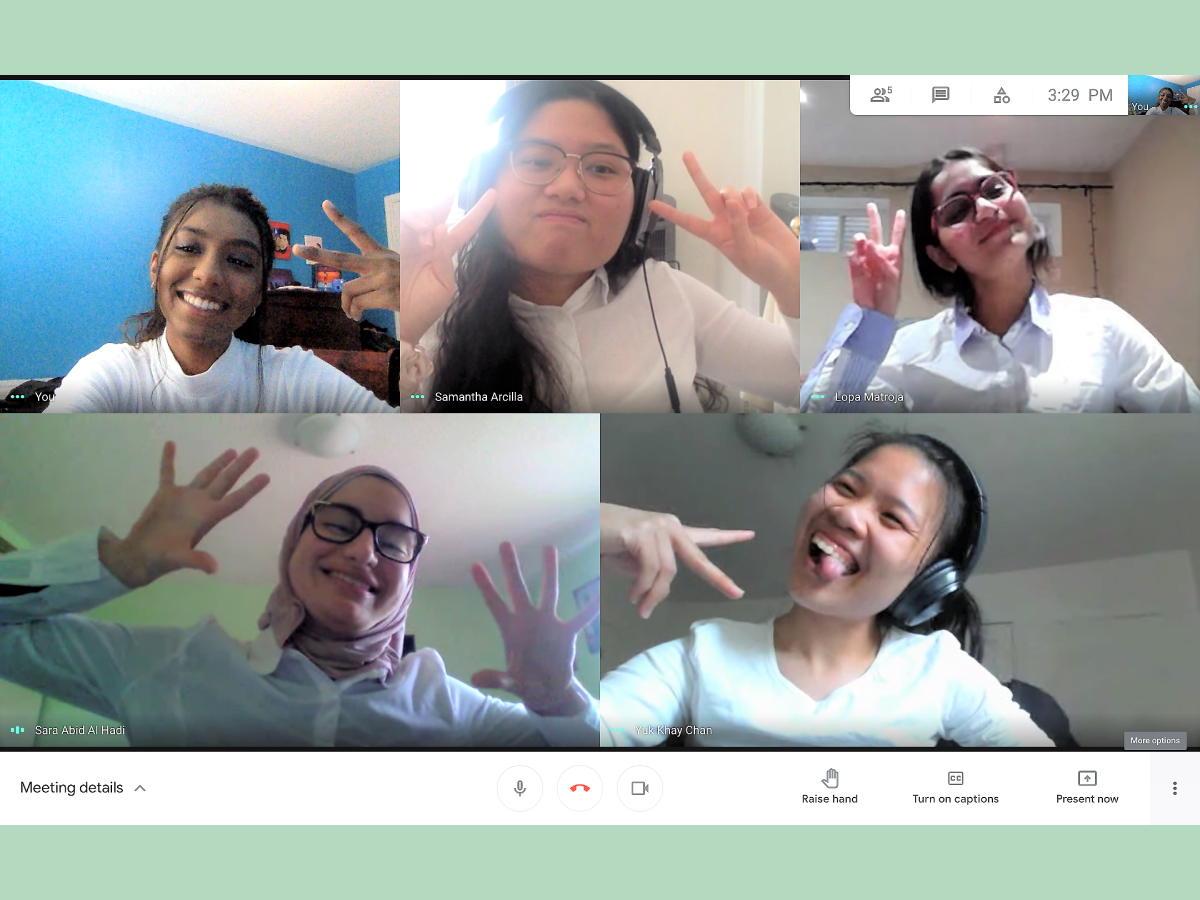
Team 4 members, (clockwise from top left) Prrunthaa Santhirakumaran, Samantha Arcilla, Lopa Matroja, Yuk Khay Chan and Sara Abid Al Hadi, meet via Google Meet. Their team went on to win the competition.
The Clean Energy Zone hosted its annual Sustainability Design Challenge from May 18–20. The competition, in its third year, saw students from across an array of programs at Ryerson University come up with economically viable solutions to sustainability issues facing cities and communities, while networking with their peers.
Just like in 2020, the challenge was forced to go virtual due to COVID-19 restrictions. However, that did not stop 30 participants from connecting remotely via platforms like Google Meet, Zoom and Slack. There were five teams competing in this year’s challenge, all aiming for a cash prize along with two spots in the Clean Energy Zone.
After two and a half days of preparation, each team showcased their idea in a five-minute presentation to a judging panel made up of three established Clean Energy Zone entrepreneurs: Bolis Ibrahim, co-founder of Argentum Electronics, Joszef Bogdan, co-founder of Niso Energy, and Nima Alibabaei, founder of BKR Energy. This was followed by a short Q and A session.
Team 4 took first place this year with their unique proposal to promote energy harvesting from day-to-day activities in new as well as existing buildings. The team pitched usage of five renewable energy sources within a building to accomplish this goal: revolving doors, piezoelectric mats (external link, opens in new window) , spring-powered elevators, in-pipe turbines (external link, opens in new window) and a heatsink rooftop.
The judges had nothing but positive remarks for the team and Ibrahim appreciated the group’s in-depth research into the environmental and economic impacts of their proposed idea. “I was surprised at the level of detail in the presentation,” he said.
“All together I thought the ideas were really great and represented [an] understanding of the problems,” added Bogdan.
“It was really great working on this challenge because we pushed our limits a lot,” said third-year chemical engineering student Lopa Matroja.
Team 2 came in second with their proposal for hybrid HVAC system upgrades to modernize homes while reducing greenhouse gas emissions.
“I had a lot of fun with it and got to learn about subjects related to my field that would often get glossed over in my average course work,” said Gregory Lagos, a fourth-year electrical engineering student.
Both teams now get to incubate at the Clean Energy Zone and take their designs to the next level.
1st place
Team 4
Samantha Arcilla
Sara Abid Al Hadi
Yuk Khay Chan
Lopa Matroja
Prrunthaa Santhirakumaran
2nd place
Team 2
Yash Chokshy
Gregory Lagos
Luzalen Marcos
Kthryn Santiago
Shanen Ulob
"It was really great working on this challenge because we pushed our limits a lot."