A Global History of Capitalism
- Date
- December 15, 2026
- Time
- 7:00 p.m. - 8:30 p.m. ET
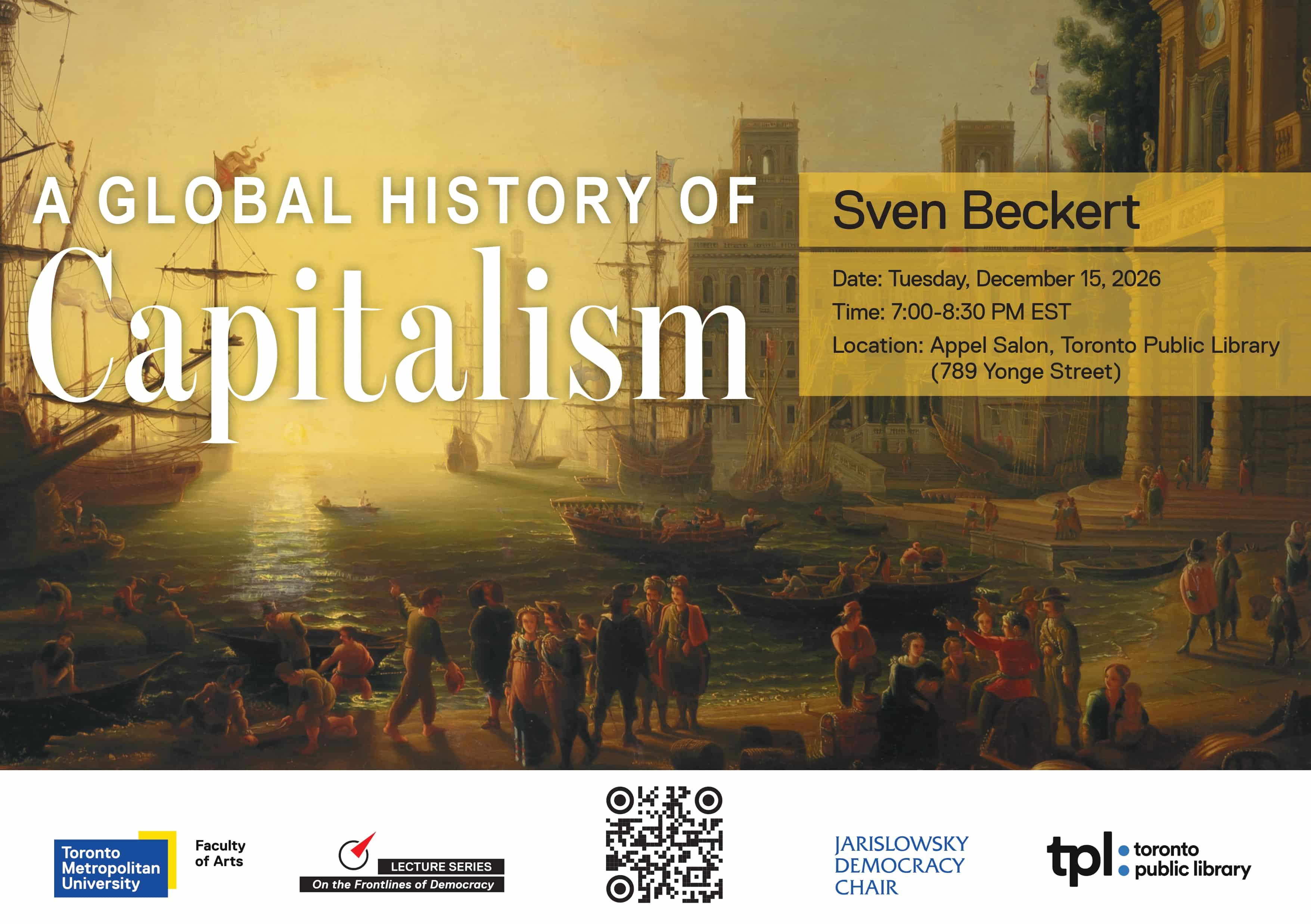
- Location
- Appel Salon, Toronto Public Library (789 Yonge Street)
How we work, rule and live: no other phenomenon has shaped our modern world as decisively as capitalism.
Conventionally, scholars locate its origins in early modern Europe, tracing its later spread across the world. Proponents champion its dynamic capacity to generate economic prosperity, technological breakthroughs and global integration.
Yet capitalism was born global. Moreover, state-backed institutions, imperial expansion, and coercive power have shaped its dynamics from the outset as much as innovation and exchange. Capitalism expanded the political voice for some. Yet it violently foreclosed it for others. Slavery, colonialism and inequality entangled its origins. At no point was capitalism an idealized dream of free markets.
How do we distinguish between its capacity to generate prosperity and lower poverty vis-a-vis its tendency to produce inequality and concentrate power? What can a thousand years of capitalist history teach us? Can we reimagine an economic order more compatible with democratic ideals amid a crisis of late-stage capitalism?
The distinguished global historian, Sven Beckert, explores these questions in conversation with Sanjay Ruparelia.
About the speaker:
Sven Beckert is the Laird Bell Professor of History at Harvard University, where he teaches the history of the United States in the 19th century and global economic history, and co-chairs the Program on the Study of Capitalism and the Weatherhead Initiative on Global History. Born in Germany, Beckert studied history, economics, and political science at the University of Hamburg, finishing his graduate studies in history at Columbia University. His books include The Monied Metropolis: New York City and the Consolidation of the American Bourgeoisie (external link) (2003), The American Bourgeoisie (external link) (2010), Empire of Cotton: A Global History (external link) (2014), Slavery's Capitalism: A New History of American Economic Development (2016), American Capitalism: New Histories (external link) (2018), and Global History, Globally (external link) (2018). The widely acclaimed Empire of Cotton won the Bancroft Prize, was named one of the 10 most important books of 2015 by the New York Times, and was a finalist for the Pulitzer Prize for History. In 2007, Beckert began collaborating with a group of undergraduate students to examine the historical connections between Harvard University and the institution of slavery. (PDF file) Harvard and Slavery: Seeking a Forgotten History (external link) unveiled how the university benefited from endowments connected to the slave economy while working to stifle debates about slavery and abolition. The report propelled other efforts to examine and address the legacy of slavery at the university. A co-editor of the Princeton University Press series, on “America in the World (external link) ,” Beckert has received numerous awards and fellowships for his scholarship, from Harvard Business School, Dorothy and Lewis B. Cullman Center for Scholars and Writers at the New York Public Library, and John Simon Guggenheim Memorial Foundation. He is an elected member of the American Academy of Arts and Sciences. His latest book is Capitalism: A Global History (external link) (2025).
About the discussant:
Sanjay Ruparelia is Professor of Politics and Public Administration at Toronto Metropolitan University, where he holds the Jarislowsky Democracy Chair (external link) , and a Senior Fellow of the Asia Pacific Foundation of Canada (external link) and the Centre for Strategic Statecraft (external link) . His main publications include Divided We Govern: Coalition Politics in Modern India (external link) ; The Indian Ideology (external link) , and Understanding India’s New Political Economy (external link) . His research has been supported by grants and fellowships from the Commonwealth Foundation, American Council of Learned Societies and Social Science and Humanities Research Council as well as Cambridge, Johns Hopkins, New School, Notre Dame, Princeton, Stellenbosch and Yale. Sanjay serves as a co-chair of Participedia (external link) , which studies democratic innovations globally, on the editorial boards of Asian Perspective (external link) , Indian Politics and Policy (external link) and Pacific Affairs (external link) , and the advisory board of the Canadian International Council (external link) . He hosts On the Frontlines of Democracy (external link) , a monthly podcast and lecture series, and regularly contributes to media in Asia and North America, including the CBC, CTV, Channel News Asia, Globe and Mail, Hill Times, Hindustan Times, Indian Express, New York Times, The Hindu, The Walrus, Toronto Star and Washington Post. Sanjay previously taught at the New School for Social Research and Columbia University. He earned a B.A. in Political Science from McGill University, and a M.Phil in Sociology and Politics of Development and Ph.D. in Politics from the University of Cambridge.
About the series:
On the Frontlines of Democracy is a public lecture and podcast series to analyze the prospects of democracy in the twenty-first century. Around the world, democracy faces serious challenges, old and new. Can we protect individual rights and the rule of law in an era of popular mistrust, severe partisanship and resurgent nationalism? How can our democracies reduce inequalities of power, wealth and status, defend deep diversity and confront climate change in the new digital age? Can we develop innovative strategies to revitalize civic engagement, empower public institutions and resist autocratic threats? How can we support the expansion of democracy, in an evolving post-western order, without committing the mistakes of the past?