Camp Eureka 2018
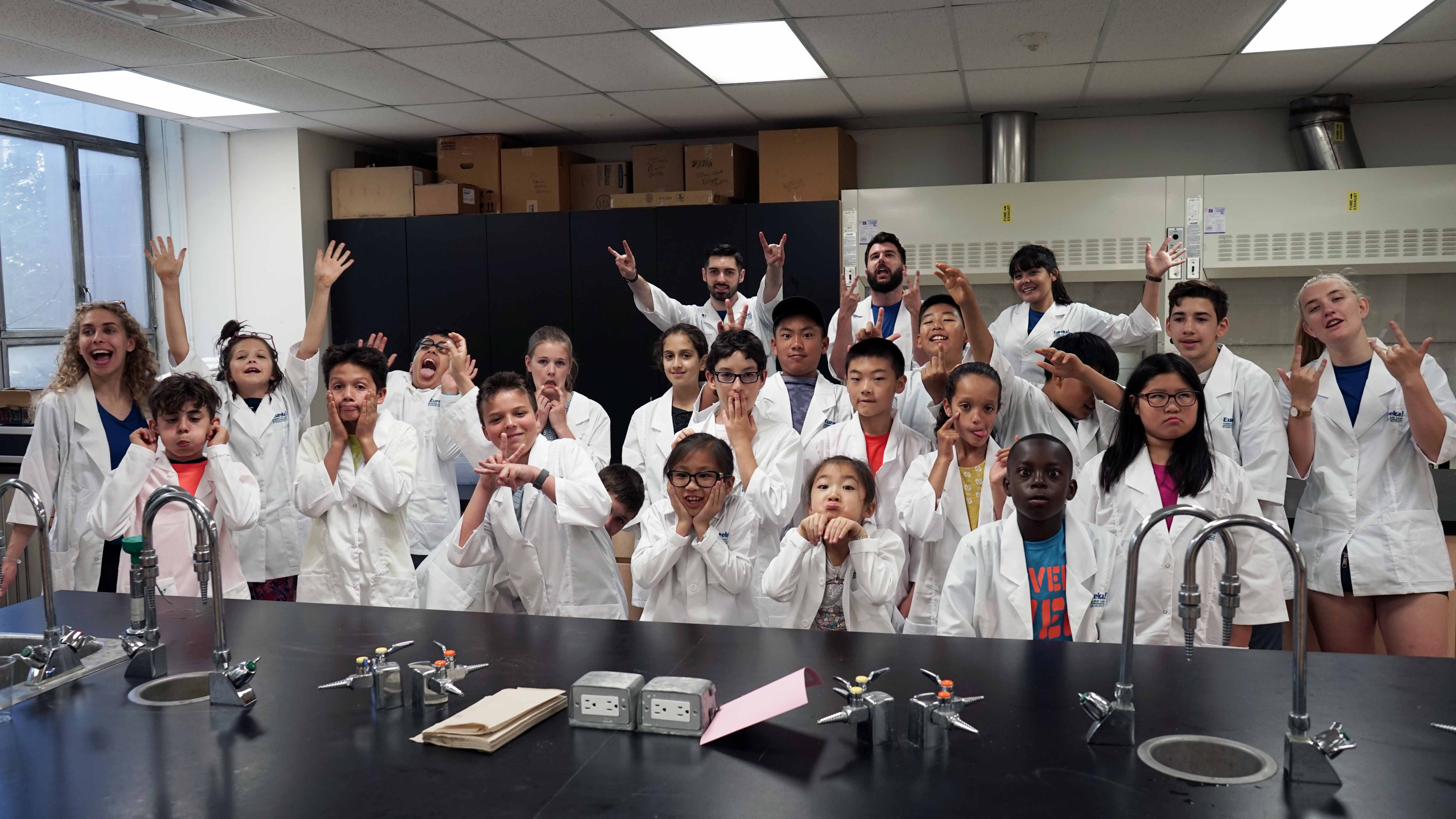
This July marked the sixth year Ryerson Science has collaborated with the Faculty of Engineering and Architectural Science and Ryerson Athletics to develop and run the Eureka Camp. Each day, campers ages 8 - 13 came to enjoy physical activities, science lab experiments and engineering design projects.This year we saw a total of 136 campers over the four weeks Eureka ran.
In past years, Eureka campers were placed into houses named after unrepresented past and present scientists and engineers. Our goal has been to expose campers to diversity within the different fields of science and engineering. This year we continued with this tradition promoting scientists Rosalind Franklin and Dorothy Vaughan. As well as engineers such as Sundar Pichai, Elon Musk and Kimberly Bryant. The Eureka camp counsellors were pleasantly surprised with the amount of curiosity that arose during group discussions surrounding these leaders.
It has been our goal to continue providing campers with a variety of experiments, as some campers are with us for the entire month. Each week had its own theme and the activities explored different aspects of each theme. By incorporating a wide range of interdisciplinary activities each week, our campers were exposed to all fields of science and engineering.
Eureka House Names
Kimberly Bryant is an African American electrical engineer who worked in multiple science sectors including the biomedical and pharmaceutical industry. Throughout her life, Bryant experienced isolation within the science community because of the underrepresented number of black woman in the field. This was something Bryant did not want repeated for her daughter as she knew all the harm it created. When she saw just that happening, Bryant went on to develop “Black Girls Code” a program that teaches stem and technology based skills to girls in underrepresented minorities in the United States and South Africa. The Black Girls Code’s ultimate goal is to train one million girls by 2040.
Rosalind Franklin was an English chemist and one of the founding scientist as a x-ray crystallographer. She was born in 1920, a period of time where woman experienced many challenges in a male dominate field. Franklin’s intellect and curiosity was something that separated her from the rest and allowed her to prevail in this type of environment. Throughout her career Franklin contributed to the development of molecular structures in DNA, RNA, viruses , coal and the common graphite. Unfortunately, Franklin passed away at the age of 38 due to cancer caused by the accumulated exposure of x-ray radiation. Many of Franklin’s team still acknowledge her contribution in the to the 1962 Nobel Prize as much of her work was used in their scientific discovery.
Elon Musk is a South African-born American knowledgeable in a wide range of engineering platforms. He grew up in an entrepreneurial family, where he went from self-learning computer programming as a child to studying physics and economics in university. Musk took an entrepreneurial approach and dove in to many interdisciplinary sciences throughout his career; establishing over 10 companies including some such as Paypal, SolarCity, Space X and Tesla.
Sundar Pichai is an Indian born American who studied material science and business in Academia. After completing his schooling Pichai focused on product management and innovation, which eventually led him to work for the company Google. At Google, he worked hard to climb up the ranks; developing operating systems and applications such as Chrome OS, Google Drive, Gmail, Google Maps and Android. Sundar Pichai now sits as CEO of google and is admired by many in the tech world for his progressive thinking.
Dorothy Vaughan was an African American mathematician and human scientist. Throughout her career Vaughan worked at NASA and NACA and played an important role in aeronautical research. Among many accomplishments, Vaughan led the first team of African American woman at NACA called the West Area Computers. They were a detrimental part on the outcome of World War II, so much so that they based a movie on them called “Hidden Figures”. Dorothy Vaughan spent the remainder of her career working for NASA and passed away on November 2008 at the age of 98.
Weekly Themes
The theme for week 1 was "Destination Earth". Campers learned about the environment in fun and creative ways. They had the chance to dissect owl pellets and see how field scientists track digestion of wild owls. We ended the week with a collaboration activity where science and engineering came together to learn about biomimicry.
For week 2, our theme was "I like to move it", where campers observed motion from both a biological and chemical perspective. Using stethoscopes and through the creation of pulse indicators, campers were able to track the movement of our blood. We also explored how and why certain chemical reactions, such as the classic elephant toothpaste, occurred.
In week 3 our theme was “Machines ‘R’ Us”. Our campers explored the machines within us! Our very popular “poop lab”, where campers built a model of the human digestive system from intake to excrement, made a triumphant return. Physics and biology were also brought together to study how our eyes work to see everything around us.
In our final week, "Wonders of the world", campers got a closer look into the wonders of everyday life. We started the week by analyzing microorganisms, some of the smallest wonders of our world, in pond water. We also looked at light and explored its properties of double duality. The week ended with an out of this world activity where campers learned about stars, the moon and created their own planets.
Successful Summer of Science
Eureka has always been a hit! Campers not only got the chance to work in a real life university lab as a scientist and problem solve like engineers, but also had time to play different sports with their fellow campers. As Eureka camp counsellors, we strived to communicate science to our campers while having fun. We knew our job was done when we saw the spark of curiosity in our campers’ eyes or left them thinking about the bigger picture.
