Innovation and research from the Living Lab could transform the future of food and farming
Photos courtesy of Geoff Fitzgerald, Ryerson Urban Farm
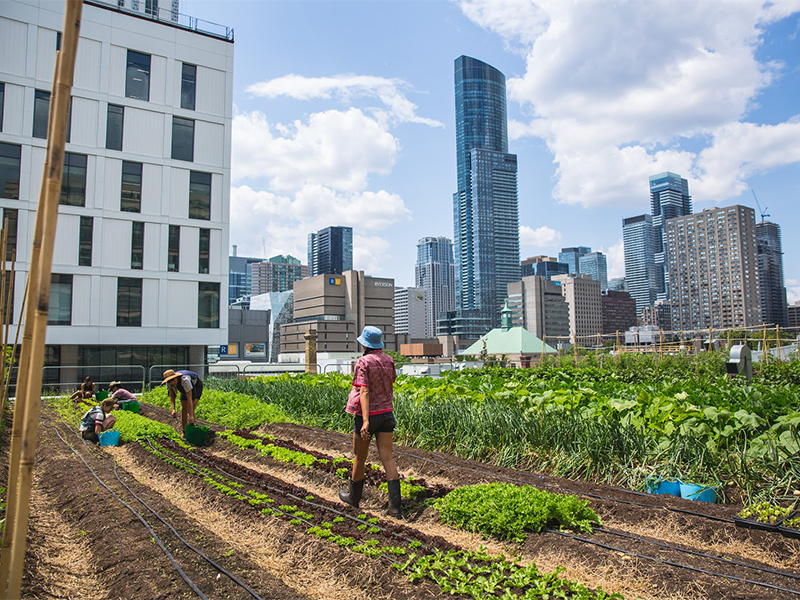
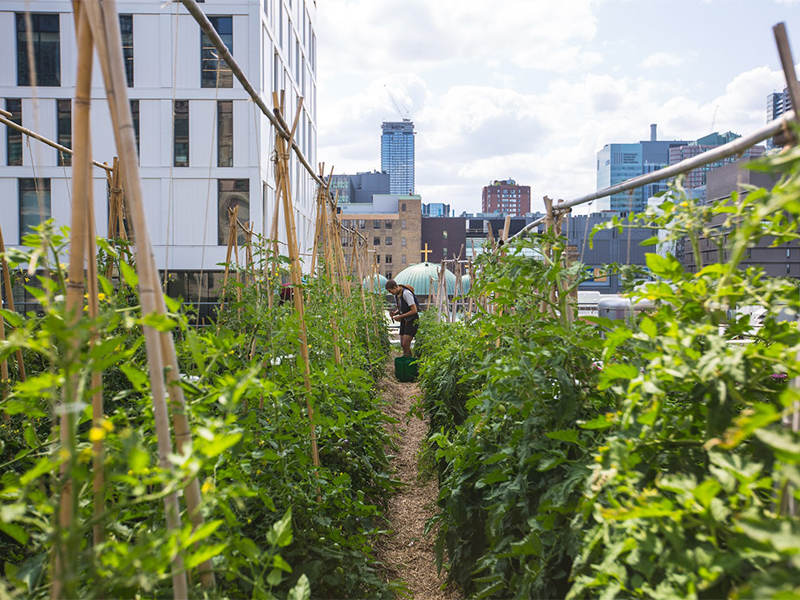
The Ryerson Urban Farm Living Lab (RUFLL), located on the George Vari Engineering and Computing Centre rooftop, is a leading centre of partnership and innovation in our understanding of rooftop food production. Sharene Shafie (external link, opens in new window) is the research coordinator at the farm. I was able to speak to her about the research, academic and community partnerships, and innovation that is happening at the farm, their programs, and the misconceptions many people have about urban farming. Shafie completed a master’s of design focused on Strategic Foresight and Innovation, explicitly looking at rooftop farming with green roof technology and how to make it profitable.
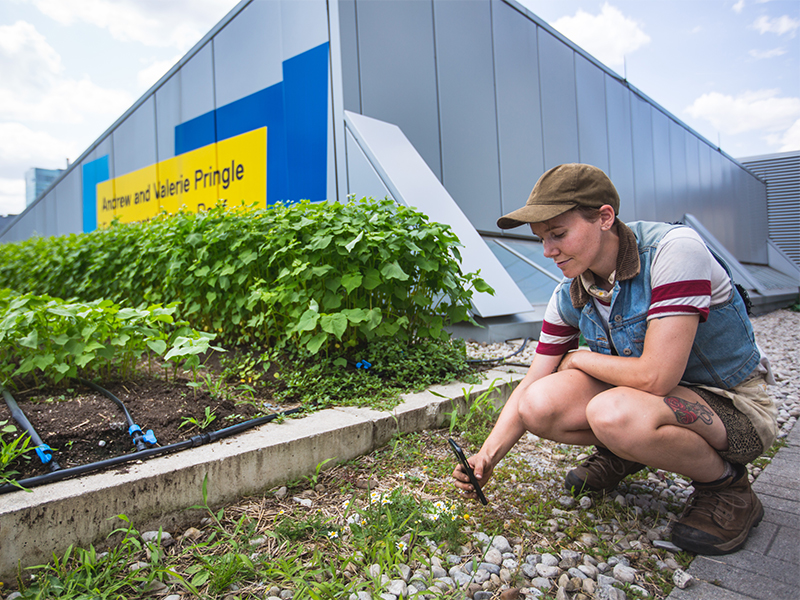
The RUFLL was established in partnership with the Centre for Food Security, building on existing support from the Faculty of Community Services. Arlene Throness, farm manager, was an advocate for building stronger ties with Ryerson researchers, thinking of the farm as a living lab. Fiona Yeudall, director of the School of Nutrition and associate director of the Centre for Studies in Food Security, worked closely with Andrew and Valerie Pringle, whose generous donation enabled this to move forward.
“One of the first things we did,” said Shafie, “was engage our stakeholders through consultation, surveys and a roundtable. We connected with academics and community members interested in urban farming to develop an advisory panel and our research priorities. We’re excited to increase our programming capacity with the new farming space on the Daphne Cockwell Complex rooftop across the street, which has a 140 person gathering space. Although Toronto was one of the first cities in North America to pass a green roof by-law, most green roofs have not been updated to incorporate urban farming and could be much more productive.”
The farm has been growing on the green roof since 2013, and many lessons have been learned. “We are working to refine our standard operating procedure, which would be valuable to people looking to start a farm. It’s an incredibly bio-intensive operation that does not use any synthetic herbicides, pesticides or fertilizers,” said Shafie. “There is a rigorous planting schedule. We know that when one crop comes out of the field, and the next one is ready to be transplanted from the greenhouse or direct-seeded.” In addition to this robust growing operation, the RUFLL was able to invest in some community priorities. “Our relationship with Aboriginal Student Services has been growing, and the generous donation from Andy and Valerie Pringle helped us to hire Samantha Williams (external link, opens in new window) to coordinate our Indigenous-led programs. This programming has included establishing Indigenous growing spaces, harvesting methods, and offering tobacco from our farm as traditional medicine. We want to make this space where Indigenous wisdom can flourish and have agency in planting and harvesting methods,” said Shafie.
“We were also able to hire a Black Food Sovereignty coordinator, Nicole Austin, to run programming primarily for Ryerson’s Black student population. The Black Food Sovereignty program will coordinate programming to improve food literacy skills: nutrition, cooking, and access to fresh, healthy food.”
COVID -19 has impacted the farm’s work, although they could manage the work with physical distancing practices and extend their funding through this summer. “We’ve seen a significant interest in the farm and its ability to support research. Currently, many of the farm’s engagement and educational events have moved to virtual spaces and have been very successful online,” Shafie noted. Find more information about what is grown and where it goes here.
“We just had an open call for research proposals in January. The first inaugural Living Lab kick-off meeting will be at the end of April. New researchers, and those with established projects, will be connecting with RUFLL staff and advisory committee members in the collaborative and user-centric spirit of the living lab,” said Shafie.
“I think, in Toronto, we have a very removed relationship to our food system. It is both integral and removed from our lives. There is a lot of myth-busting we need to do with rooftop farming. People want to have more confidence and clarity in the development of rooftop farms. Costs, yields, business models. That is some of the important work we are trying to do so that people can adapt to the technology that is available to them,” said Shafie.
“It is essential to diversify revenue streams with rooftop farming. In my research, I found that hosting events can benefit the operation financially. Events also help people to learn and get excited about rooftop farming. Lush outdoor spaces are becoming few and far between in dense urban cities, and we find that people are eager to spend time on the farm, which can also be a source of revenue. There are also many non-financial benefits to rooftop farming that are hard to quantify, including stormwater management, building temperature regulation, urban heat island reductions, reducing food miles, and increasing food security. Surveys show that staff and volunteers also reap biophilic benefits through connection with nature,” Shafie explained. “And we aim for the research coming out of the Living Lab to contribute to that growing body of knowledge and expand our understanding of the benefits of green roofs and rooftop farming.”