Shaping your future: How interdisciplinary education gives Arts students a competitive edge
Laaibah Shami, a fourth-year student in Arts and Contemporary Studies (ACS) at Toronto Metropolitan University (TMU), shares why the program was the right fit for her career goals.
I had my eye on the ACS program in the Faculty of Arts since grade 10, knowing that it was the perfect match for me. ACS does not follow the traditional route of most programs, where students focus on a specific discipline, but instead is known for its interdisciplinary pathway. This means that as an ACS student, you have the chance to focus on a specific area of interest and also explore and develop skills across multiple disciplines. You do not have to bind yourself to one specialty!

Laaibah Shami served as the Society of Arts, Social Sciences, and Humanities ACS Director from 2023-2024 and as the Arts and Contemporary Studies Course Union President from 2024-2025.
As an aspiring teacher, the ability to shape my degree specifically to my career choice stood out to me the most. The program has a set of nine options (specializations) or a generalist route that you can opt into. There are five interdisciplinary options available: Anthropology Studies, Culture Studies, Diversity and Equity, Global Studies, and Inquiry and Invention. Additionally, there are four subject-specific options: English, French, History, and Philosophy. The ACS program also gives you the flexibility to take up to two minors, as long as your advisement report permits it.
I chose the History option and a minor in English. This helped me develop teachables for teachers college, which tends to be hard in any other program, as you do not always have the course capacity to explore other disciplines you may be interested in teaching. While I studied History and English, I was also able to explore courses in Sociology and Human Resources.
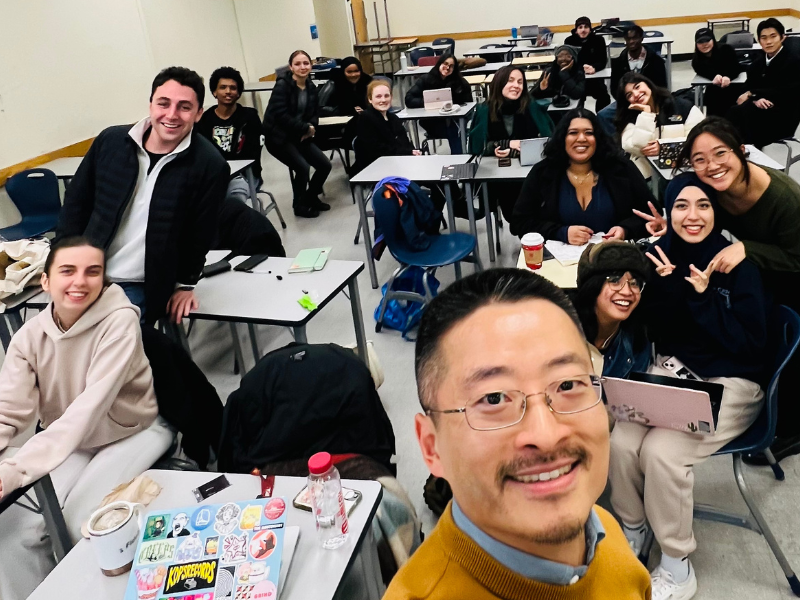
Languages, Literatures and Cultures Professor Hongbing Yu takes a selfie with his students in ACS 302 (Intro to Cultural Studies).
One of the benefits of the ACS program is the small class sizes. Part of your academic journey is to create connections with peers and professors who can aid you in your pursuit of knowledge. This tends to be harder when class sizes are in the hundreds. In ACS, I have been lucky to create lasting friendships and to have the opportunity to work closely with my professors. They are happy to connect with you, are supportive, and make it easy to work together. Being in the program presents you with many leadership opportunities, and these connections allow you to have a hands-on approach to what you study. Working closely with my professors and peers has been one of my favourite experiences. Being able to pursue my niche interests while also impacting my school community through the opportunities the faculty provides has been fulfilling.
Whether you’re looking for a specific pathway, are not sure what to pursue, want leadership opportunities, or even play professional sports, ACS is structured in a way that allows YOU to flourish in all fields and opportunities. All you have to do is reach out!
For more information on ACS and other Arts programs, visit the Faculty of Arts website.