Indigenous Pedagogies & Curriculum
Indigenous Pedagogies & Curriculum
At the Centre of Excellence in Learning and Teaching, we are committed to advancing Toronto Metropolitan University’s Truth and Reconciliation goals. As part of this commitment, we strive to decolonize our approaches to teaching, curriculum, and assessment. We are also dedicated to supporting faculty as they thoughtfully and respectfully integrate Indigenous ways of knowing, being, and doing into their teaching and learning practice.

Closeup on the Ring Sculpture is at Gould St. and Victoria St. (east of the Gould Street and Nelson Mandela Walk intersection). Designed by Matthew Hickey and Jacqueline Daniel of Two Row Architect (external link) . Photo credit: Hannah Kiviranta.
Indigenous Community Engagement
Indigenous worldviews are deeply relational, with relationships understood as the foundation of meaningful and respectful engagement. For this reason, a relationship-first approach is essential when entering into ethical, reciprocal, and long-term community engagement in a good way. One example of a community-guided relational approach is Building Relationships before the Research: A Four Step Framework for Ethical Indigenous Engagement (external link) (Ducharme & Moghaddam, 2026), which presents Indigenous engagement as a sustained process grounded in trust, reciprocity, accountability, and community direction. Rather than beginning with institutional goals or academic outcomes, this approach asks educators and researchers to listen carefully to community priorities, support community-led decision-making, create learning opportunities through ongoing relationships, and remain committed to those relationships over time, even when there is no immediate academic need.
Indigenous Epistemology and Pedagogy Approaches
According to Antoine et al. (2018), many Indigenous scholars share the thought that, while Indigenous communities are diverse in having distinct culture, traditions, languages, and histories, there are common principles that inform Indigenous pedagogical approaches. These approaches are often characterized as personal and holistic, place-based, experiential, and intergenerational (Antoine et al., 2018). This means that learning involves the whole person—mind, body, spirit, and emotions—which is shaped through relationships with family, community, Elders, Knowledge Keepers, as well as relationships to place through lived experience. In this way, Indigenous pedagogies invite educators to move beyond purely content-focused models of instruction and shift toward learning environments that are relational, holistic, provide experiential opportunities, and shared learning activities.
Indigenous frameworks, such as Kirkness and Barnhardt’s (1991) Four Rs of Indigenous Education—Respect, Relevance, Reciprocity, and Responsibility—can support efforts to decolonize and Indigenize teaching, curriculum, and assessment while advancing the Truth and Reconciliation Calls to Action (external link) . Michelle Pidgeon’s (2016) expansive visual interpretation of the Four Rs in the article, More Than a Checklist: Meaningful Indigenous Inclusion in Higher Education (external link) further offers a meaningful foundation for seeing, relating, reflecting, and acting in ways that invite educators to become part of transformative change. Pidgeon's “Wholistic Framework” illustrates the whole self and the complex interconnections to the outer layers of the framework that intricately contribute to an individual’s achievement of a balanced life. Pidgeon explains in her article that education is much more than an “intellectual exercise” and this way of thinking “ignores key components of the learning journey” that align to Indigenous ways of thinking about success and well being (Pidgeon, 2008 b)
Looking for support?
Reach out to Carol Ducharme, Educational Developer, Indigenous Pedagogies and Curriculum by emailing carol.ducharme@torontomu.ca
“Education can either maintain domination, or it can liberate. It can sustain colonization in neocolonial ways, or it can decolonize. Every school is either a site of reproduction or a site for change.”
Publications
Ducharme, C., & Moghaddam, S. (2026). Community-guided teaching: Building relationships before course design (external link) . Faculty Focus. (external link)
Ducharme, C., Moghaddam, S., (2026) Building relationships before the research: A four-step framework for ethical Indigenous engagement in higher education (external link) . Academica Forum
Four R’s Framework
The Four Rs framework created by Verna J. Kirkness and Ray Barnhardt (1991) identifies Respect, Relevance, Reciprocity, and Responsibility as guiding principles for strengthening Indigenous education and supporting more meaningful relationships between Indigenous peoples and educational institutions.
- Respect: Recognize and honour Indigenous peoples, histories, cultures, languages, traditions, and ways of knowing, being, and doing. Respect also requires educators and institutions to critically examine and challenge Eurocentric assumptions, colonial narratives, and deficit-based perspectives that have shaped educational systems.
- Relevance: Design learning experiences that are meaningful to Indigenous learners, communities, and contemporary contexts. Relevance involves acknowledging Indigenous Knowledge as living, place-based, and connected to land, environment, community, identity, and lived experience.
- Reciprocity: Build relationships based on mutual respect, shared learning, and reciprocal benefit. Reciprocity encourages educators and learners to engage with Indigenous Knowledge in ways that involve listening, giving back, collaboration, accountability, and care for the present and future generations.
- Responsibility: Acknowledge the ongoing impacts of colonization and take meaningful action to support reconciliation alongside Indigenous peoples. Responsibility includes committing to ethical engagement, continuous learning, institutional change, and responding to the priorities and challenges identified by Indigenous communities.
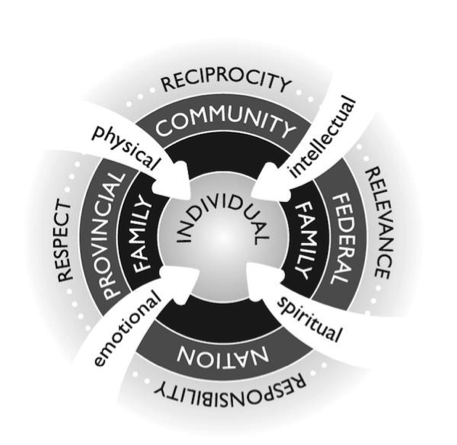
Wholistic Framework - Pidgeon, M., 2016.
Understanding Decolonization, Indigenization, and Reconciliation
Having a good understanding of key terms and processes of decolonization, and Indigenization to work towards reconciliation is important for integration and incorporating these concepts into teaching practices. The Pulling Together Guides (external link) (Antoine et al. 2018) offer an informative and engaging experience to support this important understanding. The responsibilities associated with Indigenization are layered, and require ongoing work. A good first step is to engage with the online resource Pulling Together: A Guide for Curriculum Developers (external link) . According to Antoine et al. (2018) “whether you are an Indigenous or non-Indigenous person, through this journey you will gain insight into your own culture and background, privileges, or oppressions that have affected your life, and you will identify biases or gaps in your knowledge” (p. 1).
The resource guides individuals to do inner work to better understand one’s relationship to Indigenous peoples, and to understand the trauma caused by harmful systems of oppression and colonization. Importantly, individuals will also learn why it is essential to make room for Indigenous perspectives by Indigenizing and decolonizing teaching practices. This knowledge can provide the foundation to meaningfully shift dominant Eurocentric patterns of teaching and to create learning environments that are respectful, responsible, relevant, and reciprocal. The resource also contains activities that invite participants to critically reflect on their roles, assumptions, and positionality. These opportunities may help educators to feel more confident to create relational, holistic, experiential teaching environments where educators will learn together in relationship with others and with the learners, acting as a guide on their learning journey.
Resources Used
Antoine, A., Mason, R., Mason, R., Palahicky, S. & Rodriguez de France, C. (2018). Pulling Together: A Guide for Curriculum Developers. Victoria, BC: BCcampus. https://opentextbc.ca/indigenizationcurriculumdevelopers/ (external link)
Battiste, M. (2019). Decolonizing education: Nourishing the learning spirit. University of British Columbia Press.
Kirkness, V. J., & Barnhardt, R. (1991). FIRST NATIONS AND HIGHER EDUCATION: The Four R’s — Respect, Relevance, Reciprocity, Responsibility. Journal of American Indian Education, 30(3), 1–15. http://www.jstor.org/stable/24397980 (external link)
McGregor, H., (2012). Decolonizing Pedagogies Teacher Reference. UBC Blogs (PDF file) https://blogs.ubc.ca/edst591/files/2012/03/Decolonizing_Pedagogies_Booklet.pdf (external link)
Pidgeon, Michelle. (2016). More Than a Checklist: Meaningful Indigenous Inclusion in Higher Education. Social Inclusion. 4. 77-91. 10.17645/si.v4i1.436.