Insurgent Flourishing: Centring Indigenous and Black Futurities - Recap
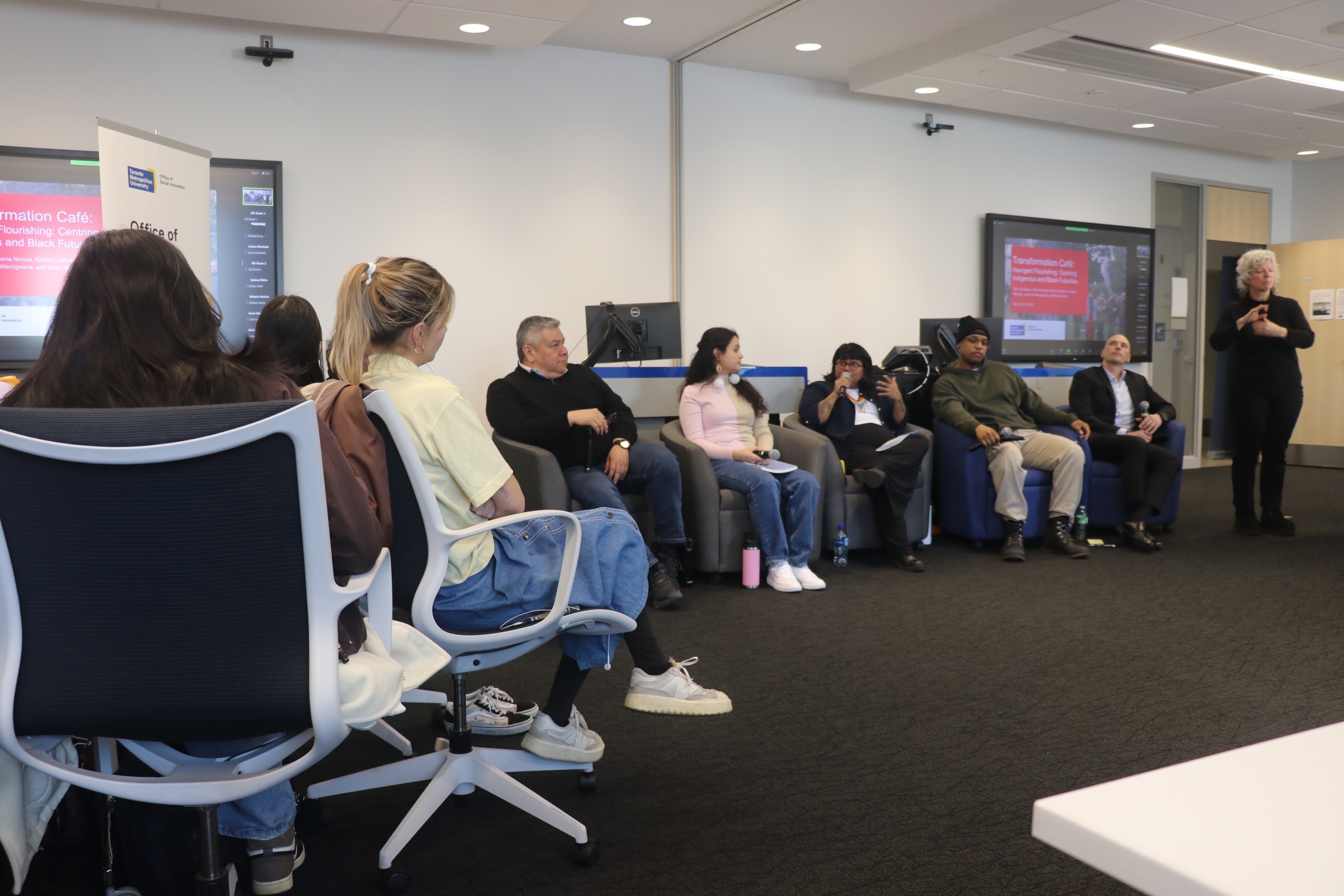
Black and Indigenous people have long come together to create, act, make “good trouble” and engage in collective world-making historically as well as in these political times.
In this instalment of the OSI flagship series Transformation Cafes, Dr. Rai Reece served as facilitator for a dynamic panel discussion where we discussed what it means to flourish, unpacked institutional requirements for flourishing, and strategized how we can support one another to flourish. We explored these topics from a host of different perspectives, chatting with Brian Norton, Program Manager of TMU’s Gdoo-maawnjidimi Mompii Indigenous Student Services,
- Jasmine Wemigwans, Toronto Metropolitan University alumni,,
- Dr. Flavia Novais, Ethel Louise Armstrong Postdoctoral Fellow, School of Disability Studies,
- Klinton Lettman, Toronto Metropolitan University alumni,
- Michael Mihalicz, Assistant Professor, Entrepreneurship & Strategy, Special Advisor to the Dean on Indigenous Initiatives at the Ted Rogers School of Management (TRSM)
Together, the panelists discussed questions like how do you flourish? How do you support others to flourish? What prevents us from flourishing, and how do we challenge those barriers? How can we collectively create conditions for flourishing to support one another over university priorities?
As guests settled in, we heard from host Dr. Eliza Chandler who started off the event with a land acknowledgement, centring our ongoing responsibility to the land we are presently on.
The conversation opened with Norton, describing how the department was developed, noting that its creation was the result of a growing need for representation for Indigenous students who attend the institution as well as the community it is situated in.
As the conversation continued, the importance of highlighting different perspectives became very apparent, with panelist Jasmine Wemigwans stating "We have to open the space to diverse students, and we have to open the space to these diverse voices." Historically, diverse communities and racialized students have been underrepresented in academic spaces and their voices unheard. The conversation called attention to the importance and urgency of amplifying these voices and improving representation.
This sentiment was further echoed by Dr. Novais stating “You're oftentimes confined the second that you step into these spaces, simply because the definition has no place for me. So when I think about flourishing, I think of more acknowledgment” in relation to entering academic spaces as a racialized student.
“You're oftentimes confined the second that you step into these spaces, simply because the definition has no place for me. So when I think about flourishing, I think of more acknowledgment” - Dr. Flavia Novais
Flourishing also brings up ideas of fostering inclusive and safe spaces and highlights the idea of allowing grace with Klinton Letterman noting that "It's one step in the journey to self-love, which is another step in the journey of self-forgiveness."
For some, it looks like fostering personal interests and hobbies. For others on the panel the idea of flourishing highlighted the need for grace and allowing space for experimentation. Norton similarly expressed,g, “Don't worry if you study the wrong thing, you're still on the right path.”
Dr. Reece added additional insights to the conversation, raising critiques of traditional university settings and it coexisting with the idea of flourishing. Reece notes "University spaces, particularly classrooms, are not pristine, right? And neither is the concept of flourishing." There is no one size fits all approach to this concept. This idea was encapsulated by this powerful remark from Michael Mihalicz.
“What does it mean to flourish? I think it starts with who you are as an individual, who you strive to be as an individual, what values you hold dear, how you manifest those, how you exist within and interact with the world around you.”
“What does it mean to flourish? I think it starts with who you are as an individual, who you strive to be as an individual, what values you hold dear, how you manifest those, how you exist within and interact with the world around you.” - Michael Mihalicz
Overall this edition of Transformation Cafes sparked a vital conversation about what it means for Indigenous and Black folks to survive, thrive and flourish. This dialogue ended with a highlighting of the urgent need for institutions and its practices to centre indigeneity and blackness.
Watch the video below.