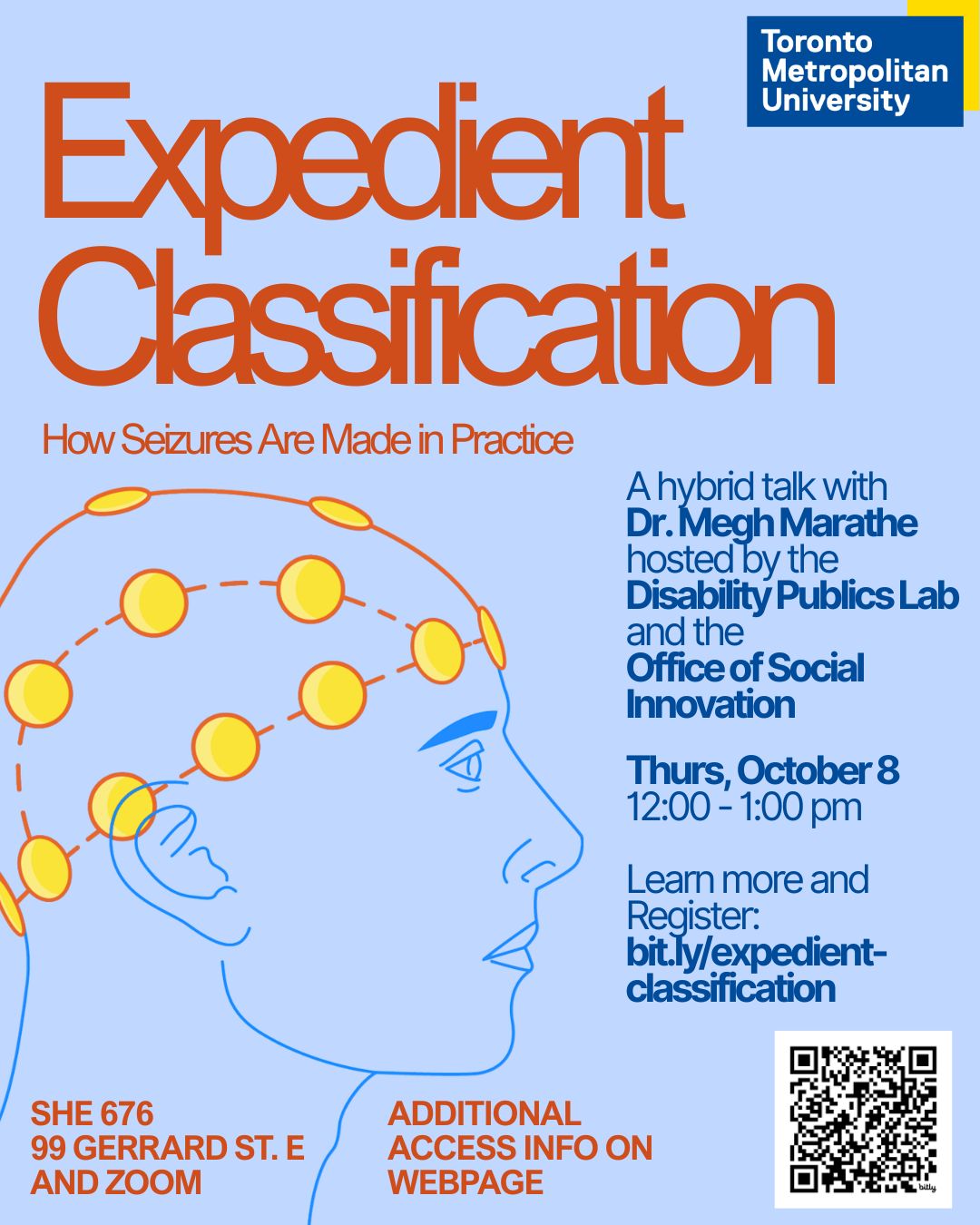
Expedient Classification: How Seizures Are Made in Practice with Dr. Megh Marathe
- Date
- October 08, 2026
- Time
- 12:00 p.m. - 1:00 p.m. ET
- Location
- SHE 676 (99 Gerrard St. E., 6th floor)
- Accessibility
- This event is hybrid. Attendees are asked to wear a mask unless they have a medical exception. Masks may be removed while eating or drinking. Nearby washrooms are wheelchair accessible. Light refreshments will be provided. A separate dining area is available upon request. If you have additional access needs, including ASL, please contact us in advance. We will do our best to support your participation. For access questions or requests, please contact Tali Cherniawsky, Lab Coordinator at disabilitypublics@torontomu.ca
- Contact
- Tali Cherniawsky at disabilitypublics@torontomu.ca
About:
This talk examines how doctors and patients distinguish between normal and pathological events in epilepsy. I show that both take what I call an expedient approach to classification, weighing the risks and benefits of labeling an event as a seizure. By engaging in expedient classification, doctors and patients bend formal classification schemes to suit the complex realities of people’s lives. These practices highlight the fluid, dynamic, and negotiated boundary between normal and pathological events in chronic conditions. The talk contributes to scholarship on disability, classification, and expertise.
Bio:
Dr. Megh Marathe is an Assistant Professor at Simon Fraser University. Their first name is pronounced “Make,” as in makerspace. Their research seeks to improve the tools that experts use to make high-stakes decisions by centering the experiences of disabled and trans people. They publish in humanistic and social science venues such as Social Studies of Science and Disability Studies Quarterly, as well as computer science venues like Proceedings of the ACM on Human-Computer Interaction.