Program Overview
The Medical Physics program at Toronto Metropolitan University teaches you how physics is used in healthcare, through both theory and practical learning.
Program: Medical Physics
Degree: Bachelor of Science (Honours)
Program Duration: 4 years, full time
Co-op Available? Yes. 5 years, full time. Explore co-op.
Medical Physics (BSc)
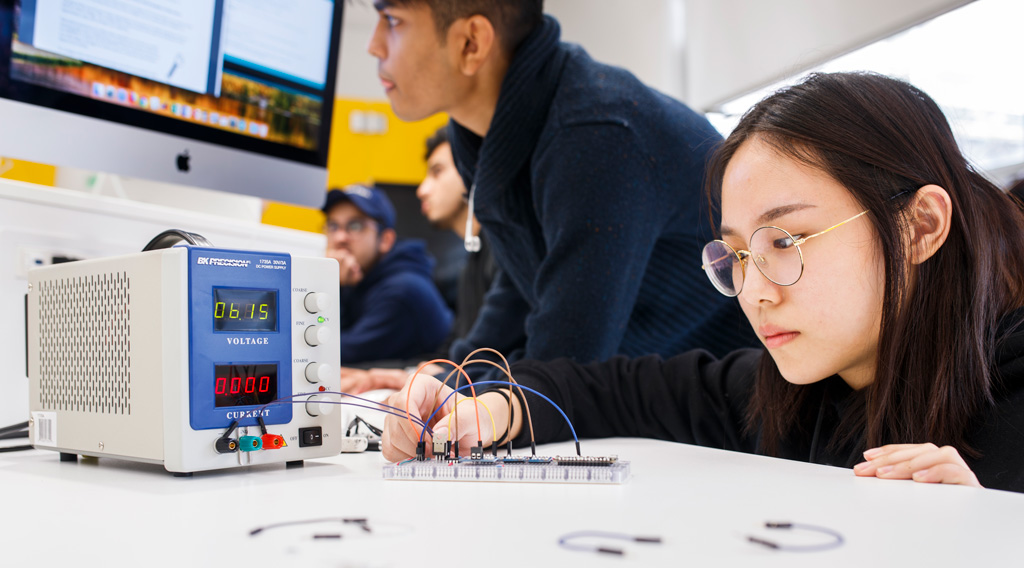
The Medical Physics program at TMU shows you how the application of physics principles can help prevent, find and treat illnesses. You'll learn about tools like ultrasound and MRI, as well as how radiation therapy can help treat cancer. Choose an optional paid co-op at a hospital, medical equipment company, in pharmaceuticals or at a power plant, and deepen your knowledge with a fourth-year research project. You can also choose a specialization in Management Sciences to become a well-rounded expert.
First year builds a broad, solid foundation in science. You'll take the same courses as first-year students in Biology and Chemistry. This provides an opportunity to learn about the various fields of science. Electives in computing and liberal arts round out your overall education. An orientation course will help you transition from high school to university-level studies.
In upper years, you’ll narrow in on physics and its applications in medicine. You will learn through lab work, research and professional-related electives to explore specialty areas. You’ll complete your own research project in the fourth year, with supervision from a professor or hospital researcher.
"As a medical physics undergraduate student, I had many opportunities in research. After graduating, I accepted a graduate scholarship and am now focused on researching quantitative image analysis and machine learning."
Undergraduate Research
Discover how you’ll gain practical research experience before you graduate in TMU’s Medical Physics program.
- Research Practicum (SCI 999) — Optional, non-credit course to gain early experience in how research works.
- 4th Year Thesis (PCS 40A/B) — A required, year-long research project, working 1:1 with faculty or hospital researchers.
- Summer Research Assistantship — Paid summer roles in faculty research labs. Check out our research areas.
- Volunteer Research — Real-time training assisting professors with their research work. Meet our professors.
- Co-op — Optional paid work terms that integrate into your studies. Find out how co-op works.
- Global Exchange — Experience science and culture abroad through course and research-based exchange programs.
Areas of Study
TMU’s Medical Physics program trains you to apply physics principles in the fields of medicine and healthcare. You'll learn to take a scientific approach to solving problems in areas such as:
- Medical Technology — how to innovate improvements to diagnostic imaging, such as MRI and ultrasound?
- Treatment Planning — what’s the most effective dosage of radiation to treat a cancer patient?
- Safety Management — how to manage the risk of radiation for nuclear power plant or clinical workers and the public?
Minors
The Department of Physics offers a Physics minor option for students outside of physics programs. To complete a minor, you must take six courses from a pre-determined curriculum. Find the latest information on minors in the Undergraduate Calendar.
Minor in Physics
A Minor in Physics will provide you with a deeper knowledge of physics and give you hands-on lab experience. This minor is not available to students in the following programs: Biology - Biophysics Option, Chemistry - Applied Physics Option, and Medical Physics.