Birthright Citizenship Workshop highlights politics and technologies undermining national belonging
At a moment when questions of citizenship and belonging are increasingly contested, the Politics and Technologies of Birthright Citizenship workshop, held on October 16–17, brought scholars together to examine the political forces behind increasingly restrictive citizenship policies. These policies often stem from anti-immigrant, racist, and sexist ideas that target racialized migrant women and their ability to have and raise children. Organized by Bridging Divides researcher and TMU assistant professor of Politics Allison Petrozziello, with colleagues Ethel Tungohan (York University) and Megan Gaucher (Carleton University), the event highlighted why these issues matter now more than ever.
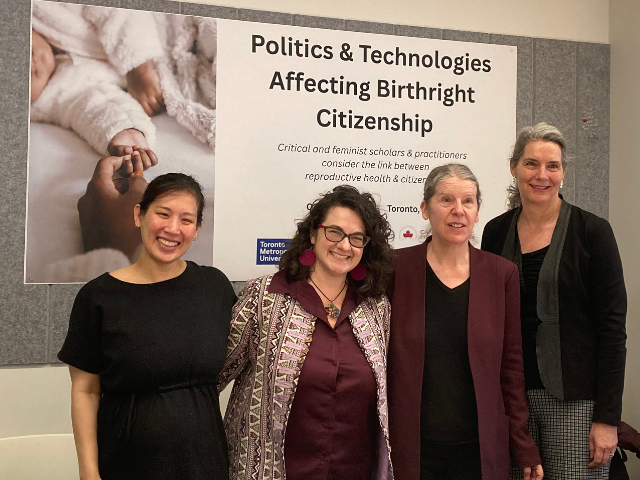
Left to right: Dr. Amanda Cheong (UBC), Dr. Allison Petrozziello (TMU), Dr. Eithne Luibhéid (University of Arizona), and Dr. Lois Harder (University of Victoria)
Debates in Parliament, global policy changes, and new digital systems all influence who can access citizenship and experience a sense of belonging. The event brought together scholars and practitioners to explore how emerging technologies and shifting political agendas are reshaping birthright citizenship in Canada and globally.
Birthright citizenship is the principle that children born in a country automatically acquire its citizenship. This principle has become a major point of debate as governments adopt more restrictive migration policies. Around the world, some governments are rolling back this right and replacing it with descent-based systems that limit citizenship to people with citizen or permanent resident parents.
In Canada, this discussion has gained more attention as new proposals challenge long-standing commitments to inclusion and equality. Earlier this month, federal MP Michelle Rempel-Garner unsuccessfully called for an end to birthright citizenship for babies born to parents who are not citizens or permanent residents. Similar efforts have taken place in the United States, where President Donald Trump signed an executive order to deny citizenship to children of undocumented immigrants, leading to a Supreme Court challenge.
Speakers at the workshop expressed concern about this trend. They highlighted how it is connected to nativist populism, anti-immigrant rhetoric, and racist ideas about reproduction and belonging. Historical examples from Australia, Ireland, New Zealand, and the Dominican Republic show how the grant of citizenship to children born to migrant women has often become a political issue – and how limits on access to reproductive healthcare and birthright citizenship can lead to rights violations, including child statelessness. Such policies not only change legal systems but also strengthen unfair social hierarchies based on race, gender, sexuality, and migration status.
Technology now plays a major role in this issue. While digital identity systems, biometric databases, and algorithmic decision-making tools promise efficiency, they can also make inequality worse. At the same time, marginalized groups are finding creative ways to use technology to claim rights and visibility. For example, some stateless communities, like the Rohingya, have used blockchain technology to access essential services such as banking and education.
In Canada, debates about citizenship go beyond birthright and also include questions about descent. Parliament is currently debating Bill C-3, An Act to Amend the Citizenship Act, which aims to restore access to citizenship for the “Lost Canadians” who were impacted by a 2009 amendment to the Citizenship Act which limited citizenship by descent to the first generation born abroad. Petrozziello’s research with the Birthing Canadian Citizens project highlights the experiences of Canadians living abroad whose families have been impacted, when the only solution offered in order to pass on citizenship by descent was for mothers to fly back to Canada to give birth–including during a global pandemic. The first-generation limit on descent was found unconstitutional by the 2023 Bjorkquist court decision, and Parliament is now pressed to pass a legislative fix. However, new proposed amendments could create the same problem again by requiring Canadian citizens living abroad to pass physical presence, language, and knowledge tests – as if they were immigrants in need of naturalization in our country – before passing citizenship to their children. Critics say this would create a two-tiered system that treats some citizens as second-class.
The workshop brought together people from many fields, including law, social work, political science, sociology, and gender studies. It centred the lived experiences of migrant parents and connected reproductive justice to citizenship policy. Researchers pointed out that protecting inclusive citizenship is not just about defending legal rights, but also about respecting the humanity and dignity of those who give birth to the next generation of citizens.
Looking ahead, the workshop participants plan to publish a special issue of a journal on The Politics and Technologies of Birthright Citizenship. The collection engages with feminist scholarship on reproductive citizenship to help understand the technological, political, and social forces which intersect to shape belonging in the 21st century. By connecting academic research with community engagement and advocacy, the team hopes to advance a more equitable vision of citizenship, one that upholds the reproductive rights of birthing humans together with their children’s right to belong from the moment of birth.