Championing women’s health: Katherine McGuire receives Gold Medal and reflects on her journey
Toronto Metropolitan University’s (TMU) Gold Medal Award is the university’s highest academic honour, recognizing a graduating student for exceptional academic achievement and meaningful contributions to their program, university, and community. Katherine McGuire is the recipient of the Fall 2025 Arts Gold Medal Award.
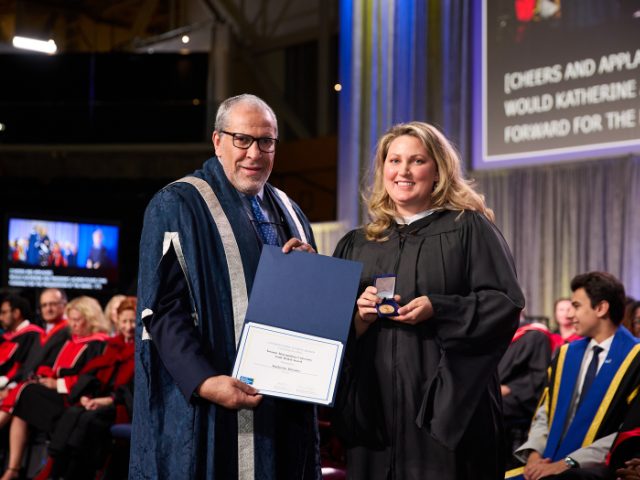
“Reflecting on my time at TMU, I’d say it was challenging, supportive, and inspiring.” - Katherine McGuire
Photo by Harry Choi.
Katherine has excelled as a scholar and leader at TMU, co-authoring five peer-reviewed publications, presenting at over 10 conferences, and earning major awards such as the Canada Graduate Scholarship – Doctoral and the Women’s Health Scholar Award. She has also demonstrated leadership through student mentorship, international research on perinatal mental health, and global collaboration.
Katherine reflected on her experience at TMU, the honour of receiving the Gold Medal Award, and her next chapter.
1. What sparked your interest in researching perinatal mental health?
My interest in perinatal mental health began during the five years I spent living in Central America, where I had the privilege of working closely with mothers and children and experienced a culture very different from my own. Immersed in this context, I was inspired by the resilience, creativity, and strength of these mothers as they navigated daily challenges. This sparked my curiosity about how social, cultural, and environmental factors shape maternal well-being. Since then, my research has focused on understanding mothers’ lived experiences across diverse cultural contexts, their access to support services, and the challenges they face. I hope to strengthen support systems for mothers and children, contribute to evidence-based programs, and broaden our knowledge of health and well-being so interventions and policies can better serve diverse populations.
2. What does winning this award mean to you?
Winning the TMU Gold Medal Award is a profound honour. I have been surrounded by brilliant, passionate students whose dedication continually inspires me, and I have learned so much from them. I am also fortunate to have been mentored by faculty who have supported and encouraged me throughout my journey. This recognition reflects years of curiosity, perseverance, and collaboration, and it motivates me to continue pursuing work that contributes meaningfully to women’s health, family well-being, and communities facing barriers to care.
3. What was the best advice you have ever received, and from whom?
The best advice I have received was from a professor in a Gender and Women’s Studies course during my undergraduate degree. She advised me to focus on the questions that matter most to me. This encouraged me to pursue research that aligns with my values and curiosity, even when it is challenging or unconventional. It reminds me that meaningful work, whether in research or professional practice, comes from exploring topics that genuinely resonate with you, especially those that challenge you to grow.
4. What advice would you give to an undergraduate student?
There is space for you, even if your path is non-linear or outside the norm. Your experiences, background, and identity bring unique perspectives, and there are mentors who will recognize and support that value. Don’t hesitate to highlight what you bring to the table, even if it doesn’t seem to “fit” the traditional mould. I began grad school as a mature student with a winding path of personal and professional experiences. Finding mentors who saw the strengths in my background allowed me to pursue research that truly mattered to me, and I encourage students to embrace their own journey and seek guidance in areas they are passionate about.
Importantly, extend yourself kindness and compassion. University is an amazing place of learning and growth, but it can also be demanding, difficult, and at times overwhelming. Give yourself permission to rest, ask for support, and celebrate yourself along the way.
6. What is next for you?
I am continuing my PhD in Clinical Psychology with my master’s degree supervisor, Dr. Fiona Thomas, focusing on trauma and perinatal mental health. I am deeply passionate about women’s health and supporting the well-being of immigrants and newcomers to Canada, and I am excited to continue my research and clinical work in these areas.