Student Projects Grants: Sociology undergrad presents on education and reconciliation in Montreal
Abby Llacer, a passionate student in Toronto Metropolitan University’s (TMU) Sociology program, sought the opportunity to share her knowledge and deepen her scholarship through experiential learning. When Abby learned she could apply for a Student Projects Grant to help support her goals: to attend and participate in a graduate-level symposium, she jumped at the opportunity.
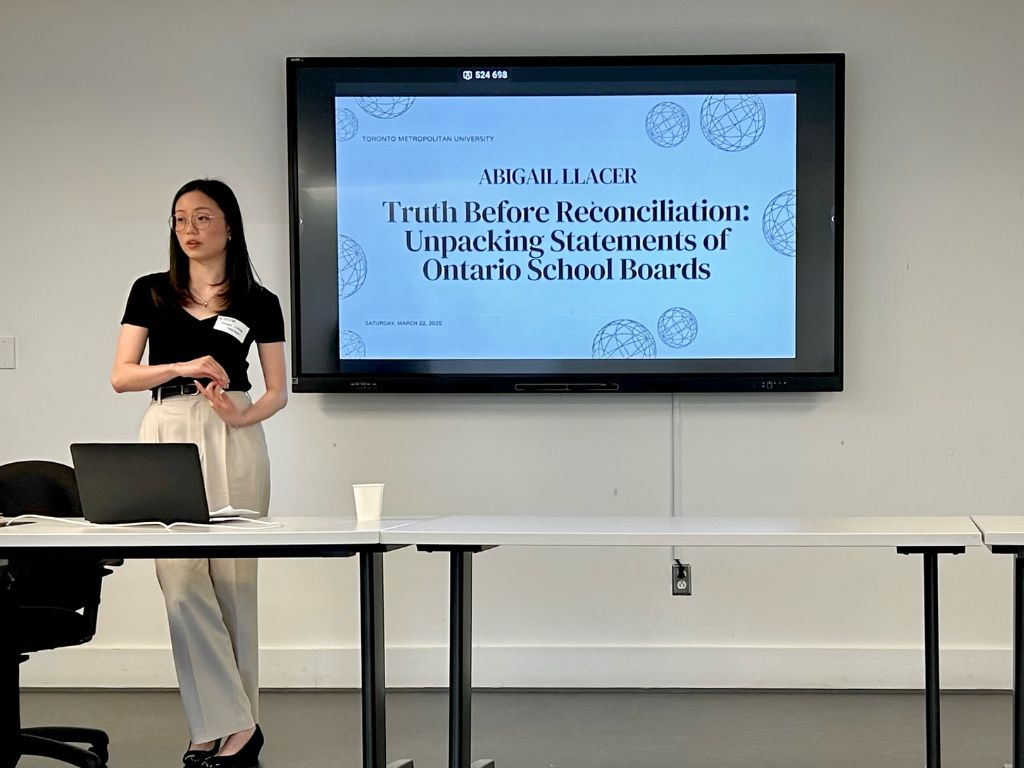
Abby Llacer is entering her final year of TMU’s Sociology program.
For many undergraduate students, presenting at conferences or symposiums is an ambitious undertaking, not only because of the strong skill set it requires, but also the funding logistics that can pose barriers to participation. With the funding support of a Student Projects Grant, Abby travelled to Concordia University in March to present at the 2025 Graduate Student Symposium on Education (external link) . The symposium, “Education and Community: Encountering the Other,” gathered graduate students and scholars investigating how education shapes community-building, fosters justice, and bridges differences. As a previous presenter at TMU’s Kaleidoscope Undergraduate Conference (external link) , Abby used her skills to represent the Faculty of Arts and contribute her sociological lens to discussions on reconciliation, curriculum, and public memory.
“After reading the symposium’s submission call, I consulted my program director, Dr. Paul Moore, about available support. He pointed me to the Student Projects Grant,” shared Abby.
“Securing SPG travel funding was crucial.”
“Once my eligibility was confirmed, I submitted an application outlining the symposium’s relevance, my research goals, and a detailed budget. The process was smooth and well‐supported, and the grant ultimately made the trip feasible.”
Abby’s paper, “Truth before Reconciliation: Unpacking Statements of Ontario School Boards,” critically examines how six publicly funded school boards in Ontario frame their statements on the National Day of Truth and Reconciliation.
“Employing a summative content analysis and critical settler colonial theory, this research examines how these statements frame reconciliation, assessing whether they engage in genuine accountability or perpetuate superficial, symbolic commitments,” Abby shared. “The study highlights how educational institutions obscure the role of government and schooling systems in shaping historical memory, policy decisions, and institutional commitments to truth and justice. In doing so, the patterns found in these statements reveal how educational institutions can challenge or fortify settler colonialism’s ongoing legacy.”
For Abby, listening to other presenters was a theoretically generative experience that helped inform her understanding. “The discussions that took place reminded me that methodological creativity and community collaboration are vital to social‐justice research and broadened my perspective on Indigenous‐settler relations.”
Throughout the symposium, Abby also engaged in valuable networking with peers who shared similar ideas or novel insights: “Informal conversations over lunch linked TMU’s reconciliation initiatives with projects underway at other universities,” she reflected. “We exchanged ideas on land‐based learning, curriculum audits, and policy advocacy, and several colleagues expressed interest in a cross‐provincial comparison of school‐board statements. Presenting my work in this environment positioned TMU as an institution whose students contribute actively to national reconciliation dialogues and strengthened inter‐university networks devoted to equity in education.”
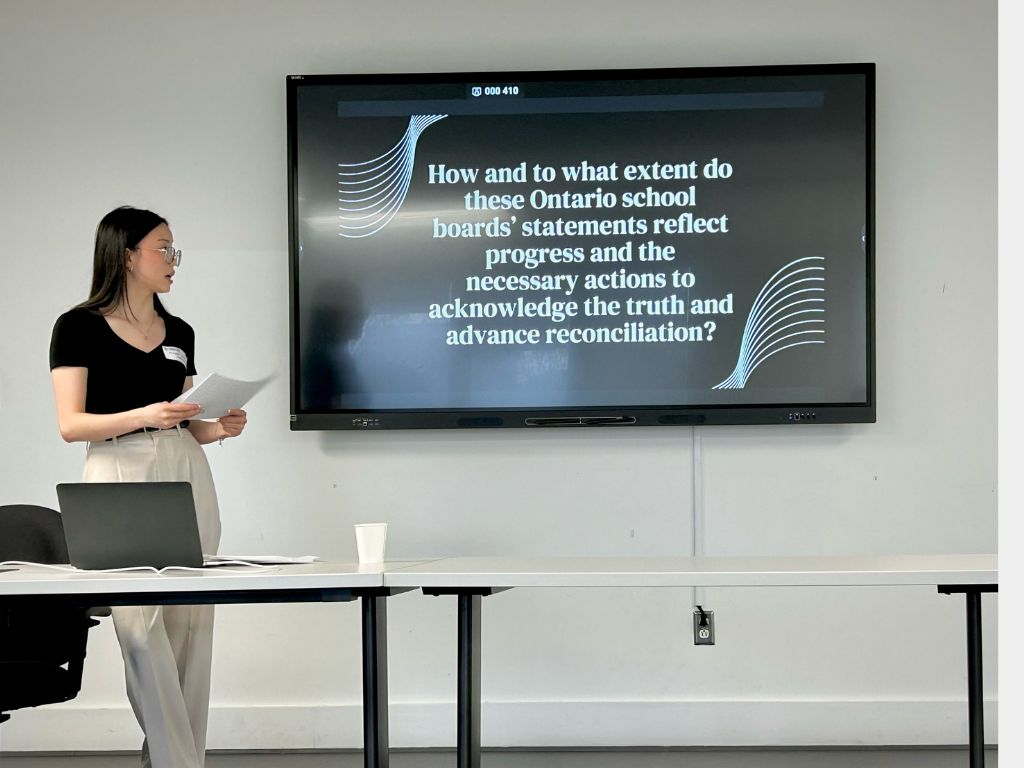
Abby Llacer presenting her paper at the Graduate Student Symposium on Education at Concordia University, Montreal.
“The experience took my learning well beyond the classroom, blending rigorous scholarship with community‐oriented engagement—an integration that will guide my future studies and advocacy.”
“Most importantly, the symposium confirmed that research can influence practice when shared in accessible forums,” Abby reflected. “I returned to Toronto with refined arguments, a wider scholarly community, and renewed motivation to hold educational institutions accountable to the truths they commemorate.” As an undergraduate student, the opportunity to participate in a graduate-level symposium contributed to Abby’s personal and academic development while inspiring her to take on new challenges going forward in her studies.

What is a Student Projects Grant?
Student Projects Grants, administered by the Faculty of Arts, provide financial support of up to $1,500 for student-initiated extra-curricular projects and activities that promote experiential learning and student engagement, with applications accepted on an ongoing basis. Students should email spg@torontomu.ca to express their interest in applying for a grant.