Masters in Criminology and Social Justice students learn about restorative justice with Peacebuilders International
World Day for Social Justice (external link) , recognized annually on February 20, commemorates the advancement of social justice in national and international policies, promoting a global agenda focused on fundamental rights, employment opportunities, social protections, and constructive social dialogue, which are critical to placing social justice at the core. For 2025, the Faculty of Arts is spotlighting the MA Criminology and Social Justice program at Toronto Metropolitan University (TMU). This program equips students for professional and leadership roles in the private, public, and non-profit sectors, focusing on social justice. Graduates pursue careers in local communities, NGOs, government, international organizations, the legal field, and academia.
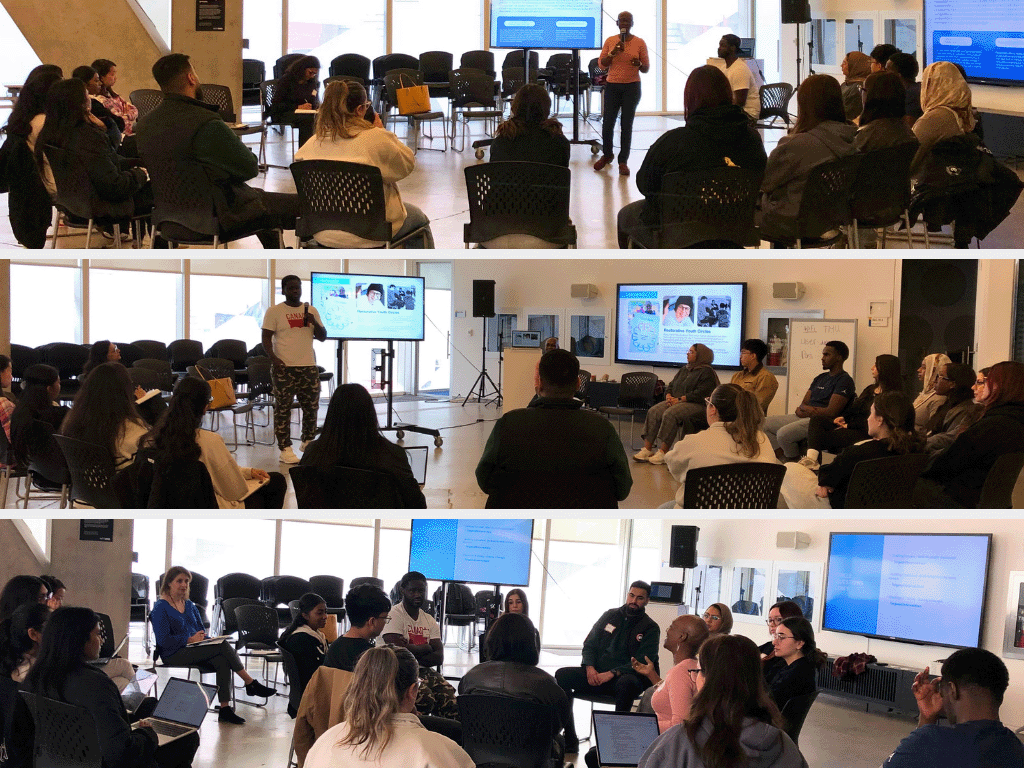
Top: Lorna Richards presenting. Middle: Richard Frimpong presenting.
On November 1, 2024, students from the MA Criminology and Social Justice program participated in an immersive learning experience to explore the principles and practices of Restorative Justice. Students from Criminology professor Kim Varma’s course, Alternatives to Formal Justice Processing and Restorative Justice (CR8103: Graduate Special Topics Seminar), had the opportunity to engage in a mock restorative justice circle. They role-played key participants in a hypothetical criminal case in collaboration with Peacebuilders International (external link) . This event was made possible by an Experiential Learning Grant, and in collaboration with Reena Tandon, Community Engaged Learning and Teaching (CELT), Faculty of Arts.
Students were guided through the restorative process by two distinguished Peacebuilders International guests: Lorna Richards, Restorative Justice Programs Manager, and Richard Frimpong, Restorative Justice Coordinator.
Natalie Balan, a participating MA Criminology and Social Justice student, reflected on the experience, "Our mock circle provided an understanding of how restorative justice creates an environment grounded in trust and respect for all participants. The circle facilitated a nonjudgmental dialogue focused on addressing the underlying causes of harmful behaviour rather than resorting to exclusionary practices rooted in shame. This process highlighted the perspectives of everyone who was impacted by a harmful situation, fostering meaningful collaboration, agency, and accountability in determining the most constructive pathways toward reparation."
During the mock circle with Peacebuilders International, participants aimed to address harm, foster accountability, promote healing and empowerment, and encourage inclusion and reintegration for all parties involved. Students assumed various roles within the scenario, with some playing those directly involved in the incident and others observing as part of the broader community of stakeholders.
This hands-on experience provided a unique opportunity for students to critically assess the potential and limitations of restorative justice compared to traditional court-based models of justice. The mock circle was designed to complement the class material. Earlier in the semester, students visited the Ontario Court of Justice to observe formal justice processes, allowing them to compare and learn from both approaches.
Kadija Odunaiya, an MA Criminology and Social Justice student, shared that restorative justice provided her with a profound insight into alternative ways of addressing harm, which traditional punitive measures often overlook. She explained, "By prioritizing trust-building, restorative justice shifts the focus from mere punishment to genuine accountability and healing. Deconstructing the root causes of harmful behaviour allows for meaningful intervention, addressing systemic issues such as trauma, inequality, and social marginalization…Restorative justice is not just a method of addressing wrongdoing, but a framework that provides deeper understanding and lasting change."
Through this community-engaged learning process, students gained valuable insights into how restorative justice practices prioritize building trust, understanding the root causes of harmful behaviour, and fostering long-term solutions. The session emphasized the importance of relationship-building, creating space for meaningful dialogue, and considering the transformative potential of restorative practices in addressing criminal harm and conflict.
“The classroom provided students with the theoretical context and a research framework to understand what restorative justice practices may provide in terms of justice, but the practical tools informed by the [CELT] workshop led by Peacebuilders International allowed students to understand the importance of human interaction, non-verbal communication, and face-to-face interactions that shift the landscape of measures of justice with an emphasis on relationships. These observations, in tandem with debates and discussions in our course, will hopefully have a more pronounced and lasting impact on students as they pursue their chosen careers or further academic studies.”
This immersive learning experience highlights the power of restorative justice in creating lasting change. By bridging theory with practice, students from the MA Criminology and Social Justice program have gained invaluable insights into alternative approaches to justice that prioritize healing, accountability, and community. The emphasis on restorative justice in line with World Social Justice Day underscores the importance of bridging theory with practice, reinforcing the need for justice systems prioritizing healing, inclusion, and genuine social transformation.