Black Studies at TMU— from formative beginnings to Black futurity
“It’s not an add-on. It’s essential,” said Melanie Knight, Interim Associate Dean of Arts, Research and Graduate Studies and Advisor to the Dean on Blackness and Black Diasporic Education.
Black faculty, students and Toronto Metropolitan University (TMU) community members long advocated for a Black Studies program dedicated to advancing Black scholarship. In 2022, under the leadership of professors Melanie Knight, Anne-Marie Lee-Loy, and Cheryl Thompson, TMU officially launched the Black Studies Minor. Housed in the Faculty of Arts, the Black Studies Minor offers up to 40 courses across 18 departments—its breadth spans literature, music, politics, creative practices, business, fashion, journalism, health equity, and histories across the Black diaspora.
A milestone in addressing a serious gap in Canadian postsecondary education—the Black Studies Minor is continuing to expand its curriculum, introduce new experiential learning opportunities, recruit and retain diverse Black faculty members and foster opportunities for student learning and mentorship.

Artwork: Futuristic Knowledge Keeper Isicholo Hat by Nerissa Hutchinson (left); Set Free by Ozi Molokwu (right)
The minor’s interdisciplinary approach to the field of Black Studies “explores the histories and cultures of Black diasporas, ideologies of anti-Black racism, themes of Black resistance to oppression and exploitation, and the range of political strategies and community-based mobilization tactics that Black activists have employed to counter systemic and institutionalized oppressions and fight for social justice.”
As a university-wide program, the Black Studies Minor reinforces that Black history, art, and ideology should be imbued in every facet of higher education. The program serves as a crucial first step in enhancing the inclusivity of Black research in academia and broadening the representation of Black communities' history and legacy within Canada and beyond.
Research, creativity, and experiential learning opportunities within and beyond the classroom
Black studies transcend the boundaries of Eurocentric scholarly traditions through diverse pedagogical practices, ideologies, and immersive curricula. The Black Studies Minor aims to provide students with scholarly and creative depth and breadth, equipping them for successful careers in fields ranging from business to public service, research, policy, education, lawmaking, and more. Courses within the minor are taught by leading scholars of Black Studies and emphasize critical engagement with various topics and experiential learning opportunities.
Administered by the Department of English, the minor’s foundational course, ENG 142 Black Arts, Black Power, examines the textual and cultural productions that reveal the material conditions of Black experience.
Afrofuturism: Black 2 the Future
In ENG 647 Afrofuturism: Black 2 the Future, Anne-Marie Lee-Loy, English professor and Associate Dean of Undergraduate Studies, guides her students in creatively exploring Afrofuturism. Students engage with Black artists like Ekow Nimako (external link) , delve into speculative fiction across various storytelling mediums, and create multimedia projects embodying Black aesthetics and futurity.
“Black studies should be embedded in all programs. Black studies is education and knowledge.” – Nerissa Hutchinson, Child and Youth Care graduate
“The Afrofuturism class with Dr. Lee-Loy happened at the right time in my life,” shared Nerissa Hutchinson, a recent graduate of TMU’s Bachelor of Child and Youth Care. “The impact of anti-Black racism and the death of George Floyd, and returning to the classroom was quite difficult for me. I felt I had lost my artistic joy. Dr. Lee-Loy's class reminded me of who I am as a Black African Caribbean woman and showed me that I am from greatness and resilient. Plus, I got to meet my idol: Ekow Nimako.”
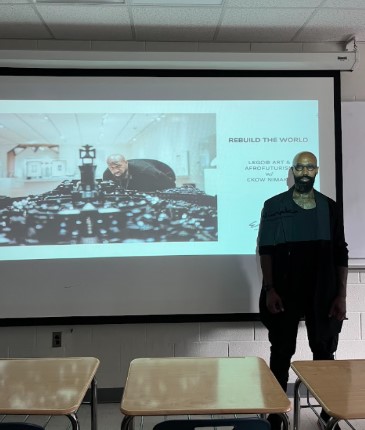
Ghanaian-Canadian artist Ekow Nimako, known for his futuristic and eclectic sculptures using black LEGO® presented to students in ENG 647 Afrofuturism: Black 2 the Future.
For the future, Nerissa hopes to see more focus on Black studies in all programs and the hiring of more Black educators and students. Reflecting on her creative expression of Afrofuturism, Nerissa shared, “It was so amazing to create an art piece reimaging Black African art outside of colonization. It made me realize we are so much more as a people, rich in culture, art, knowledge, and spirituality.”
Politics and Governance student Ozi Molokwu reflected on her artistic expression: “In my Afrofuturism course, I worked on a music project called Set Free (external link) . I am particularly proud of this project because it marked a breakthrough in my exploration of sound.”
“The course materials and guidance provided the flexibility to explore themes of my African heritage, my current positioning in society, and where we, as a people, could be in the future. Set Free was deeply inspired by African influences in contemporary thought, and the final song resonated with listeners—it is now my most-streamed track on Spotify to date.”
Ozi expressed that the course not only inspired her own artistic creation but also promises a multitude of creative possibilities. “I would highly recommend Afrofuturism because it provides a space to critically engage with Black history, identity, and futures through art, culture, and speculative thinking. It allows students to reimagine possibilities for Black communities while drawing inspiration from historical narratives and creative expression.”
Courses like THF 470 Black Creative Practices and FSN 620 Black Fashion delve into Black aesthetic histories and possibilities—offering students further opportunities to engage in their own visionary artistic creations.
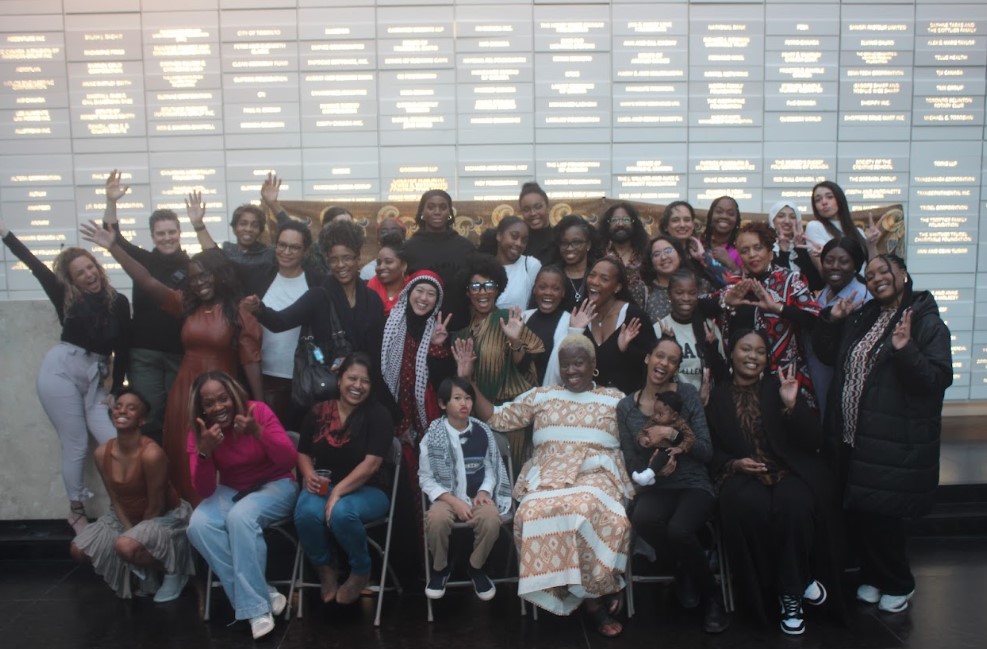
Photo from the Colour of Birth Reception, Fashion Show & Memorial March, hosted at TMU on February 2, 2024. Bottom, third from the right: professor Karline Wilson-Mitchell. First from the bottom left: Emilie Jabouin (PhD) professional Haitian dancer.
Black Birthing and Health Equity
MWF 508 Black Birthing and Health Equity addresses a historical disparity in Black maternal health through its exploration of the effects of colonialism and enslavement on Black childbearing families. “The course uses a variety of teaching methods to engage students in critical thinking about Black birth and health equity,” shared professor Karline Wilson-Mitchell. “Methods include didactic lectures, panel discussions, problem-based learning, and group presentations. Students are encouraged to actively participate in class discussions, conduct self-reflection and attend anti-oppressive, anti-Black racism workshops.”
Wilson-Mitchell is also involved in the Colour of Birth project, an interdisciplinary collaboration between scholars, historians, archivists and storytellers that seeks to elucidate and understand the histories of racialized immigrant midwives in Canada.
In the classroom, professor Wilson-Mitchell prioritizes Afrocentric pedagogy infused with critical, anti-Black feminist frameworks. While some classes take the form of a more traditional lecture style, others involve her and her students “sharing food, knowledge, understanding, experiences, hopes and ideas” while listening to guest speakers from across Canada, the US, Belize and Haiti. Former guests have included Dr. Trudy McFarlane, Black Health and Flourishing Director of the new TMU medical school; Karie Stewart CNM, PhD (c), an American midwife; Shafia Monroe MPH, CPM, an American midwife, and Cathy Ellis RN, MA, a Belizean traditional midwife.
A first of its kind, professor Janelle Brady’s course, CLD 540 Black Childhoods in Canada, explores childhoods through Black feminist, anti-racist, and de-colonial theoretical and practical frameworks and pedagogy.
“For me, taking Black Studies courses tells me I am seen and heard, and my experiences as a Black person are valuable and important.” – Nerissa Hutchinson, Child and Youth Care graduate
Criminalizing Blackness
CRM 250 Criminalizing Blackness critically engages with anti-Black state violence historically and contemporarily within the criminal justice system and other institutions.
In the classroom, criminology professor Lahoma Thomas has asked her students to create their own Public Service Announcement to bring awareness to the criminalization of Black people and communities. The final assignment invites students to work collaboratively to critically engage with the connections between anti-Black racism and notions of Black criminality, aiming to challenge societal perceptions and inspire change through awareness and resistance to systems of power. In the past, Thomas has also invited transnational Black scholars from across the Americas to lecture in a speaker series that offers further insights into systemic injustices and modes of Black resistance.
“Criminalization is not just about laws and policing—it is a process that operates both formally and informally. From legal statutes to media narratives, from policing practices to everyday surveillance, Black people experience criminalization in ways that shape their lives, communities, and avenues for resistance," shared Thomas. "This course challenges students to critically engage with these structures, examining how anti-Blackness is embedded in various institutions and everyday life while exploring movements toward freedom, liberation and pathways toward justice beyond punishment.”

No justice, no peace sign / Pixabay
Law, Justice and Abolition
In SOC 705 Law, Justice, and Abolition, sociology professor Rai Reece’s students have had the opportunity to engage with speakers from Walls to Bridges (external link) , an educational program that connects incarcerated and non-incarcerated students to study post-secondary courses within jails and prisons across Canada. Reece’s final Social Justice Project encourages students to demonstrate their learning.
Co-instructed by Reece and professor Megan Scribe, SOC 576 Colonialism and Anti-Blackness critically examines scholarly conversation between Black and Indigenous studies and explores their methodologies and abolitionist possibilities.

In music studio / Pexels
Black Popular Culture in Society
In SOC 320 Black Popular Culture sociology professor Sam Tecle asks: what might it mean to study culture produced from within the wake of Black abstention, and how might this study continue to expand our understandings of art, culture, form, genre, and aesthetics? As part of the course, students have engaged with Black art and exhibits such as BAND (external link) and Nia Centre for the Arts (external link) .
Interested students can also explore SOC 221 The Hip Hop Lens of Society and immerse themselves in RTA 484 Music of the African Diaspora.
“The Black Studies Minor has allowed me to bridge the gaps between my identity, my passion, and my studies. It has encouraged me to think innovatively and creatively about addressing social issues, building community, and giving back to the economy.”
Blackness and Freedom
In SOC 530 Blackness and Freedom, professor Melanie Knight explores the impact of the Transatlantic Slave Trade and the contradictions of freedom after emancipation. "What happened after emancipation? Where could Black people live, work and commune? Concepts of rights and democracy are discussed in relation to the instituting of Black codes, spatial and embodied erasures and surveillance of blackness. Throughout, Black resistance has always been about true freedom." The course is heavily structured around community-engaged learning, with a Black History tour, a visit to the Blackhurst Cultural Centre, the Image Centre, Urban Farm and an assignment with the Immersion Studio at the Library.
“I love having Black professors who are so passionate in what they teach. [In the Black Studies Minor] there is something for everyone.” – Abi Jones, Psychology student
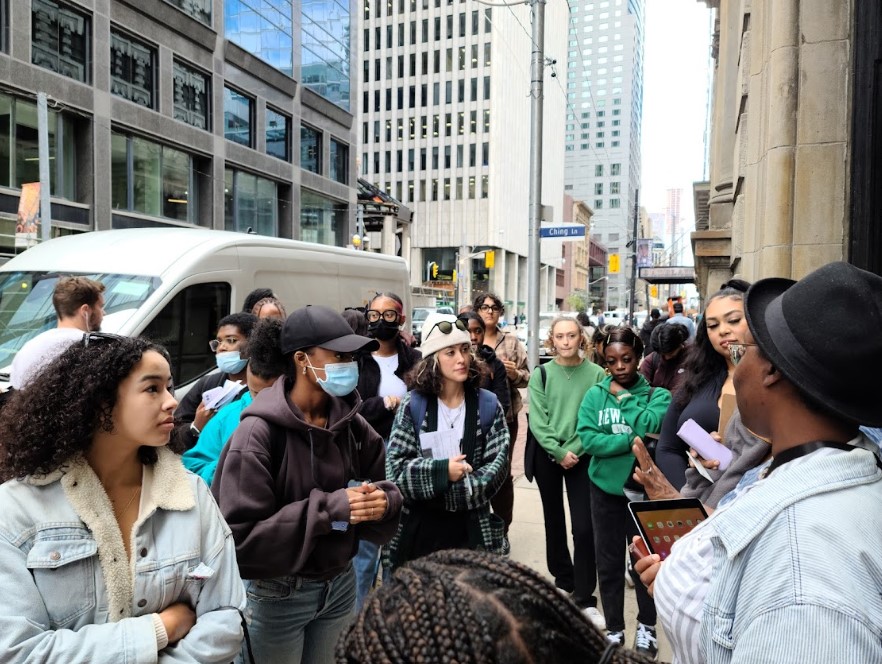
Students attending the Ontario Black History Society Walking Tour as part of SOC530’s Community-Engaged Learning and Teaching (with Dr. Reena Tandon).
Black Political Thought
PHL 570 Black Political Thought explores philosophical thinkers from across Africa, North America, and the Caribbean. From the 19th century onward, Black Political thought engages with prominent topics, including equality, freedom, identity, justice, violence, the struggle for civil rights, prison abolitionism, intersectionality, policing, necropolitics, Black feminism and critical race theory.
French Caribbean Literature and Culture
In professor Ndeye Ba’s FRS 602 French Caribbean Literature and Culture, students encounter the literary, cultural and artistic forms of the Francophone Caribbean. The course topics come alive through poetry, novels, storytelling, theatre, music and film.
African Diasporic and Canadian History
HIS 760 The African Diaspora, taught by history professor Patrice Allen, is an essential course exploring the cultural, political, and economic legacies of the Atlantic Slave Trade and the movements and institutions that have emerged in its wake.
In HIS 392 African Canadian History, Allen explores the structures of African Canadian communities, institutions, and abolition movements to the emergence of Black Power and the impact of migration from Africa, America, and the Caribbean in the twentieth century.

For students interested in history or archival research, TMU’s Black Studies Guide offers information on the historical, social, economic, political, and cultural histories of people of African descent across the diaspora, particularly in Canada. From stats to film, the guide hosts a diverse collection with over 13,000 views to date.
The Black Studies Minor is a testament to the change that still needs to be made within the postsecondary education system and envisions where transformative curriculum, social policy, and ideology spearheaded by Black leadership can pave the way for an inclusive future.
“I see a future driven by innovation, creativity, community engagement, and grassroots activism. Black Studies at TMU has the potential to continue fostering meaningful conversations, inspiring change, and shaping a more inclusive academic and social landscape.”