Dr. Daniel Rubenson appointed Executive Director of Evidence in Governance and Politics
Following a one-year transition period, Professor in the Department of Politics and Public Administration, Dr. Daniel Rubenson (external link) , officially began his term as Executive Director at Evidence in Governance and Politics (external link) (EGAP) in January 2024. Dr. Rubenson’s term runs for three years with a possible two-year extension. Dr. Rubenson has been an active member of EGAP since its founding in 2009.
Dr. Rubenson's primary research focus lies within the field of comparative politics, where Dr. Rubenson investigates questions about political participation, social identity, natural resource governance, property rights and institutions in a variety of settings around the world. His research often entails conducting field experiments in collaboration with political campaigns, organisations and policymakers to draw causal inferences about the effects of interventions.

Dr. Daniel Rubenson
EGAP is funded through the support of the William and Flora Hewlett Foundation and anonymous philanthropic donors. It is the leading global research, evaluation and learning network in governance and politics. The organisation also serves as a research hub fostering knowledge accumulation, innovation and evidence-based policymaking at a global scale, with over 250 members in 38 countries on six continents. EGAP members include individual researchers, institutional members, governmental organisations, international humanitarian aid and development organisations, and local or regional civil society organisations.
EGAP promotes rigorous knowledge accumulation, innovation and evidence-based policy in various governance domains by fostering academic-practitioner collaborations, developing tools and methods for analytical rigour, and training academics and practitioners alike, with an intensive focus on the Global South.
EGAP is leading efforts to change research practice in the social sciences, including pioneering new models for coordinated knowledge accumulation via the Metaketa Initiative (external link) , which has pushed the boundaries of how social science knowledge and evidence are accumulated. Over 30 projects have been implemented around this work, involving more than 100 researchers on topics such as information and accountability (external link) , natural resource governance (external link) , community policing (external link) , taxation (external link) and women’s participation in local services (external link) .
Dr. Rubenson notes that “the success of EGAP is entirely based on the members of the network who are among the most innovative, dedicated and energetic social scientists in the world. The network provides a rare forum for practitioners and researchers to interact, exchange ideas and learn from one another. As I see it, one of EGAP’s key missions is this exchange — bringing practitioners to the university and bringing researchers to practitioner spaces. In this way, EGAP can contribute to informing action directly.”
EGAP has also been at the forefront of promoting and creating institutions for research transparency. The EGAP design registry (external link) was one of the first in the social sciences and now has nearly 3000 registered designs, greatly improving research transparency and changing research practice.
The development of new methods for quantitative research and methods for causal inference, and providing training in these methods is another core activity of EGAP. EGAP’s Learning Days (external link) are intensive week-long training in statistics and causal inference aimed at principal investigators based in the Global South. Close to 200 scholars and evaluation professionals have participated in a Learning Days workshop. Participants represent 31 countries in Latin America and Sub-Saharan Africa.
Dr. Rubenson enthuses, “An aspect of EGAP’s approach that I am both proud of and excited about is how we strive to develop the idea of evidence as a governance accountability mechanism. A big part of our focus is on using our methods and training work as tools. The work done in the Learning Days is pretty amazing and has an impact on exactly this notion of evidence as an accountability mechanism. So, EGAP will continue to be unapologetic in its core belief that a certain type of evidence and evidence generation is the way to achieve these goals and will continue working to expand and flatten access to methodological tools and insights.”
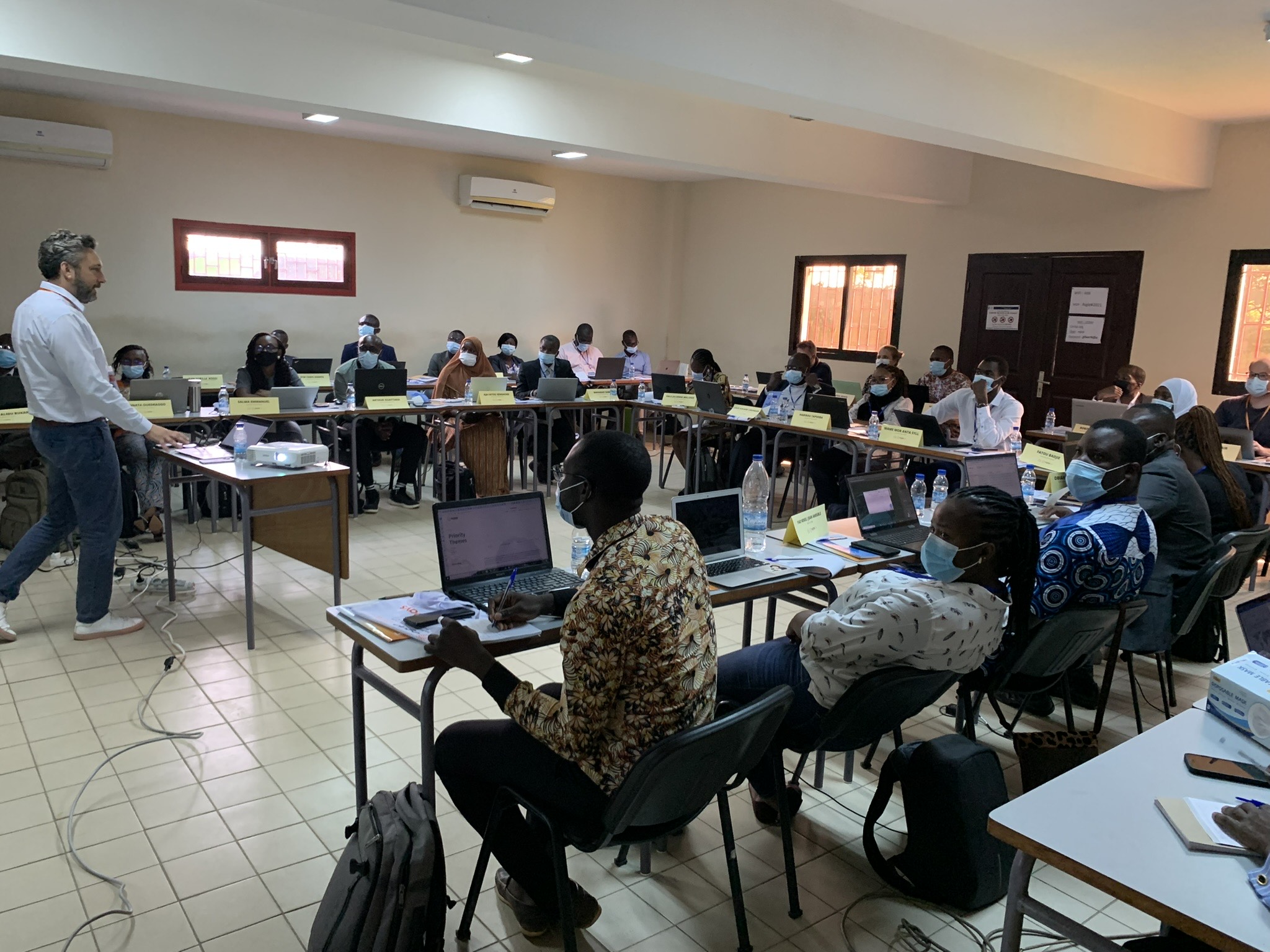
Professor Dr. Rubenson teaching in a Learning Days session hosted by the EGAP West Africa Hub in Abidjan, Côte d’Ivoire, July, 2022.
During his three-year term, Dr. Rubenson aims to grow EGAP’s membership by issuing a call for new members in the coming months. Dr. Rubenson added, “EGAP has a particular mission to promote and facilitate the codesign of research and learning initiatives. EGAP’s approach in this regard is centred around the recognition that when policy questions and research topics concern specific groups, particularly marginalised groups, it is those voices that are contributing, both on the research and practitioner side. This occurs through several channels, including our regular meetings, the grants and fellowships we fund, and our ongoing feedback sessions for researchers and practitioners.”
“I’m delighted to congratulate Dr. Rubenson on his election to this position,” said Dr. Steven N. Liss, TMU’s vice-president, research and innovation. “This recognition by his EGAP peers demonstrates his outstanding contributions to comparative politics research and this global organisation. I am particularly pleased for Dr. Rubenson, and the opportunity for TMU to contribute to this important scholarly network.”
In his new role as Executive Director of EGAP, Dr. Rubenson brings years of expertise and commitment to advancing rigorous research and evidence-based policymaking on a global scale. Dr. Rubenson’s leadership aims to strengthen EGAP's mission of fostering collaboration, developing tools for analytical rigour and innovation in governance and politics worldwide.