How Democracies Degenerate
- Date
- October 07, 2021
- Time
- 6:00 PM EDT - 7:30 PM EDT
- Location
- Online
- Open To
- All
 (external link)
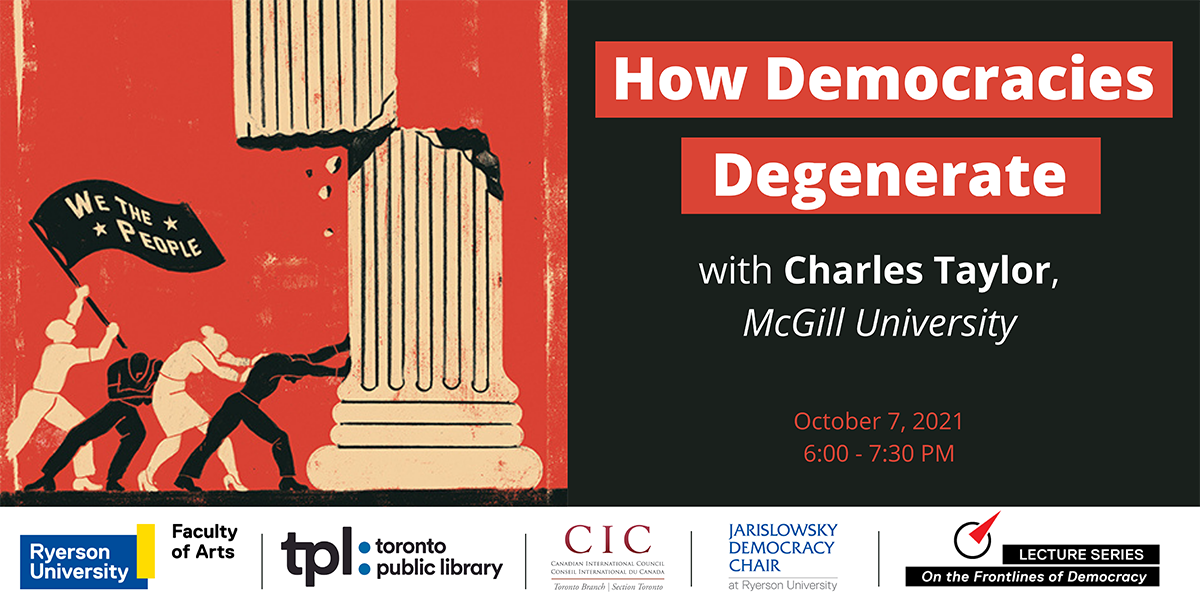
Democracy represents a political ideal: popular self-rule. It envisions a political community of citizens empowered to participate in public life, choose their representatives and determine a common future. Yet the real history of modern democracies involves bitter struggles to extend civil liberties, political rights and social equality, and to expand the boundaries of nations, to realize this ancient ideal. And since our societies create new hierarchies over time, the struggle to empower ordinary citizens against various elites never really ends. Years of progress are often followed by periods of regression. The ideal of democracy can slip away.
What are the sources of degeneration in our democracies today? How are they similar and different from earlier decades? And what can we do to reverse the slide?
The eminent philosopher Charles Taylor, one of Canada’s foremost public intellectuals, explores these questions in conversation with Sanjay Ruparelia.
About the Speaker and Discussant:
CHARLES TAYLOR, Professor Emeritus of Philosophy at McGill University, is one of the world’s most renowned philosophers.
A bilingual native of Montreal, he earned his BA in History from McGill and MA and DPhil in Philosophy from Oxford, where he later held the Chichele Professorship of Social and Political Theory. Bridging multiple traditions, his writing has made seminal contributions across the humanities and social sciences, ranging from aesthetics, language and morality to studies of democracy, national identity and the modern self. The author of over twenty books, his representative publications include Sources of the Self: The Making of the Modern Identity (1989), The Malaise of Modernity (1991), Multiculturalism and The Politics of Recognition (1992), Modern Social Imaginaries (2004), A Secular Age (2007), The Language Animal (2016), and Reconstructing Democracy (2020). A recipient of many distinguished awards, including the Kyoto Prize, Templeton Prize and John Kluge Prize, Taylor is a member of the American Academy of Arts and Sciences and of the Companion of the Order of Canada.
In addition to his scholarship, Taylor has actively participated in Canadian public life. A founding member of the British New Left during his graduate studies, he subsequently ran for parliament and served leadership roles in the New Democratic Party and the French Language Council, while training generations of students who became activists and politicians. In 2007-2008, he co-chaired the Quebec Consultation Commission on Accommodation Practices Related to Cultural Differences, which sought to practice a form of civic ethics based on mutual recognition that his philosophy espoused.
SANJAY RUPARELIA is the Jarislowsky Democracy Chair, and an Associate Professor of Politics, at Ryerson University. He is the author of Divided We Govern: Coalition Politics in Modern India (2015), editor of The Indian Ideology (2016), and co-editor of Understanding India's New Political Economy: A Great Transformation? (2011). Sanjay is a co-chair of the Participedia network (participedia.net), associate editor of Pacific Affairs and country expert for V-Dem: the Varieties of Democracy Project (Sweden). He previously taught at Columbia University and the New School for Social Research, served as a consultant to the Asia Foundation (Kabul), United Nations Development Programme (New York) and United Nations Research Institute for Social Development (Geneva), and was a fellow at Notre Dame, Princeton and Yale. He earned his B.A. from McGill University, and M.Phil and Ph.D. from the University of Cambridge.
About the series:
On the Frontlines of Democracy is a public lecture series to analyze the prospects of democracy in our world. In every region, democracies face serious challenges, old and new. Can we protect our constitutional democracies in an era of popular mistrust, severe partisanship and resurgent nationalism? Can they reduce inequalities of power, wealth and status, defend deep diversity and confront climate change in the new digital age? Can we develop innovative strategies to revitalize civic engagement and empower public institutions to renew the promise of collective self-rule? And what can Canada offer, learn and do to promote the prospects of democracy, in a spirit of mutual learning, in our increasingly post-western world?
A special collaboration between Ryerson University, Faculty of Arts, and the Toronto Public Library.
This event is co-sponsored by The Canadian International Council (CIC) (external link) Toronto Branch. The CIC is Canada’s foreign relations council; a non-partisan membership organization dedicated to advancing constructive dialogue on Canada’s place in the world and providing innovative ideas on how to address the world’s most pressing problems