Professor emeritus Blake Fitzpatrick and IMA alumni join portfolios for Nuclear Topographies Artspace exhibit
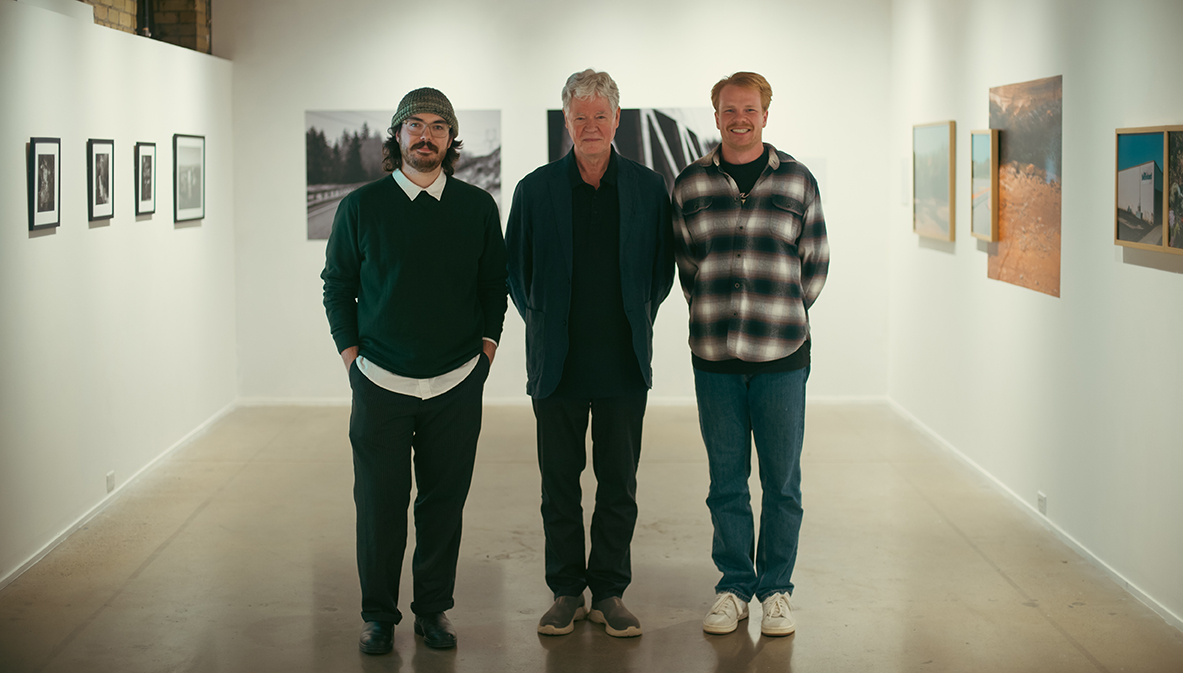
Logan Rayment and Avery Nielsen-Webb, two graduates of Toronto Metropolitan University (TMU)’s Photography Media Arts program, joined with their fourth-year thesis supervisor, professor emeritus Blake Fitzpatrick, to put on a nuclear photography exhibit at Artspace.
Artspace (external link) , a student-led gallery that features student and alumni work, hosted the Nuclear Topographies exhibit (external link) from Oct. 24 to Nov. 15 to explore “the ever-lasting radioactive histories of nuclear industrialism within North America.”
Rayment originally had the idea of putting together the exhibition as he worked on a nuclear photography project for his grad school portfolio. He hadn’t been ready for a solo exhibition, and reached out to his long-time friend, Nielsen-Webb, who was also working in the nuclear photography space and had been in TMU’s Photography Media Arts undergraduate program with him.
Nielsen-Webb said while brainstorming the direction of the show, the pair remembered how influential Fitzpatrick had been as their thesis advisor, and invited him to join the exhibit. They were enthusiastic when he said yes.
“The collaboration felt symbolic of our progression from students to emerging professionals,” Nielsen-Webb said.
The Nuclear Topographies exhibit showcased multiple facets of the nuclear industry in North America, such as its profound impact on environments. The photographs told a story from the mining of uranium, to its refining and processing, and finally, when uranium is used and laid to rest, Nielsen-Webb said. Each of the photographers drew on their own experiences with the nuclear world to put the exhibit together.

Nielsen-Webb had grown up in the Pacific Northwest, where he and his family often passed the Hanford Site, a decommissioned nuclear production complex in Washington, while driving to hockey games. As he got older, the site kept appearing in the media for its plutonium leaks, contamination and ultimately, environmental damage.
Rayment was similarly drawn to focus his photography on the nuclear landscape, as his grandfather worked in uranium mining in Saskatchewan. He became interested in his grandfather’s story and, more broadly, the effect of radiation passing through generations.
“For me, [the] nuclear industry is so interesting because its consequences are truly world-ending unlike other major polluting industries,” Rayment said.
Fitzpatrick, meanwhile, has been photographing the nuclear industry for over 30 years, he said.
“I was drawn into the topic because nuclear war, weapons, waste and the industries that support them are some of the most important issues of our time with issues of life and death very much on the line,” Fitzpatrick said. It’s also what drew him to join the Atomic Photographers Guild, and later, serve on the guild’s advisory committee.
Deciding on the work for the exhibit — which featured photographs, satellite images, a projection of a GIF compiling archival research and more — was a challenge, Rayment said. But all three collaborators agree on the impact of photography as a medium to discuss the pitfalls of the nuclear industry.
“Photography became the way for me to visually trace these layers: the land, the infrastructure, the politics, and the unresolved failures of the nuclear age,” Nielsen-Webb said.
Fitzpatrick said the project pushed him to ask how photography can make the invisible, visible.
“It is a conceptual challenge that addresses not only photography and its limits but the environment as a subject that does not give up its secrets easily,” he said.

Rayment said a “new nuclear age is dawning,” as uranium mining sanctions lifted in Nova Scotia, energy-hungry generative AI data centres prompt modular nuclear reactors to power them and there is a renewed focus on nuclear arsenals.
“Being able to talk to people about these modern issues through the lens of the past nuclear industries, and how they are still wreaking havoc in communities across the country, puts it into perspective that if we re-invest into these industries as a country, our kids and their children as well will still be fighting the aftermath of what we do today, and what we have done in the past,” he said.
The reception to their exhibit at Artspace had been encouraging, as many said they learned the history of nuclear industries for the first time.
“It really affirmed that I’m on the right path that the work is doing what I intend it to do, which is to bring forward histories and failures that are often obscured, normalized, or intentionally kept quiet,” Nielsen-Webb said.
All three were grateful for the support their project received.
“Being able to show my work again alongside my longtime friend Avery, and my former professor Blake for the first time was a true honour, and I am grateful to both of them for being such great collaborators,” Rayment said.