GCM SRC Seminar
- Date
- November 26, 2024
- Time
- 4:00 PM EST - 7:00 PM EST
- Location
- School of Graphic Communications Management, Heidelberg Centre (HEI Building), 125 Bond Street, Toronto, ON M5B 1Y2 Canada

Join Us for the Annual GCM Scholarly, Research, and Creativity (SRC) Seminar!
We are excited to invite you to the Annual GCM SRC Seminar hosted by The School of Graphic Communications Management (GCM) at The Creative School at Toronto Metropolitan University, where groundbreaking ideas and innovative research come to life! This year’s event promises to be an inspiring showcase of the latest research projects, creative developments, and future-forward insights in graphic communications.
What to Expect:
- Cutting-edge research on emerging technologies
- In-depth presentations on sustainability, design, digital asset management, print and packaging innovations, and more
- A platform to network and exchange ideas with peers and professionals
Whether you're a researcher, industry professional, or student, this event is your chance to dive deep into the future of graphic communications and discover the latest challenges and trends shaping the industry.
- Save the Date: November 26th, 2024
- Time: 4:00 - 7:00 p.m. ET
- Location: School of Graphic Communications Management, Heidelberg Centre (HEI Building), 125 Bond Street, Toronto, ON M5B 1Y2 Canada
Limited Seats! To register please visit: https://forms.gle/ooCfi8uQb2uGMmGU8 (external link)
For more information or questions contact Dr Reem El Asaleh, Associate Chair, GCM at reem.elasaleh@torontomu.ca
Agenda
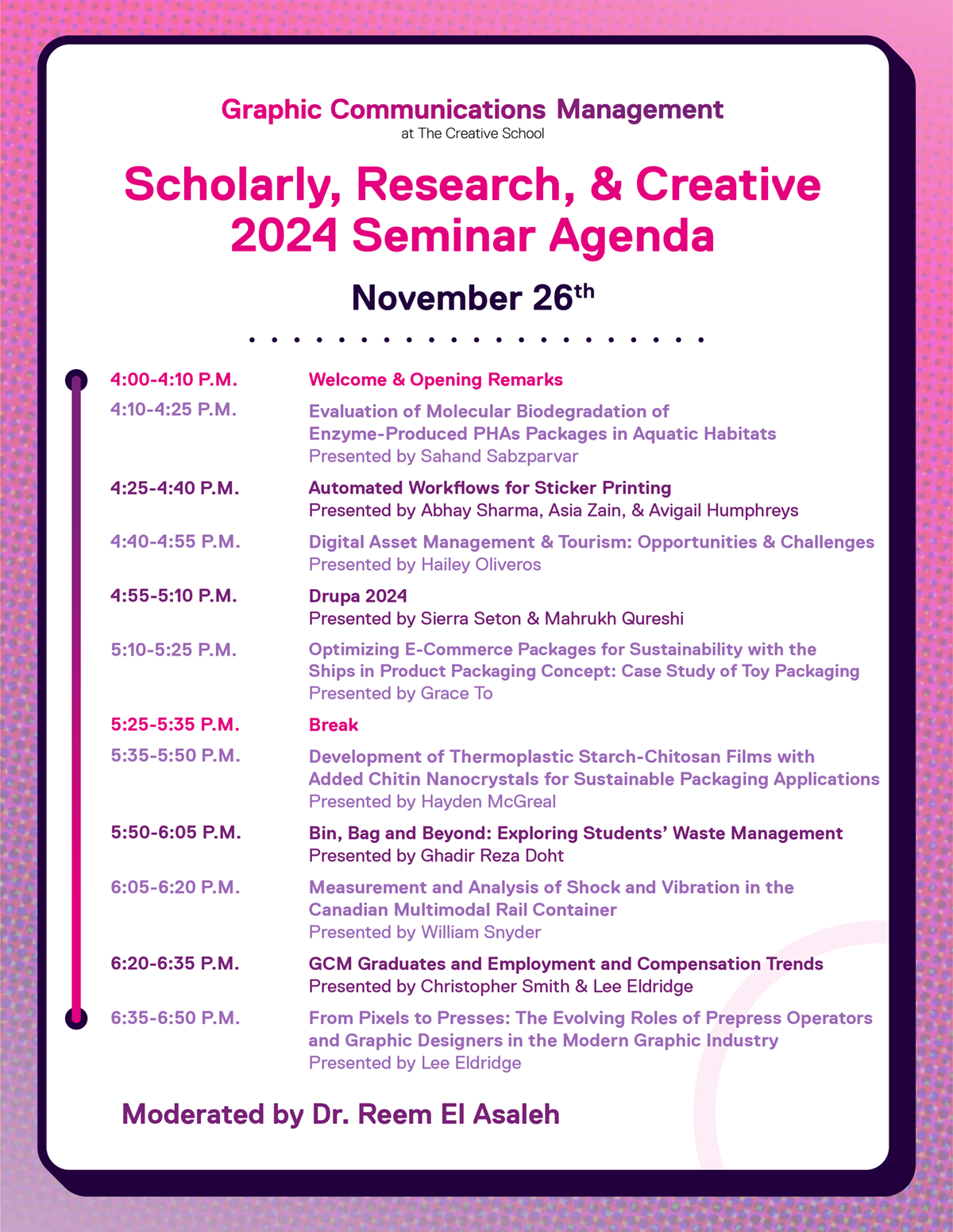
Seminar Presenters & Abstracts
Evaluation of molecular biodegradation of enzyme-produced polyhydroxyalkanoates (PHAs) packages in aquatic habitats
Presented by:
Sahand Sabzparvar (sahand.sabzparvar@torontomu.ca (opens in new window) )
Supervised by:
Dr. Ehsan Behzadfar
Abstract:
Polyhydroxyalkanoates (PHAs) are a class of bioplastics that can be composted, recycled, or, in the case of improper disposal, degraded in marine, fresh water, and soil environments. Single-use plastic packaging accounts for a large portion of waste that falls out of proper end-of-life streams and into the environment. Enabling the possibility of thermoforming PHA into packaging at production speeds can divert plastic waste from sitting indefinitely in unintended environments and instead degrade relatively quickly. Although these packages are known for biodegradability, studies have primarily focused on qualitative studies, and there is no quantitative index showing the degradation rate of these packages in marine, freshwater, and soil environments. This project aimed to determine the degradation process of polymeric films of two commonly used PHs, namely polyhydroxybutyrate (PHB) and poly(3-hydroxybutyrate-co-3-hydroxyvalerate) (PHBV), by submerging in simulated aquatic habitats over an extended period and establishing a benchmark against known materials such as polylactic acid (PLA). The submerged films were then studied by measuring the changes in thermophysical characterization through thermogravimetry (TGA), differential scanning calorimetry (DSC), static light scattering (SLS), and rheometric analysis to determine and demonstrate the degradation processes of these materials. The findings showed that PHAs undergo a quicker degradation process compared to PLA counterparts, and their degradation depends on their molecular structure. While our TGA data refer to insignificant changes in the thermal stabilities of PHAs and PLA, the DSC data indicate the changes in the molecular structures evidenced by changes in the crystallization behaviour and temperatures. Also, the SLS data confirms the changes in the molecular structures. This study highlights the significance of quantitative studies in properly investigating the end-of-life of biogenic plastics.
Biography:
Sahand Sabzparvar graduated from the Graphic Communications Management program with a concentration in packaging in the spring of 2023. He has worked closely with professors and students within the program providing teaching support for close to four years. Now he is in his second year of working towards a Master’s of Applied Science in the Environmental Applied Science and Management program. Sahand is focusing his research on biopolymer formulation with an emphasis on manufacturing processes for packaging. In the past year, Sahand has been testing a biopolymer’s ability to naturally degrade in Lake Ontario water.
Automated Workflows for Sticker Printing
Presented by:
Asia Zain & Avigail Humphreys
Supervised by:
Dr. Abhay Sharma
Abstract:
Customized stickers are in demand for corporate events, advertising, and creative and recreational uses. If a print device is capable of print-cut functionality, the user can do all the work on a phone app and a templated sticker workflow can output the final stickers with no human intervention. In this session we will use Antigro Designer Sticker Builder software and a Roland BN 20 desktop inkjet print-cut to make a set of stickers.
Biographies:
Dr. Abhay Sharma is a professor in the School of Graphic Communication. Dr Sharma is currently working on a chapter in upcoming textbook - Expanded Colour Gamut Printing, Wiley, 2025. Asia Zain and Avigail Humphreys are third year GCM students.
Asia Zain, a third year GCM student concentrating in Digital Output.
Avigail is a 3rd year GCM student undergoing a concentration in packaging with an interest in marketing, automation and production management. She's currently employed as a social media and marketing representative for Made You Look Jewellery.
Digital Asset Management (DAM) & Tourism: Opportunities & Challenges
Presented by:
Hailey Oliveros (holiveros@torontomu.ca (opens in new window) )
Supervised by:
Dr. Reem El Asaleh & Dr. Chris Cibbs
Abstract:
In the age of digital-first marketing, destination marketers must navigate the complex task of managing vast amounts of digital content across multiple platforms, including websites, social media, and other shareable resources. User-generated content (UGC), particularly on platforms like Instagram, YouTube, and travel blogs, has become a powerful tool for tourism promotion, creating authentic and engaging narratives that resonate with travelers. However, while large Destination Marketing Organizations (DMOs) benefit from extensive human and financial resources to manage their digital assets, smaller DMOs often face significant challenges due to limited resources. This study explores the specific challenges and opportunities faced by smaller DMOs in the creation, management, sharing, and archiving of digital assets. The findings provide insights into how these organizations can optimize their digital asset management strategies to enhance efficiency and competitiveness in a content-driven landscape.
Drupa 2024
Presented by:
Sierra Seton (sseton@torontomu.ca (opens in new window) ) & Mahrukh Qureshi (mahrukh.qureshi@torontomu.ca (opens in new window) )
Supervised by:
Ian Baitz & Dr. Martin Habekost
Abstract:
This presentation will discuss the trip to the DRUPA conference by a group of GCM students, who were accompanied by Ian Baitz and Martin Habekost. DRUPA, the "world's number one event for printing technologies" (Drupa, 2024), takes place in Germany every four years. Although the main purpose of the trip was to attend the DRUPA Conference, the students were able to participate in a variety of other activities that expanded their knowledge of the printing industry and German culture. These activities include a tour and live gravure demonstration at our German partner school, Stuttgart Media University, also known as HdM (Hochschule der Medien), as well as visits to the Museum für Druckkunst (The Museum of the Printing Arts) in Leipzig, the Porsche Museum in Stuttgart, the Lindt Chocolate Museum in Cologne, the Stasi Museum in Leipzig, and the Bach Museum in Leipzig. This presentation aims to provide a thorough picture of the students' learning objectives, which are both technical to the printing industry and cultural in terms of German culture and the printing business in Germany.
Biographies:
Sierra Seton: Third Year GCM Student | Teaching Assistant | Passionate About Workflow Automation, Graphic Design, and Flexography
Sierra Seton is a third-year student of the Graphic Communication Management (GCM) program, where she also works as a teaching assistant for GCM 120 and GCM 130. With a strong passion for workflow automation, graphic design, and flexography, Sierra combines her technical skills with a creative mindset to solve problems and enhance learning outcomes.
In addition to her academic pursuits, Sierra enjoys drawing and creating art in her spare time, this reflects her love for visual expression.
Mahrukh Qureshi: Third Year GCM Student | Marketing Associate at TMUTAGA | Interested in packaging and product development, graphic design and Marketing
Mahrukh Qureshi is a third year Graphic Communications Management student (GCM) program, where she is also the Marketing Associate of the student run publication group TMUTAGA. Mahrukh is interested in creating unique packaging and products while utilizing social media as a powerful marketing tool. With her creative abilities, she designs and brings new ideas to life. Her interest in both design and effective marketing strategies drives her projects in the Graphic Communications Management program.
Outside of her studies she enjoys traveling and photography, using her camera to capture her experiences and keep a digital diary. Her various interests combine her passion for design and storytelling.
Optimizing E-Commerce Packages for Sustainability with the Ships in Product Packaging Concept: Case Study of Toy Packaging
Presented by:
Grace To (grace.to@torontomu.ca)
Supervised by:
Dr. Jay Park
Abstract:
When a toy is purchased through an online retailer, for example Amazon, products commonly ship with packing cushion materials and in an overbox or mailer. Characterised as the excessive use of packaging materials for a product that does not provide any added value, overpackaging is a major issue in e-commerce. Ships in Product Packaging (SIPP) program launched by Amazon is becoming a growing trend in e-commerce consumer packaged foods for its environmental and economic benefits. This study aims to optimize an e-commerce toy package based on the SIPP concept and relevant package testing methods such as the ISTA 6-Amazon.com. In addition, a life cycle assessment (LCA) was conducted to analyze its environmental benefits. The redesign intends to optimise volume, reduce material consumption, and strictly use paper-based materials while visually appealing to parents and creating a unique unboxing experience for children. The results of this study show the SIPP toy packaging scenario as having less environmental burdens than the original packaging scenario across all impact categories. The main reason for these results is that the original packaging uses a larger amount of crude oil at the production site than the SIPP package. The original packaging contains PET material which requires crude oil to produce, and the original packaging in total weighs more than the SIPP package, which results in a heavier load that consumes more fuel during transportation.
Biography:
Grace To is a 4th student of GCM and an undergraduate research assistant at the Sustainable Packaging Research Lab, supervised by Dr. Park. She has participated in multiple research projects in the lab such as life cycle assessment on fast food meal packaging: A case study on burger combos in Canada.
Development of Thermoplastic Starch-Chitosan Films with Added Chitin Nanocrystals for Sustainable Packaging Applications
Presented by:
Hayden McGreal (hayden.mcgreal@torontomu.ca (opens in new window) )
Supervised by:
Dr. Ehsan Behzadfar
Abstract:
This research investigates the development of biodegradable and fully biobased films for packaging applications, utilizing a composite of thermoplastic starch (TPS) and chitosan, reinforced with chitin nanocrystals (ChNCs). The aim is to improve the barrier properties, particularly moisture and oxygen permeability, in order to provide a viable eco-friendly alternative to traditional petroleum-based plastics. The presentation will cover the formulation, processing, and characterization of these films, with a focus on their physical properties, such as tensile strength, elongation, and water vapor transmission rate, as well as their potential application in food packaging.
Biography:
Hayden McGreal, BTech, is a dedicated graduate student in the Environmental Applied Science and Management program at Toronto Metropolitan University. As a core member of the Sustainable Polymers Research Lab, he has contributed to important research in sustainable materials. His notable work includes co-authoring a paper on The Effects of Rheological Properties on the 3D Printing of Biopolymer Hybrid Materials. Focused on sustainable packaging, biopolymers, and advanced processing applications, Hayden is currently interested in developing sustainable polymer films based on common polysaccharides and their derivatives. A graduate of the Graphic Communications Management program with a Bachelor of Technology, Hayden integrates his competencies in environmental sustainability with technological innovation. Recently, Hayden has presented his ongoing work at the 2024 Canadian Chemical Engineering Conference in Toronto, as well as the 2024 IAPRI World Packaging Conference in Valencia, Spain.
Bin, bag and beyond: Exploring students’ waste management and green purchasing behavior using an extended theory of planned behavior model. A predictive model approach.
Presented by:
Ghadir Reza Dokht (ghadir.reza@torontomu.ca (opens in new window) )
Supervised by:
Dr. Ehsan Behzadfar
Abstract:
This study investigates the pro-environmental behaviors of young adults in secondary schools in Toronto, focusing specifically on waste management practices. Using an extended version of the Theory of Planned Behavior (TPB) as the theoretical framework, this research aims to identify the psychological, social, and contextual factors influencing students' intentions and actions regarding waste management. A mixed-methods approach will be employed, combining quantitative surveys to measure behavioral intentions with qualitative interviews to explore deeper motivations and barriers. Key variables include environmental attitudes, perceived behavioral control, and subjective norms, with additional consideration of factors such as Knowledge and concern. Findings from this research are expected to inform the design of educational programs and interventions that can foster more sustainable waste management practices among young adults. Additionally, the study contributes to the literature by offering insights into the drivers behind pro-environmental behaviors in an urban educational setting.
Biography:
Ghadir Reza Dokht is a dedicated academic and professional with a background in Chemical Engineering and Environmental Sciences, where her research addressed forecasting water demand in a developing country. With seven years of teaching experience across various scientific subjects and five years as an academic counselor, Ghadir has significantly influenced students at multiple educational levels. She has also gained practical experience as a lab technician in food and material testing and currently serves as an instructor at Humber College and Education Director at Scholars. Now pursuing a Ph.D., her research investigates the factors influencing high school students' pro-environmental behavior, specifically regarding waste management and green purchasing. Her work reflects her commitment to sustainable practices and contributes meaningful insights to the academic community.
Measurement and Analysis of Shock and Vibration in the Canadian Multimodal Rail Container
Presented by:
William Snyder (wrsnyder@torontomu.ca (opens in new window) )
Supervised by:
Dr. Jay Park
Abstract:
During transportation, packaged goods are exposed to shocks and vibrations that can compromise product integrity, leading to damage and waste. To develop effective packaging solutions, it is essential to measure the severity of these hazards in real-world distribution environments and use the data to simulate these conditions in a laboratory setting. This study focuses on characterizing the shock and vibration environments of multimodal rail transport in Canada, particularly during container handling operations at train yards. Containers are subjected to significant shocks when transferred from truck to train by rubber-tired gantry cranes, which lift 53-foot containers from the yard and stack them onto the well cars of the train consist. By quantifying these impacts, analyzing the data, and replicating the conditions in a controlled lab setting, the research provides insights into designing packaging that can withstand the unique hazards of multimodal rail transportation
Biography:
Will Snyder is a graduate student at the Sustainable Packaging Research Lab, supervised by Dr. Park. His research focuses on the measurement and analysis of distribution hazards to inform the development of optimized packaging solutions. Will’s master’s thesis examined the shock and vibration profiles of Canadian long-haul trucking and cross-country train transportation, identifying critical impact points that influence packaging performance. His previous work includes life cycle assessments on reusable food packaging and reusable e-commerce mailers, with an emphasis on sustainability and reducing environmental impact. Will’s research aims to guide packaging design strategies that address real-world transportation hazards, enhancing both product safety and packaging sustainability. He received BTech in GCM and MASc in Environmental Applied Science and Management from Toronto Metropolitan University.
GCM Graduates and Employment and Compensation Trends
Presented by:
Christopher Smyth (csmyth@torontomu.ca (opens in new window) ) & Lee Eldridge (lee.eldridge@torontomu.ca (opens in new window) )
Abstract:
This project expands on earlier work 'GCM Graduates and their Social Construct Relationships within Graphic Communications-related Industries' to identify trends related to compensation in and between graphics affiliated industries; advertising and marketing, commercial print, publishing and consumer goods packaging. This includes analysis by graduation cohorts, length of tenure, organizational level, and gender.
Biographies:
Christopher Smyth: Christopher is an Associate Professor with Toronto Metropolitan University’s School of Graphic Communications Management. He is active with industry organizations, such as PRINTING United Alliance, and others, as well as a member of Canada’s TC 130 group for ISO standards. He has an extensive background in retail, commercial, and magazine printing and publishing. His focuses are on innovation for media organizations through technologies and managerial operations.
Lee Eldridge: A seasoned expert with almost two decades as Director of Advanced Technologies at CJ Graphics, the world's most award-winning print-communications company. Lee also served as Associate Editor of DesignEdge, Canada's premier trade-magazine for graphic designers for seven years. His current focus is on research and education, dedicating his efforts to mapping industry trends and integrating AI-powered tools into creative professions. A frequent speaker at international conferences, including appearances in Beijing, Tel Aviv, and Reykjavik, he shares insights on current and future trends in graphic technologies. Lee also develops and teaches courses at Toronto Metropolitan University's Creative School and serves on the Board of Directors of the Ontario Print and Imaging Association, helping to shaping the next generation of creative professionals.
From Pixels to Presses: The Evolving Roles of Prepress Operators and Graphic Designers in the Modern Graphic Industry
Presented by:
Lee Eldridge (lee.eldridge@torontomu.ca (opens in new window) )
Abstract:
This research offers a comparative analysis of the shifting roles of Graphic Designers and Prepress Operators in the evolving print graphics and digital production ecosystems. Drawing on empirical research from a dual study of career posting data from the Greater Toronto area, I examine the distinct yet interconnected skill sets, software proficiencies, and labor market demands for these professions. Prepress Operators, traditionally situated as technical mediators between creative design and print output, increasingly navigate a hybrid role that includes graphic design tasks - highlighted by the fact that 30% of prepress postings list creative design expertise as a key job requirement. By mapping the overlaps and divergences between these roles, this research provides a more nuanced understanding of how technological advancements in lithography, digital print, and packaging are reshaping occupational boundaries. The session will provoke discussion on the future trajectory of both professions, offering implications for workforce development and education within the graphic communications and print industries.
Biography:
A seasoned expert with almost two decades as Director of Advanced Technologies at CJ Graphics, the world's most award-winning print-communications company. Lee also served as Associate Editor of DesignEdge, Canada's premier trade-magazine for graphic designers for seven years. His current focus is on research and education, dedicating his efforts to mapping industry trends and integrating AI-powered tools into creative professions. A frequent speaker at international conferences, including appearances in Beijing, Tel Aviv, and Reykjavik, he shares insights on current and future trends in graphic technologies. Lee also develops and teaches courses at Toronto Metropolitan University's Creative School and serves on the Board of Directors of the Ontario Print and Imaging Association, helping to shaping the next generation of creative professionals.