First-of-its-kind simulator sheds light on EV supply chain’s carbon footprint.

Countries around the world have embraced electric vehicles (EV) but in the race to electrification, a critical question has gone unanswered: what is the sustainability and resilience of the EV supply chain? New research led by Toronto Metropolitan University (TMU) civil engineering researchers can finally offer the world a complete answer.
Tracing the untraceable
Lifecycle assessment studies trying to evaluate the EV industry environmental impact have historically focused on monitoring emissions data during the vehicle production phase. This approach has led to critical gaps in data and a lack of traceability throughout the intricate lifecycle of EVs. Inspired to find an accurate and accountable solution to address these lapses of data, PhD student Tareq Alsaleh set to work on a first-of-its-kind simulator.
Working in TMU’s Laboratory of Innovations in Transportation (LiTrans) alongside supervisor and founding lab director Dr. Bilal Farooq, Alsaleh developed the Supply Chain for EV production Simulator (SCEV-Sim), a probabilistic simulation model and optimization tool for the EV supply chain. The model addresses the critical gaps in current EV lifecycle analyses and provides the first comprehensive quantification of EVs environmental sustainability and resilience. The SCEV-Sim achieves this by replicating global market dynamics and capturing the complexity and uncertainty of the EV supply chain. This enables a thorough evaluation of the supply chain’s carbon footprint, sustainability, resilience, and what-if counterfactual scenarios for alternative market structures.
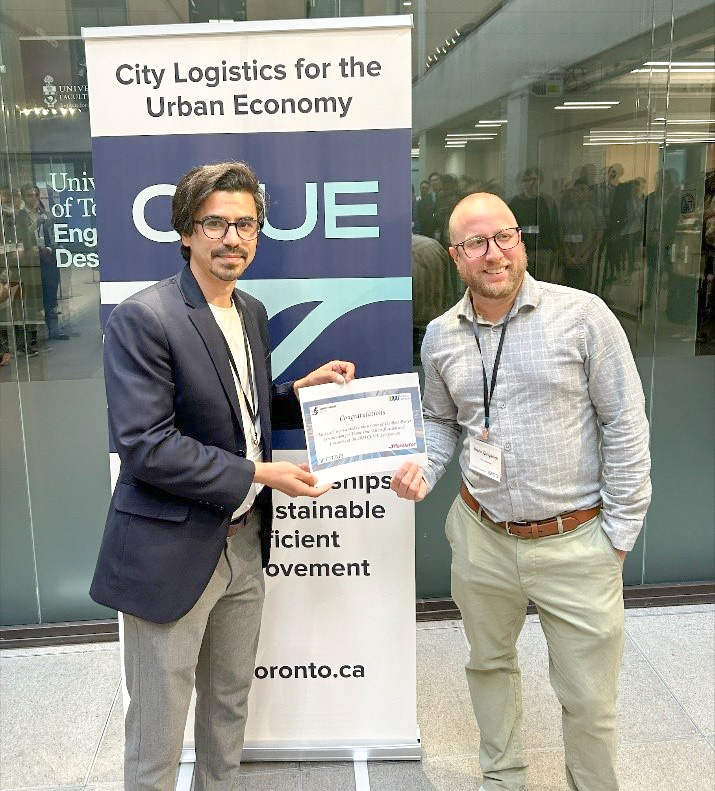
Alsaleh received the Best Poster Presentation award for his simulation model research at the University of Toronto’s City of Logistics for the Urban Economy (CLUE) conference.
Seeing the big picture
The team’s SCEV-Sim revealed surprising insights into the environmental impact of the EV lifecycle. “The supply chain’s contribution to pre-operation emissions has long been underestimated, “said Alsaleh. “Our findings prove that the average supply chain emissions are as high as 25% of the total emissions from the mining of all minerals required for battery production.” The research also highlights that the geographical distribution of facilities in the supply chain can greatly impact emissions. With critical reliance on a few key regions and industrial actors, the simulator unveiled how fragile the global supply chain currently is. In response to the data, Alsaleh believes there are opportunities to make optimizations and create a more sustainable supply chain that reduces emissions throughout the lifecycle.
“In some instances, by reconfiguring some of the resourcing and manufacturing options, we can reduce up to 80% of this vulnerability and the emissions for a specific region.”
Alsaleh’s simulation work has been awarded widely by the research community, including being recognized for Best Paper by the Transportation Research Board Air Quality and GHG Mitigation Committee, a division of the National Academies of Sciences, Engineering, and Medicine, among many other national awards. He plans to build on this momentum as a PhD scholarship awardee and member of TMU’s Bridging Divides Program, where he is extending the sustainability analysis to individual mobility behaviour of newcomers.
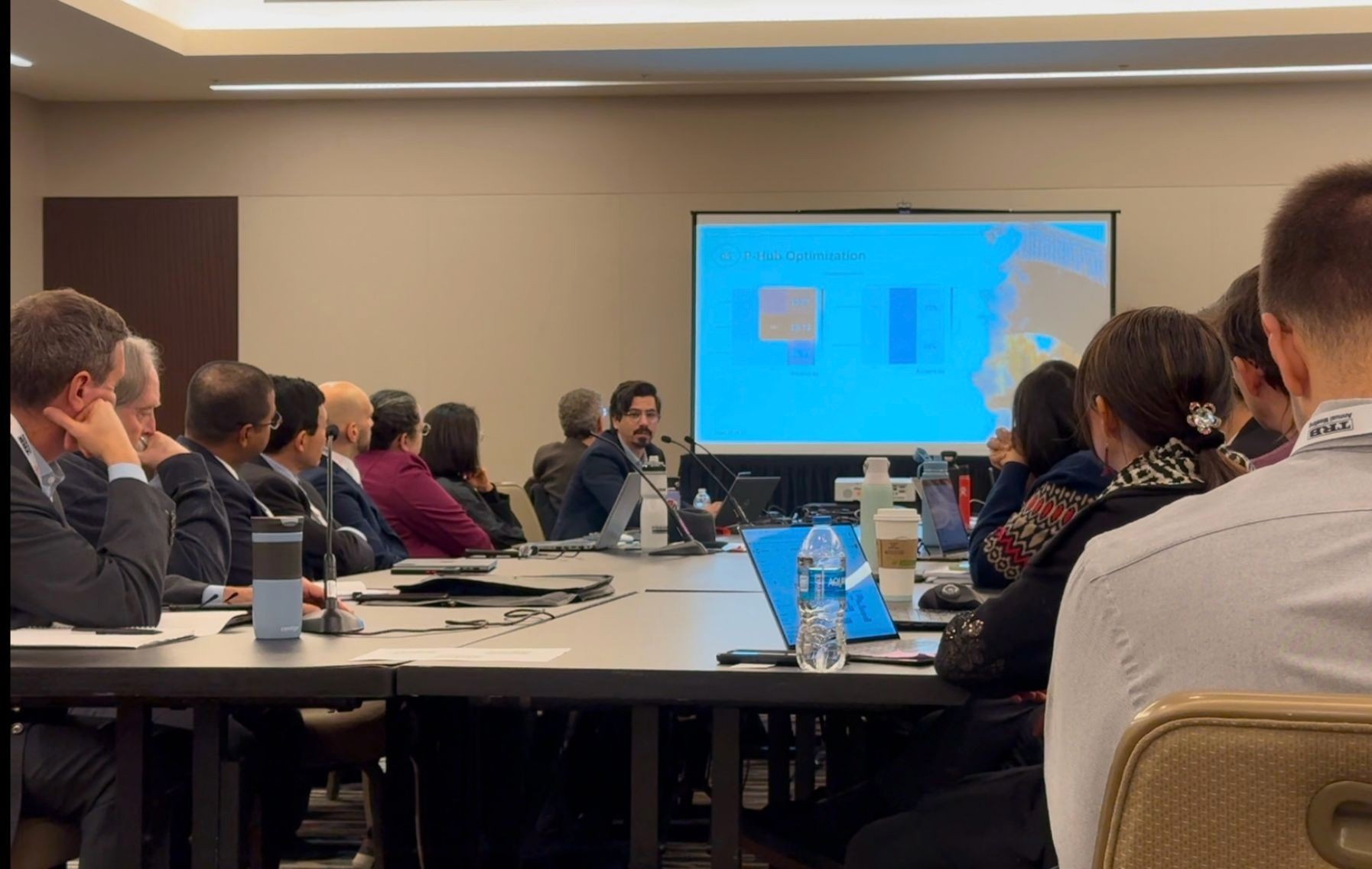
Alsaleh was recognized for Best Paper by the Air Quality and GHG Mitigation Committee at Transportation Research Board Annual Meeting in Washington, D.C.