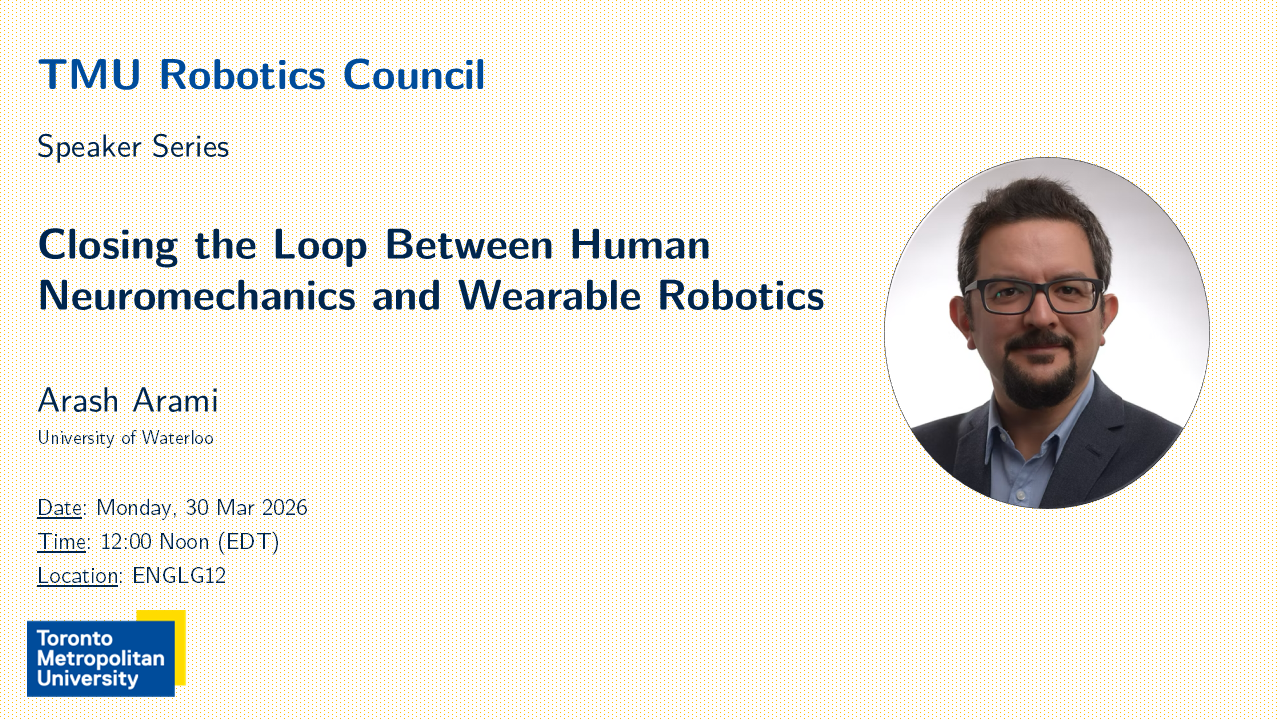
"Closing the Loop Between Human Neuromechanics and Wearable Robotics" seminar by Arash Arami
- Date
- March 30, 2026
- Time
- 12:00 p.m. - 1:00 p.m. ET
- Location
- 245 Church Street, George Vari Engineering & Computing Centre (ENG) / Room: ENG LG12
- Open To
- All TMU students and faculty
- Contact
- Mohamad Shahab mshahab@torontomu.ca Farrokh Janabi-Sharifi fsharifi@torontomu.ca
The TMU Robotics Council invites you to the following seminar as part of its speaker series:
"Closing the Loop Between Human Neuromechanics and Wearable Robotics" featuring speaker professor Arash Arami from the University of Waterloo.
Abstract

Understanding and assisting human movement requires bridging neuroscience, biomechanics, and robotics. In this talk, attendees will gain insight into computational neuromechanics and its applications to the analysis, prediction, and control of human locomotion.
Drawing on his team’s research and experiences, professor Arash Arami will cover key topics that include:
- Approaches for modeling the principles governing human movement, including inverse optimal control frameworks for identifying the objectives underlying human gait
- Neuromechanical modeling approaches aimed at characterizing movement stability, including models of joint mechanical impedance. This includes pathological dysregulation of neuromechanics, such as spasticity, and approaches for modeling it.
- Control strategies for lower-limb exoskeletons, which aim to dynamically balance assistance, user engagement, and stability during locomotion
- The concept of the Interaction Portrait, a framework for characterizing and visualizing the dynamics of human–robot interaction during assisted movement
- Predicting freezing of gait in Parkinson’s disease, with discussion on how computational models and machine learning can help anticipate pathological movement behaviors to possibly trigger robotic assistance
About the speaker
Arash Arami received his Ph.D. in electrical engineering from Ecole Polytechnique Fédérale de Lausanne (EPFL), Switzerland, in 2014. Following a Postdoctoral fellowship at EPFL (2014-2015) and a Research Associate position in the Human Robotics Group at Imperial College London (2015 to 2017), he joined the University of Waterloo in December 2017, where he is currently an Associate Professor of robotics and Director of the Neuromechanics and Assistive Robotics Laboratory (Arami Lab). He is a member of Waterloo Institute for Artificial Intelligence, Waterloo Robohub, and an affiliated scientist at KITE institute (Toronto Rehabilitation Institute). His research interests include human movement neuroscience, human-robot interaction, and motor neurorehabilitation. Dr. Arami’s research has contributed to the development of musculoskeletal predictive simulations, neuromechanical modeling of movement control, wearable and implantable sensors and cooperative control of lower limb exoskeletons for individuals with neurological conditions like incomplete spinal cord injury.
Email: arash.arami@uwaterloo.ca
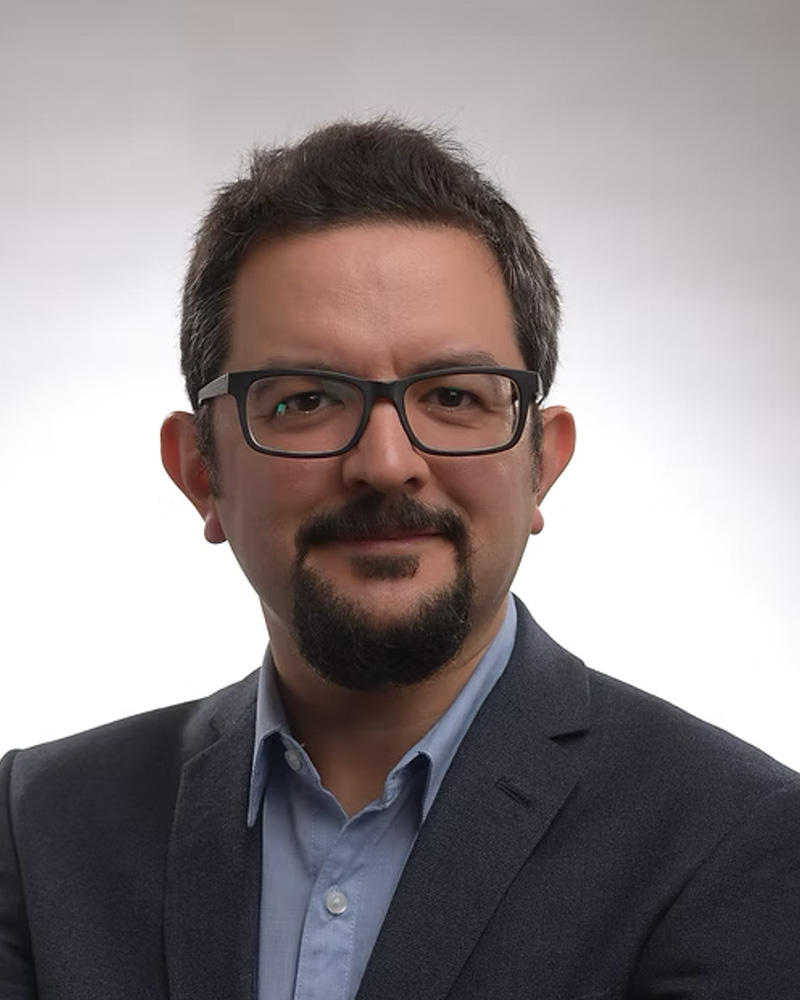
Prof. Arash Arami, University of Waterloo