Architectural Science - BArchSc (Hons)
Full-time formats:
• 4 Year
• 5-Year Co-op
Part-time format:
N/A
Requirements:
Grades-Plus
Grade range:
90%+
Faculty:
Faculty of Engineering and Architectural Science
Experiential learning:
Co-op available

Is this degree for you?
Design visionary environments that help both people and our planet thrive in the Architectural Science degree program at Toronto Metropolitan University (TMU). As a student in Canada’s only school that connects architecture, building science and project management, you’ll learn to solve problems through design and building expertise.
Your education will come to life through interactive design studios and collaborative projects led by expert faculty. You’ll gain direct experience using a variety of technologies and modelling techniques to create high-performing spaces. You’ll also collaborate on real-world projects and discover how to leverage creativity to make a positive impact.
Concentrations:
- Architecture
- Building Science
- Project Management
Accreditation:
- The Canadian Architectural Certification Board (CACB). The BArchSc (Hons) is recognized by CACB as a pre-professional program. When combined with our professional Master of Architecture, it forms a program of study that is CACB-accredited.
The following is a preview of first-year courses based on the available current academic Undergraduate Calendar for this program.
2nd Semester
Career possibilities
- Architect
- Building scientist
- Construction project manager
- Policy advocate
- Researcher
Employer possibilities
- Architecture49
- Bjarke Ingels Group (BIG)
- Diamond Schmitt Architects
- Gow Hastings Architects
- Waterfront Toronto
Further education
- Architecture (MArch)
- Building Science (MASc, MBSc)
- Project Management in the Built Environment (MPM, MASc)
- Any graduate degree involving the built environment
Sign up for emails
Get updates on programs, events and applying, plus the real story on TMU life straight from our students!
Explore the world and big ideas
Expand your perspective through local and international field trips, summer studies abroad and international exchanges.
Career-integrated co-op and internship program
Combine your academic studies with up to 16 months of paid work experience.
Get involved
Student organizations, design teams and competitions create meaningful connections with alumni and industry.
This is a Grades-Plus program. Admission decisions for Grades-Plus programs are based on academic performance plus non-academic criteria such as interviews, auditions, essays and portfolios. Your ability to follow and adhere to the requirements is part of the assessment of your application.
Academic requirements for full-time, 4-year program
To be considered for admission, Ontario high school students must meet the following requirements:
- Completion of the Ontario Secondary School Diploma (OSSD)
- Completion of 6 Grade 12 U or M courses with a minimum overall average of 70%
- Completion of the following required Grade 12 U courses (minimum grade of 70% in each):
- English/anglais (ENG4U/EAE4U preferred)
- Physics (SPH4U)
- Mathematics [one of Calculus and Vectors (MCV4U) or Advanced Functions (MHF4U)]
An overall average of 70% is required for consideration. Due to competition, the average needed for admission can fluctuate each year (it depends on the number of applications received and the number of spaces available). The grade range at the top of this page represents the average required in previous years.
Academic admission requirements for all other applicants are available on the admission requirements page. If you haven’t been educated in Ontario, you may be considered with the equivalent of the Ontario requirements. TMU reserves the right to determine equivalency at its sole discretion.
Non-academic requirements
Fall 2027 non-academic requirement due date:
February 1, 2027 or 10 business days from your application submission date, whichever comes later.
What to include in your portfolio:
1) Creative pieces
Between 12 and 14 examples of your own creative work that highlights and demonstrates the range and variety of your creative interests and abilities through different media. Please carefully select and format your work to show it in the best way possible. For three-dimensional work, include several photographs to show the work from different angles. The assessment committee is not keen to see architectural scaled plans and detailed drawings, etc. These should at most form only a small part of the portfolio. You should focus on showing your creativity in other ways. For each piece, please include the title, the medium/media, the date executed, the size of the original piece and a one-line description. Images of your creative process, in addition to the final work, are required.
2) Home exercise
Section Sensation
An architectural section is a magical thing! It reveals hidden (and sometimes surprising) spaces, layers, materials and relationships. We cut sections everyday — think of cutting a sandwich in half, or an orange, or an onion. Depending on what is cut, a section might show a large void in the middle, like a kettle, or a solid core, as in an avocado, or the intricate inner workings and interrelations of parts, like a typewriter, power tool or tree.
Exercise:
Choose an object and draw its section. Document this exercise with 3 images:
- The section drawing itself
- A photograph of the object
- A third image that you create adding context to the work
- Document your process, showing a series of sketches and developmental imagery
Things to consider:
- The object should not be a building, but rather something that you can easily access and spend time understanding through drawing.
- You do not need to actually cut the object in half, but rather imagine its section through careful observation.
- Each image should be made with care and creativity. The artistic medium is up to you.
- Other things you may consider: intricacy, scale, orientation, materiality, texture, relations of solid to void, light and shadow, inside and outside, context and purpose, relationships to the ground or surface supporting the object, and the elements of surprise, delight, and detail.
3) Writing sample
Write a short statement (up to 150 words) that describes:
- The object you chose for the home exercise, and why.
- What the section reveals.
- Your intentions in creating the third image, which may suggest larger interests about architecture.
We're looking for thoughtful and clear reflections on the work presented.
Compiling your portfolio:
The entirety of your portfolio should be submitted as one .pdf file. Please ensure you upload your portfolio contents correctly and completely, as multiple submissions won't be considered.
Please include the home exercise in your portfolio, clearly labelled HOME EXERCISE. The writing sample should be an additional page at the end of these images. You may use several pages to show your images. The home exercise/photos and writing sample don't count as part of the 12 to 14 projects in your portfolio.
Please do not include your name within your portfolio, on the cover or on any individual component. Do not submit a resume/CV. Please submit only the required portfolio pieces. You must include your TMU Student Number in the portfolio.
Applicants are reminded that non-academic work may be assessed by the selection committee prior to TMU receiving your interim or final grades. Regardless of how your non-academic work is evaluated by the selection committee, TMU’s academic admission standards will be maintained and will ultimately determine your admission into our program. The selection committee’s evaluation of non-academic work is final. Due to the volume of applications, re-evaluation/re-assessment of the non-academic work isn't possible.
The non-academic requirements assessment fee is $50 CAD and must be paid in order for your submission to be reviewed. Here’s how to pay:
-
Access your ChooseTMU Applicant Portal account (instructions to access the portal can be found below under Submission Instructions).
-
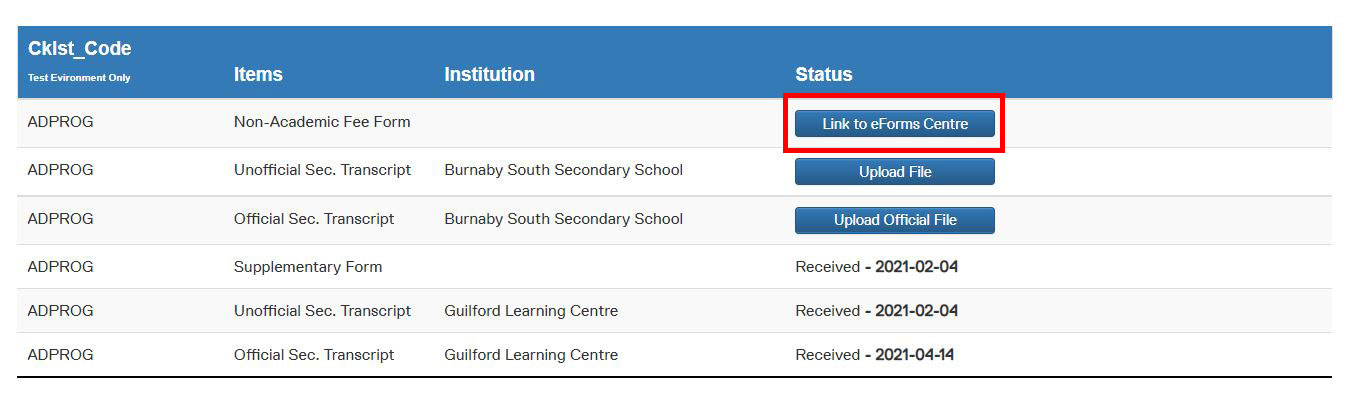
Click on the button to link to the eForms Centre.
-
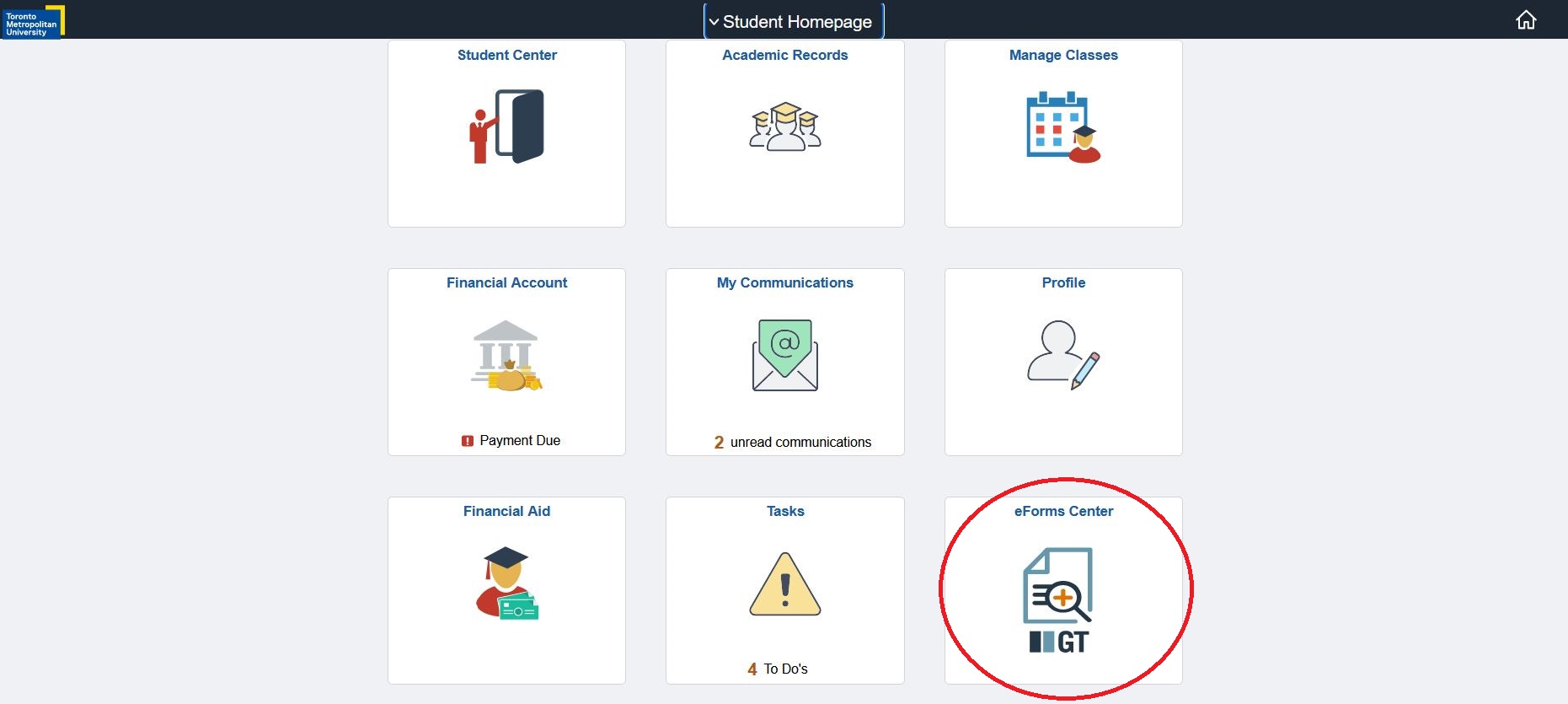
Next, click on the eForms Center tile.
-
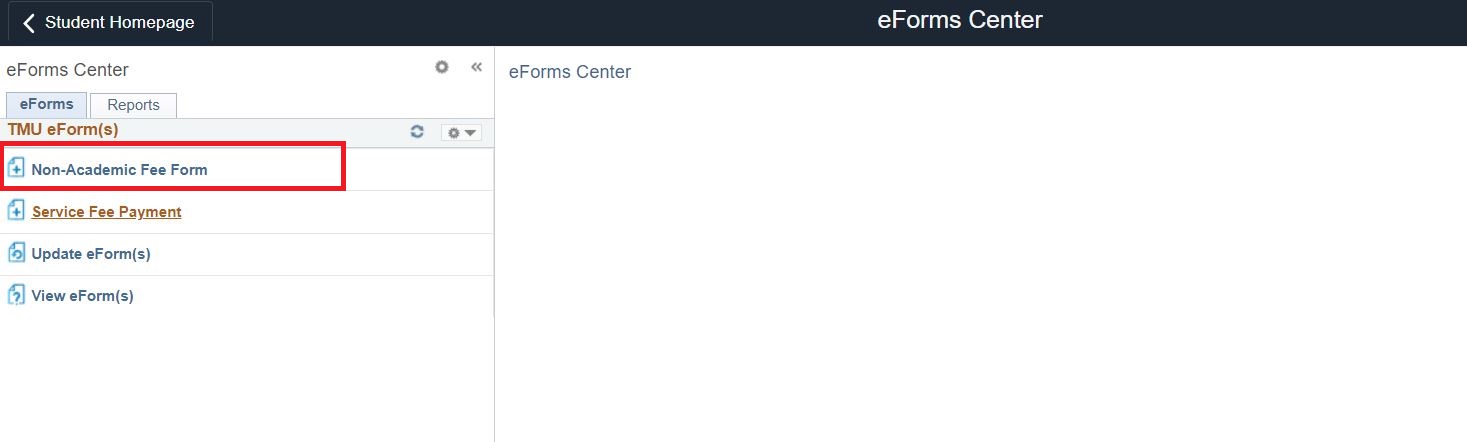
Then click on the Non-Academic Fee Form link.
You're required to submit all components of your non-academic requirements via the ChooseTMU Applicant Portal. Due to the volume of applications received and our system performance, we strongly encourage you to submit your documents well in advance of the noted deadlines.
Here’s how to access your ChooseTMU Applicant Portal account:
- Get your TMU Student Number in the email acknowledgement of your application
- Activate your TMU Online Identity. Fill in the Activation Form on the Accounts website. When asked for your Student/Applicant ID, enter your 9-digit TMU Student Number. Keep a record of your user name and password
- 24 hours after activating your TMU Online Identity, visit the ChooseTMU Applicant Portal
If you're applying for readmission or reinstatement, you're not required to submit non-academic requirements.
You must inform the program department of your intentions by February 1, 2027, or 10 business days from your application submission date (whichever comes later).
Tuition and fees range 2026-2027
For detailed fees info, visit tuition and fees by program and costs to expect.
Full-time format:
Ontario: $10,960 - $11,571
Out-of-province: $13,773 - $14,572
International: $44,375 - $44,675

Over $20M across all levels of study
We award more than $20M in awards, scholarships and bursaries throughout all years of study.
Find scholarships for you.
Explore financial assistance
Learn more about government financial aid programs like OSAP, out-of-province student loans and U.S. student loans.
Apply for financial assistance.
“One of the most valuable things I’m walking away with from Architectural Science is leadership and community. My unique experiences in student groups, joining design builds, writing research papers and participating in co-op are examples of how program opportunities are not only teaching moments for students but chances to engage and make an impact within the department as well as in the industry at large.”
- Saroash Haider, Architectural Science, Class of 2024
TMU’s Faculty of Engineering and Architectural Science (FEAS), is leading the way in experiential and immersive learning. Through extensive co-op and internship programs, research initiatives, co-curricular activities and targeted experiences designed in partnership with industry leaders, every student has the opportunity to grow both personally and professionally. When you join one of our 11 undergraduate degree programs, you join a supportive and inclusive community that works and innovates together to tackle local and global challenges.
Faculty of Engineering and Architectural Science degree programs
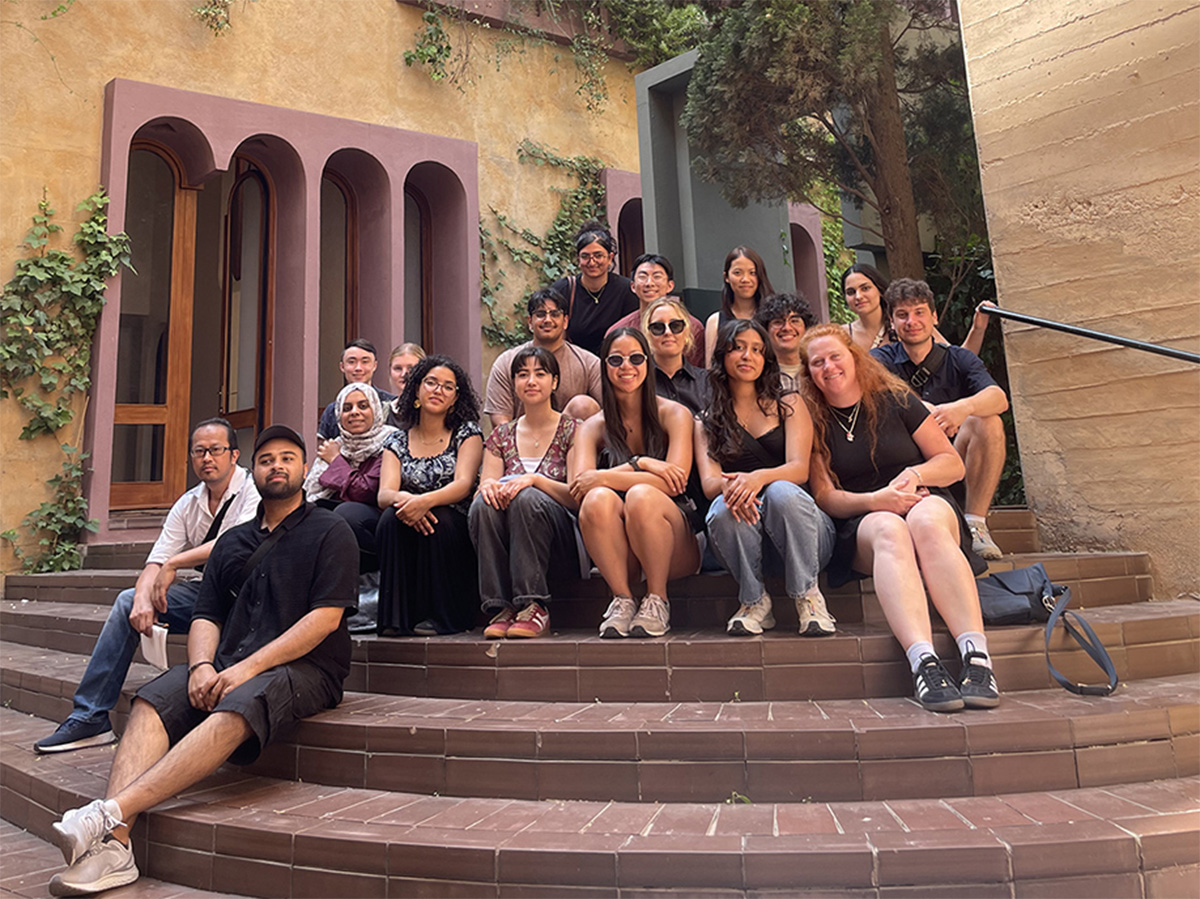
Undergraduate students travel to Spain for Studio Abroad
As part of their fourth-year design studio, a group of undergraduate architectural science students spent a few weeks in Barcelona. The students focused on investigating the city as a museum, and the museum as a city.
Read more: Barcelona Studio 2025


Your next steps
Disclaimer:
While every effort is made to ensure accuracy on this site, in the event of a discrepancy, TMU's current Undergraduate Calendar is the official reference.