Rethinking sustainable mobility beyond the drive for electrification
Sustainable transportation is often associated with one solution: replacing conventional vehicles with electric ones. But this view is increasingly seen as too narrow for our complex world. Researchers are looking beyond the vehicles themselves to understand how people travel, why they make certain transportation choices, and how different experiences shape the way people move through a city.
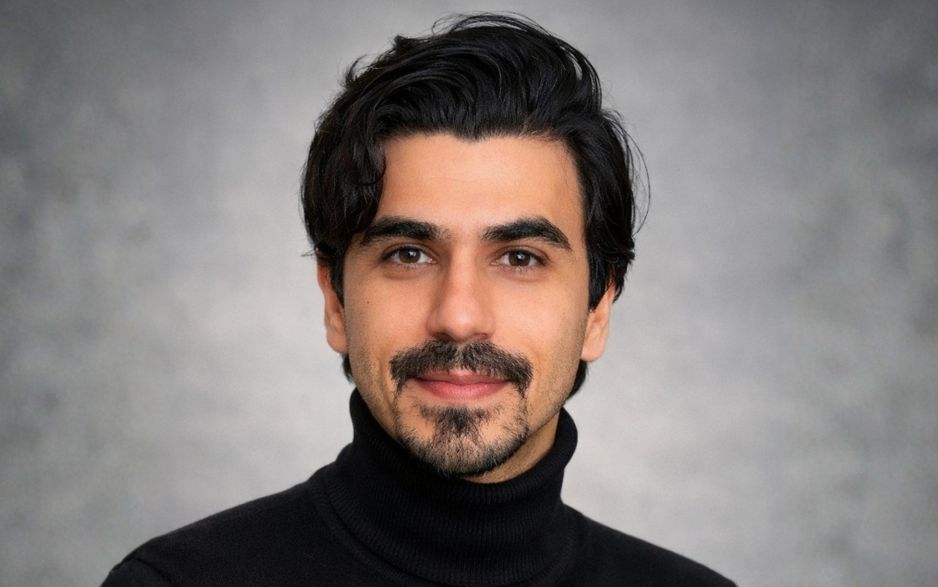
Tareq Alsaleh, a Toronto Metropolitan University (TMU) and Bridging Divides Graduate Student Stipend alumnus, explored these questions in his doctoral research in Civil Engineering, defended earlier this year. Bringing together engineering, transportation modelling, and migration studies, his work examines sustainable mobility with particular attention to the experiences of newcomers to Canada.
His research has earned him two major distinctions: the 2026 Governor General’s Gold Medal and the C. Ravi Ravindran Outstanding Doctoral Dissertation Award.
We spoke with Tareq about his research, the importance of looking beyond conventional approaches to transportation planning, and how his experience with Bridging Divides shaped his work.
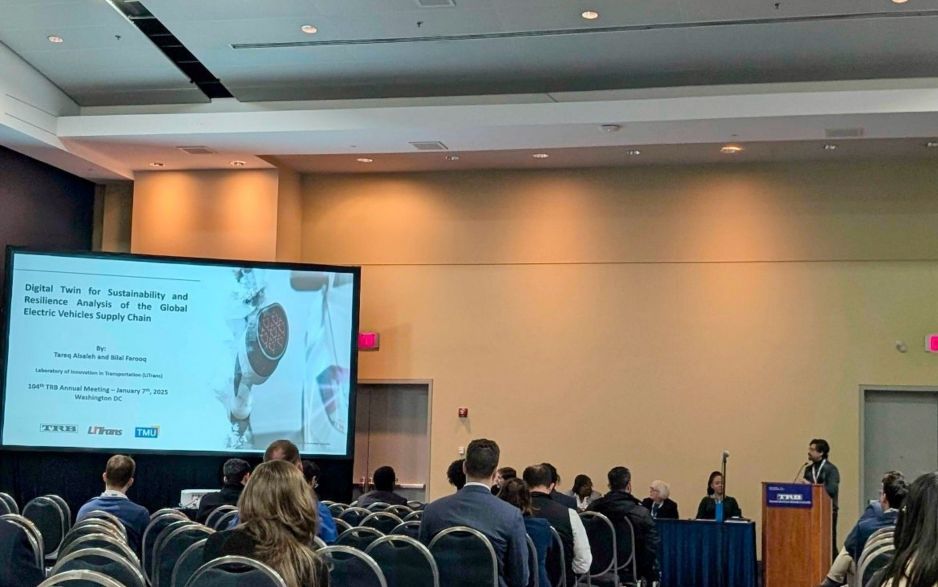
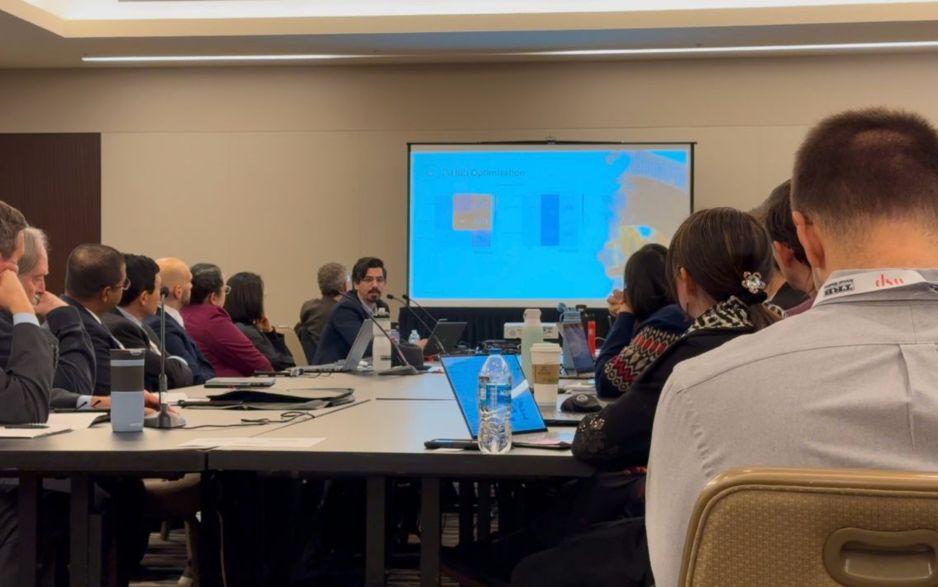
During his graduate studies, Alsaleh presented on his research at a number of conferences and other events.
Q: Your doctoral research brings together several different fields. How would you explain its central idea to someone unfamiliar with the topic?
TA: Well, to begin, I think it is quite an unconventional thesis because it does not follow one single storyline. I was trying to address a very complex problem: how to make the transition to more sustainable mobility. My research explored two pathways. The first was a more “common” pathway: vehicle electrification – turning a lot of the vehicles on the road into electric ones – looking at specific challenges related to production, manufacturing, and market configuration.
The second pathway recognized that electrification alone would not be enough. We also need behavioural change among commuters, encouraging a shift away from private vehicles towards public and active transportation. This part of my research focused on modelling travel behaviour, and that's where I touched on the migration component. People bring perceptions and habits from their home countries that can influence how they travel, yet conventional models rarely account for these differences.
In the end, the two pathways came together. For example, if our travel behaviour models show that more people are likely to shift to transit, walking, or cycling, fewer will buy cars, electric or otherwise. Feeding those forecasts into the electrification models gives a more realistic picture of future electric vehicle demand, which in turn helps determine where production and manufacturing hubs should be located and how large they should be.

Q: Why isn't switching to electric vehicles enough to make transportation sustainable?
TA: Electrification is important, but there are limitations to relying on it alone. Electric vehicles are not necessarily sustainable in every context. It depends, among other things, on how the electricity used to charge them is generated, how vehicles are manufactured, and how quickly we can transition the existing fleet, including trucks and buses.
There is also a more fundamental question: sustainability is not just about emissions. It is also about convenience, accessibility, walkability, and travel time.
Imagine replacing every conventional car with an electric vehicle. We might reduce emissions, but we would not necessarily reduce congestion. People could still spend two, three, four hours travelling relatively short distances, particularly in downtown areas.
Changing how people travel is just as important as changing the vehicles they use. To encourage that change, we first need to understand how those transportation decisions are made.
Q: Your research also examines the experiences of migrants. Did your own experience as an international student influence this direction?
TA: Very much so. I came to Canada as an international student, and I was surrounded by a large international community at TMU. Before starting my PhD, I also worked in international development, lived and worked in several countries, and travelled to more than 40 countries.
These experiences made me aware of how differently people perceive and experience transportation. For example, imagine someone arriving in Toronto from a place where using public transportation carries a certain social stigma. They might not immediately feel comfortable using public transit, even if the service is objectively good. Similarly, if someone has experienced safety concerns associated with particular forms of transportation, those perceptions can stay with them when they move somewhere new.
So we tend to assume that people make transportation choices by objectively evaluating the options available to them, but decisions are also shaped by previous experiences, cultural perceptions, and personal circumstances. These do not disappear when someone moves to a new country, and the process of adapting is different for everyone.
Q: How did you account for those differences in your research?
TA: We wanted to move away from the assumption that integration happens according to a fixed timeline. Conventional approaches might assume that someone's behaviour changes after six months, one year, or two years in a new country. But someone could live in Canada for 15 years and have a very different experience of integration from someone who arrived two years ago.
We introduced a migration integration index to measure different dimensions of integration, including economic, financial, cultural, health, and civic integration. We then examined how integration relates to changes in transportation behaviour.
We also compared migrants with Canadian-born individuals who had similar characteristics, such as education, income, and residential location. This allowed us to look more closely at differences associated with migration experiences and develop a more nuanced understanding of how people adapt to transportation systems over time.
Q: How did being part of Bridging Divides influence your approach to research?
TA: It was an enormously eye-opening experience. I come from a very technical background, and initially I approached the migration component primarily through mathematical modelling.
Being part of Bridging Divides exposed me to research questions and perspectives I had not previously considered. I attended sessions where researchers presented work on completely different topics, and I began to see connections between their research and my own. In fact, the idea of developing an integration index was partly inspired by one of those sessions.
Interestingly, I only became involved with Bridging Divides during the final year of my PhD. The migration component was not part of my original research plan. It emerged as I started thinking about how to make my behavioural prediction models more inclusive and representative.
That interdisciplinary exchange encouraged me to look beyond the technical dimensions of the problem and consider the broader social factors influencing the models we develop.
Being part of Bridging Divides made me more aware of how understanding migrants’ experiences could actually impact the way that we make predictions and plan infrastructure and public services – I wanted that to be part of the models that we were developing.
Q: What is one thing you hope policymakers and infrastructure planners take away from your research?
TA: I think the most important message is that inclusivity is not simply something we do to be considerate. It actually improves the quality of our work, because it makes our models closer to the truth.
Inclusivity is not just a nice thing to do. It is part of doing your work diligently.
Accounting for different experiences and using data that captures those differences is necessary to improve accessibility, service uptake, and overall performance.
For cities such as Toronto and Montreal, where migrants represent a significant proportion of the population, ignoring their experiences means overlooking an important part of how people actually move around the city.
Q: You've now received two major awards for your doctoral work. What does this recognition mean to you?
TA: I feel very surprised, honoured, humbled, and grateful. I am particularly grateful to TMU, my department, Bridging Divides, and, above all, to Canada. I arrived as an international student and received such a warm welcome throughout my four years of study. I never felt like a stranger.
It is wonderful to see work that required so much effort recognized at this level. It also means a great deal to my supervisor, Prof. Bilal Farooq, who was an important part of this journey.
Complex challenges rarely have one solution or one dimension. This is especially true in applied research and practical implementation, where we need different disciplines and perspectives working together. Bridging Divides provides an opportunity to engage with people working on different problems and discover how their work connects to yours.
Q: What's next? Are you still finding ways to connect your research with your professional work?
TA: I currently work as a Team Lead Consultant with Accenture UK, within its infrastructure and capital projects team. My work focuses on the development and management of large infrastructure projects, as well as digital transformation and the integration of AI into infrastructure management.
I am also continuing to collaborate with Prof. Farooq, my former supervisor. We are building on some of the research and data we developed around migrant experiences, including preparing additional experiments looking at safety-related aspects for migrants.
Although my professional role has shifted more towards infrastructure delivery, I expect to remain involved in research. I still follow Bridging Divides’ newsletters (external link) , and I would love to stay connected and contribute to the community in the future.
My involvement with Bridging Divides certainly left a lasting impression on me. Looking ahead, I hope to stay connected with the program and continue collaborating on research related to migrant data and transportation safety.