Scaling Solutions for Climate
To mark Toronto Climate Week 2026 from June 1-7, we'll be hosting an event series designed to prepare Torontonians at all career stages for the climate revolution.
Let's build solutions that scale.
Perspectives on Sustainable Innovation: Panel + Q&A
SLC Sandbox, 341 Yonge Street • Tuesday, June 2nd, 9:30 AM
The future of Canada’s built environment is no longer just a question of infrastructure, but a momentous challenge defined by rapid, cross-disciplinary innovation. This panel brings together a high-impact group made up of startup founders, academics, and urban planning experts to explore how we can accelerate Canada’s transition to a sustainable future.
Themes will include:
- Bridging education and industry: is the current academic landscape successfully cultivating the specialized talent and "green-collar" skills necessary to fuel Canada’s net-zero ambitions?
- The role of SMEs: SMEs are uniquely positioned to serve as the primary engines of climate agility. While large-scale policy sets the stage, it is often the founders and boutique innovators who pilot the disruptive technologies that redefine what is possible in construction.
- The evolving DNA of Canadian developments: Examining the "next generation" of building needs, from circular economy principles to resilient urban design.
Light snacks and coffee will be provided.
Panelists
- Chloe Doesburg, Seafoam Materials (external link)
- Dr. Dorothy Johns, Toronto Metropolitan University
- Stefan Novakovic, Expo Magazine (external link)
- Alexandre 'Lexi' Parrott-Mautner, Ryzome Environmental (external link)
- Emma Verbisky, Weston Consulting (external link)

| Agenda | |
| 9:30 - 10:00 AM | Doors open, networking |
| 10:00 AM - 11:00 AM | Panel & Keynote |
| 11:00 AM - 11:30 AM | Networking, End of Event |
Caffeinated Networkers + Final Case Competition Pitches
SLC Sandbox, 341 Yonge Street • Friday, June 5th, 9:30 AM
Join us for an insightful morning of community connection and climate innovation. This event combines the SVZ's signature conversation series, Caffeinated Innovators, with the grand finale of the Scaling Solutions for Climate competition.
Part 1: Caffeinated Networkers (9:30 – 10:30 AM)
We’re bringing the collaborative spirit of Caffeinated Innovators to a special networking session. Connect with founders, students, and social impact leaders over fresh coffee and treats. Whether you're looking for a co-founder or just a fresh perspective, this is the place to build your network.
Part 2: Final Pitches (10:30 AM – 12:00 PM)
The stakes are high as TMU student finalists pitch their solutions for Seafoam Materials. Watch as teams present their strategies for circular economy supply chains and sustainable building transitions, competing for $2,500 in prizes before a panel of expert judges.
Why join us?
- Network: Meet the city’s brightest social entrepreneurs.
- Inspire: See how student innovation is solving real-world climate challenges.
- Impact: Celebrate the culmination of Toronto Climate Week at the SVZ.

This Toronto Climate Week, we’ll be hosting a Case Competition powered by KPMB Architects for TMU students focused on bridging the gap between youth innovation and the future of sustainable building.
Along with our partner Seafoam Materials, we’re asking a range of TMU students to address a key question in the sustainable building transition, vying for $2500 in prizes.
A Preview of the Challenge
Seafoam’s business model depends on accessing inputs other industries treat as low-value waste. That model works today, but the seaweed industry in North America is underdeveloped, the forestry sector is in transition, and Canada’s circular economy is maturing. The supply chain Seafoam needs doesn’t fully exist yet.
At the same time, their secondary inputs — cardboard, wood fibre, and agricultural straw — are available in more locations across Canada, and point toward a product that could be manufactured closer to where Canada is building. Seafoam Materials sits at the centre of a supply chain loop that needs to grow, and may be one of the companies that could help grow it.
The full case ask, supporting exhibits, and judging rubric will be released to registered teams on May 13.
The Company
Seafoam Materials is a Vancouver-based climate tech startup developing building insulation from seaweed and upcycled waste. Their product is a drop-in replacement for conventional insulation: non-toxic, fire-resistant, fully compostable at end-of-life, and designed to store carbon inside buildings for the life of the structure.
The headline claim: Seafoam’s insulation can reduce a home’s upfront embodied carbon by up to 20% achieved by storing more biogenic carbon in the material than is emitted during its low-energy manufacture. The carbon stays locked in the building for the life of the structure.
| What goes into Seafoam Materials Insulation | |
|---|---|
| Brown Seaweed | Acts as a binder; contributes fire and rot resistance. |
| Waste cardboard fibre | Upcycled from post-consumer streams. |
| Waste wood fibre | Sourced from sawmill and forestry byproducts. |
| Agricultural fibre (straw etc.) | Under active experimentation as a fourth input. |
In teams of 3-5, students will come up with and present an innovative solution to a defined Case Study within the sustainable building industry. While this industry is the focus of the topic, successful solutions will need to be well-rounded and multi-pronged, meaning that students from all fields will have something to offer.

- A shot at $2500 in prizes.
- Hands-on experience with a live, unresolved problem at a climate tech startup.
- The opportunity to build and lead a cross-disciplinary team.
- Direct exposure to climate tech investors, practitioners, and policymakers through the Toronto Climate Week keynote and panel on June 2.
- A competitive credential that belongs on a resume and in an interview.
This program is open to any student who is enrolled at Toronto Metropolitan University, with an estimated graduation date of 2026 or beyond. Priority will be given to students at the Graduate and PhD level, due to the advanced scope of the case, but we are open to receiving applications from engaged third and fourth year undergraduate students.
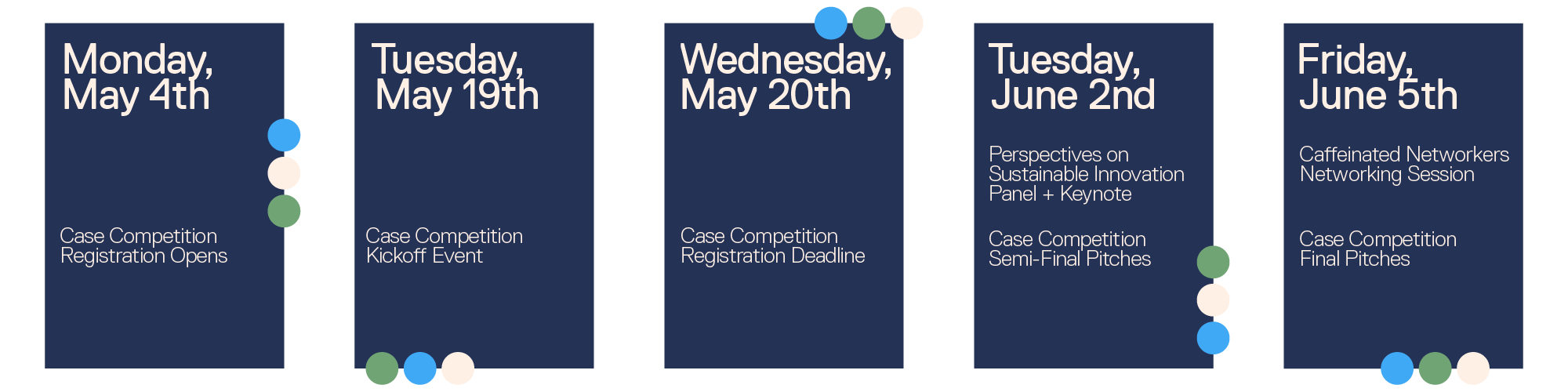
| Registration opens | Monday, May 4 |
| Full case package released | Wednesday, May 13 |
| Kick-off event | Tuesday, May 19 at 5 PM |
| Registration closes | Wednesday, May 20 at Midnight |
| Written brief due | Friday, May 22 at Midnight |
| Q&A period with Seafoam Materials | Monday, May 25 at 1 PM |
| Semi-Final Pitches | Tuesday, June 2 |
| Final Pitches | Friday, June 5 |
The winning pitch will recieve $1800 CAD, and the first runner up will recieve $700 CAD.
Toronto Climate Week is a citywide celebration backed by the City of Toronto that brings together communities, ideas, decision makers, and climate solutions. From grassroots changemakers to clean tech innovators, policy nerds to plant lovers - this week's got something for you. TOCW was born from a bold grassroots vision: to create a Canadian platform that unites climate action with culture, innovation, and community. Its mission is to position Toronto as a globally recognized hub for climate solutions.
Applications are now closed, but you are welcome to join us at either of our other two TOCW events!
The full case competition package will be sent to your email once your application is recieved.
Programming Schedule