Alistair Newton on the purpose of theatre, and maintaining creativity during the pandemic
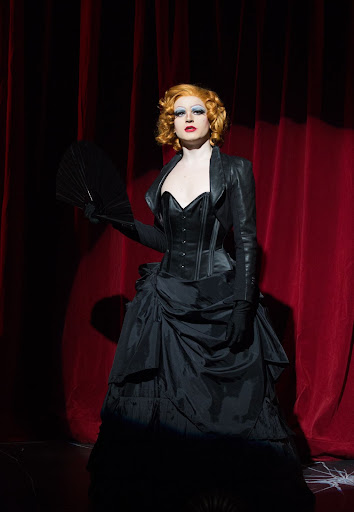
Jacob Fulton in The Picture of Dorian Gray (George Brown Theatre School, 2019), photo by Cylla von Tiedemann
Director and playwright Alistair Newton (he/him) moved to Toronto after graduating from the University of Victoria, and has been creating theatre here ever since. He ran his company, Ecce Homo, for ten years before moving into freelance work. “The work I was interested in doing wasn’t being done, so I had to generate it myself.”
Alisatir shares with a bright smile:
“I have my own aesthetic. [I call it] Alexander McQueen Elizabeth: if McQueen, with all his cultural commentary and social critique, and the way he used shape and silhouette, were to do a 1590s collection.”
Alistair has worked on every kind of theatrical production - from opera to musicals, new work to classical. He reflects that the purpose of theatre is to “speak to the current moment. It has to challenge, inform, and still entertain… there is a coming together, not just amongst the group of people making the show, but with the public. That’s what Ecce Homo was built on, a dialogue I was hoping to have with the public.” This dialogue continues in Alistair’s work as a freelance artist.
Over the past five years, Alistair has been focusing on “creating boutique productions of classical work, tailored to the needs of the ensemble and the programs” which he is working with - currently, the third year Acting class in the School of Performance, and their production of Edward II. “I’ll take a piece, find out who is in the ensemble and what the production needs are, and tailor an adaptation specifically for those individuals, to make a boutique experience for everyone.”
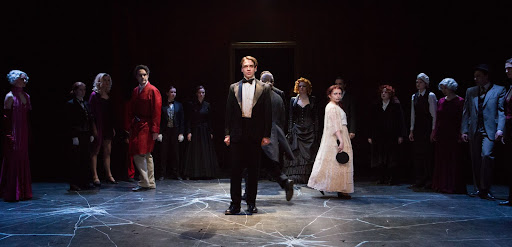
The ensemble of The Picture of Dorian Gray (George Brown Theatre School, 2019), photo by Cylla von Tiedemann.
Alistair’s adaptations explore gender, sexuality, and gender presentation in classical theatre. To make it specific to the group he is working with, he asks his ensemble whether they’re more interested in performing a character who shares their identity, or going against the gender they identify with. “I’m more interested in changing the gender of the character to match the gender of the performer.” Shifting the gender of the character creates an opportunity to “open up a whole other language inside the play.”
Another important part of Alistair’s philosophy as a director, is to “avoid a hierarchical vertical structure, with the playwright at the top,” followed by the director, actors, designers, and so on.
I’m really looking at a lateral hierarchy, where all of the different elements of production are equally important. I care as much about the visual storytelling of a show, as I do the sonic language, as I do the spoken text and the actors' performances. I’m trying to create a holistic theatre experience that combines art forms and tries to place everyone on a lateral playing field.
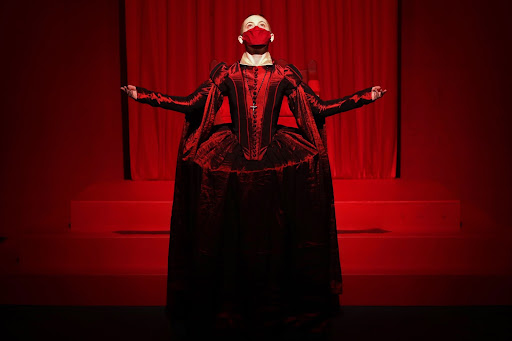
Molly Redden in Mary Stuart (Dalhousie University, 2021), photo by Nick Pearce.
Edward II will be Alistair’s fourth pandemic production, and he continues to find ways to spark creativity within the restrictions of COVID-19 - particularly, around space and staging. “I always used distance in my work as a way to compose stage pictures, but when you are obligated to distance by six feet all the time,” the way you play with space naturally needs to shift. When the closest you can get to your acting partner in the most intimate moments is six feet away, the distance you need during public moments grows exponentially.
Pandemic restrictions also create a challenge when it comes to handling props. Alistair uses a rehearsal example, where two actors on stage needed to exchange a dangerous letter. Alistair challenged the actors to address the weirdness of the situation, without letting it stop their creativity.
“Instead of handing it to the other character in a secret way, [the actor] chose to lay it on the empty throne and walk away. This meant the other actor had to run up and grab it and hide it, because the action of putting it on the throne is super transgressive.” The throne represents the monarch, whether or not she is present. In this example, the restriction presented by COVID-19 “becomes a storytelling device, and all of a sudden this helps the scene.”
You know, I always use Peter Jackson’s metaphor: the train is coming towards you, and you’re walking backwards, laying the tracks down. As long as you can walk backwards and lay down the tracks fast enough, there won’t be a train wreck.
There are always pivots in the performance industry. Part way through the run of Alistair’s King Lear in High Park, one of the actors had a medical emergency, and Alistair had to step into the role for a number of shows. “I never thought I was going to be in Elizabethan drag in my own show, but you know, those are the things that happen,” he said with a smile. Alistair has certainly laid the tracks of a pandemic production many times before, and his expertise, focus on collaboration, and boutique-adaptation-style, will surely make a positive experience for our third year actors.