Francis Duah
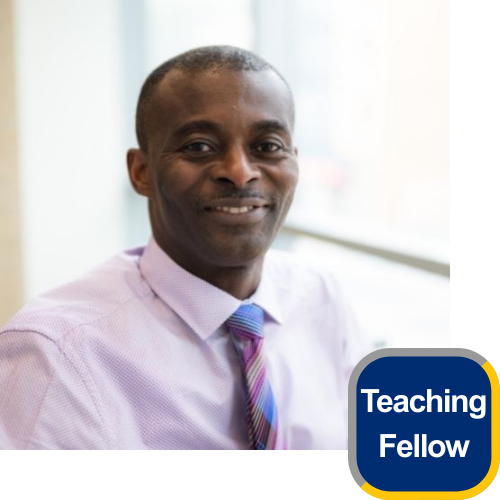
Dr. Duah joined the Mathematics Department in 2021 as an inaugural Assistant Professor in STEM Education Research. A Fellow of the UK Institute of Mathematics and Its Applications, Senior Fellow of the UK Higher Education Academy, and a BSc graduate from the London School of Economics, Dr. Duah is a mathematician with multiple identities and a multidisciplinary background. He received his PhD in Mathematics Education from the Mathematics Education Department, Loughborough University, UK and an MSc in Mathematics Education from the School of Education, University of Southampton, UK. He held positions in the UK as the Mathematics and Statistics Skills Centre Manager at the University of York and Senior Lecturer at the University of Chichester.
Dr. Duah’s research interests are in quantitative social and educational research, and computational social science. He currently researches learning and teaching of undergraduate mathematics, transitions in undergraduate mathematics, and widening participation in the mathematical sciences.
Faculty-student Partnership in Learning and Teaching Development: Creating, producing, and aligning learning outcomes with assessment tasks and learning activities
The advent of the faculty-student partnership movement (see for example, Cook-Sather et al. 2014) has shown that it is mutually beneficial for faculty and students to work together to explore issues of learning and teaching, and course design. The goal of such faculty-student partnership is often to enhance the student learning experience, improve achievement, and reduce student attrition.
During his tenure as a teaching fellow at the Centre of Excellence in Learning and Teaching, Dr. Duah will develop and research a model of faculty-student partnership in Learning and Teaching Development. The partnership will work to introduce learning outcomes for all topics taught in two Mathematics courses, and align these with learning activities and assessment tasks. He will research this intervention in order to understand its impact on the student learning experience and achievement on the courses. The findings and implications of this scholarship of learning and teaching project will not only be of interest to all who teach mathematics to specialist and non-specialist students, but also those who teach courses on other programmes.