Funding Opportunities
The EL Hub will be sure to keep this page updated as more details are provided. If you are interested in getting email updates or have questions about any funding opportunities, subscribe to our mailing list (external link) .
On this page
On this page, you will find internal and external funding opportunities relevant and available to the EL community at the University. Please contact us if you have any questions or know of additional funding opportunities to include on this page.
Co-Operative Education and Work-Integrated Learning (CEWIL) Canada (external link) announced the creation of its Innovation Hub (iHUB), funded in part by the Government of Canada’s Innovative Work-Integrated Learning Initiative (I-WIL).
The CEWIL iHUB operates as a centre of expertise that provides grant-based funding to enable and promote curricular work-integrated learning (WIL). WIL focuses on applied research/industry projects, entrepreneurial WIL, field placements, and service-learning WIL. The iHUB supports the advancement of and innovation in these forms of WIL, extends access to WIL and ensures WIL projects are delivered with appropriate quality and learning standards for students.
The EL Hub was pleased to deliver two short-term funding opportunities available to members of the TMU community for the 2025-26 academic year. Whether you're looking to integrate experiential learning into your course or develop dynamic simulations, we have resources to help your vision.
A funding opportunity to develop a custom live actor simulation for a course or training program, partnering with the LAS team to create an authentic, interactive learning experience to strengthen students' interpersonal and professional skills.
A funding opportunity to help instructors develop skills and resources needed to meaningfully integrate experiential learning (theory-practice connections) into their Winter 2026 courses.
Through the Student Work Placement Program (SWPP), employers can access wage subsidies to help hire post-secondary students across Canada for work-integrated learning (WIL) opportunities.
Funding available
- Up to $5,000 for every student you hire through the program
- Up to $7,000 for every student hired who is:
- in their first year of study, or
- from an under-represented group, including: women in STEM, persons with disabilities, newcomers, Indigenous students, and visible minorities
What counts as a placement?
Student work placement activities can include, but are not limited to:
- Co-op placements
- Internships
- Practicums
- Applied research projects
- Mentorship programs
How to apply
While post-secondary institutions cannot apply directly, employers can apply through SWPP’s network of 18 national funding recipients. These delivery partners work with colleges, universities, polytechnics, and CEGEPs to connect students and employers.
For a full list of funding recipients and details on how to apply, visit the official Government of Canada SWPP page (external link) .
The Provost’s Award for Teaching Excellence recognizes Toronto Metropolitan University educators or groups of educators with outstanding teaching records and who have made contributions to advancing teaching and learning at the university. Nominations should focus on i) innovation in teaching, ii) inclusive teaching, or iii) experiential teaching. Up to three awards will be given out annually.
Individual recipients receive a certificate of recognition and a one-time monetary award of $2,000 (subject to applicable deductions). Group recipients receive individual certificates and a total one-time financial award of $2,000 (subject to applicable deductions) to be shared equally among members.
Co-Operative Education and Work-Integrated Learning (CEWIL) Canada (external link) announced the creation of its Innovation Hub (iHUB), funded in part by the Government of Canada’s Innovative Work-Integrated Learning Initiative (I-WIL).
The CEWIL iHUB operates as a centre of expertise that provides grant-based funding to enable and promote curricular work-integrated learning (WIL). WIL focuses on applied research/industry projects, entrepreneurial WIL, field placements, and service-learning WIL. The iHUB supports the advancement of and innovation in these forms of WIL, extends access to WIL and ensures WIL projects are delivered with appropriate quality and learning standards for students.
CEWIL iHub Funding Recap
Since 2021, Toronto Metropolitan has received over to $1.7 million in funding for innovative work-integrated learning that values the student experience and direct compensation and financial support for students. Over 2000 students have directly benefited from the funding across 16 programs/areas.
These projects tackled social impact internships, PPE access during the pandemic, technology innovation, service-learning initiatives, putting accessibility into practice, and many more critical areas.
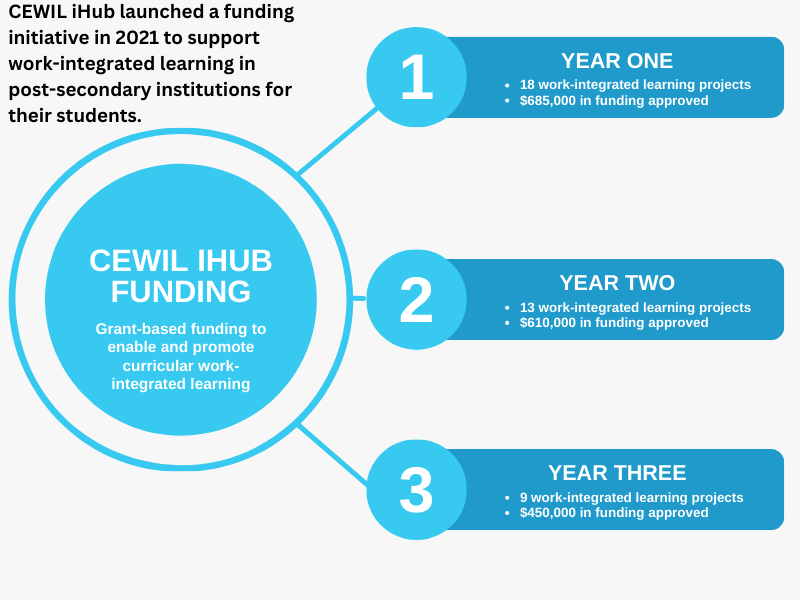
The EL Hub was happy to assist these fabulous projects by:
- Sharing the funding with our community,
- Attending CEWIL iHUB information sessions on behalf of Toronto Metropolitan and sharing knowledge with interested members of our community,
- Assisting applicants in writing robust applications,
- Liaising between internal Toronto Metropolitan groups to streamline internal processes for successful projects,
- Assisting project leads in completing their final reporting by ensuring leads have and understand all reporting requirements and;
- Liaising with CEWIL iHUB Canada to ensure that Toronto Metropolitan applicants are compliant and share knowledge.
It’s been amazing to see the CEWIL iHUB projects come to life due to this funding opportunity. We are happy to have played a part in bringing WIL experiences to the Toronto Metropolitan community.
The Pathways to Equity Bursary provides financial support to undergraduate students who face economic barriers when participating in unpaid Work-Integrated Learning (WIL) opportunities. This initiative ensures all students have equitable access to valuable experiential learning experiences, regardless of their financial circumstances.
Announced on December 11, 2020, the VLS is a historic $50 million investment by the Ontario Ministry of Colleges and Universities (MCU) intended to drive growth and advancement in virtual learning across the province’s post-secondary institutions. The strategy will expand the possibilities of traditional and life-long learning through the accelerated use of both online and hybrid learning.
The COVID-19 pandemic has had an unprecedented impact on Ontario’s postsecondary education sector as institutions rapidly transitioned to remote delivery. In close consultations with the postsecondary sector in summer 2020, the MCU heard the need for virtual learning supports to enable access to high-quality learning. These results informed the launch of the Virtual Learning Strategy.
Pathways to Equity: Work-Integrated Learning Bursary is a new initiative aimed at enhancing access to work-integrated learning (WIL) opportunities for Toronto Metropolitan University (TMU) undergraduate students from equity-deserving groups. Pathways to Equity (Domestic) (external link) (external link, opens in new window) was made possible through funding from CEWIL Canada's Innovation Hub (iHub), supported by the Government of Canada’s Innovative Work-Integrated Learning Initiative (I-WIL). Pathways to Equity (International) (external link) (external link, opens in new window) was made possible through support from the Office of the Provost & Vice-President Academic at TMU.
We are thrilled to announce that the bursary supported 177 students, with a total of $311,800 being distributed! Depending on financial need and the number of hours in their WIL opportunity, students received anywhere between $500 - $1800. These much-needed funds helped offset financial costs students incurred when completing their unpaid curricular WIL opportunities, including: travel, materials, supplies, memberships, lost/missed income, childcare, eldercare expenses, and more. Stay tuned for future offerings!
Aiming to strengthen Canada’s skills development and address critical knowledge gaps by testing and scaling promising solutions while mobilizing insights to improve skills policies and practices, Future Skills Centre is seeking partnerships to advance the next generation of solutions and insights for a strong and inclusive future of work. The Skills Horizon Calls for Proposals will offer funding to organizations nationwide, empowering projects that tackle Canada's most pressing skills and labour market challenges.
- The Skills Solutions call will fund projects focusing on solution design or advancing skills initiatives based on evidence of what has worked.
- The Skills Research call will explore critical knowledge gaps or emerging challenges shaping Canada’s labour market.
Through both open calls, project submissions can focus on research, solution development, or piloting new approaches related to their five focus areas (external link, opens in new window) : Pathways to Jobs, Tech & Automation, SME Adaptability, Inclusive Economy and Sustainable Jobs.
For more information, visit Skills Horizon Calls for Proposals (external link, opens in new window) .