FEAS and Schneider Electric partner to deliver sustainability curriculum through real-world, industry-mentored projects
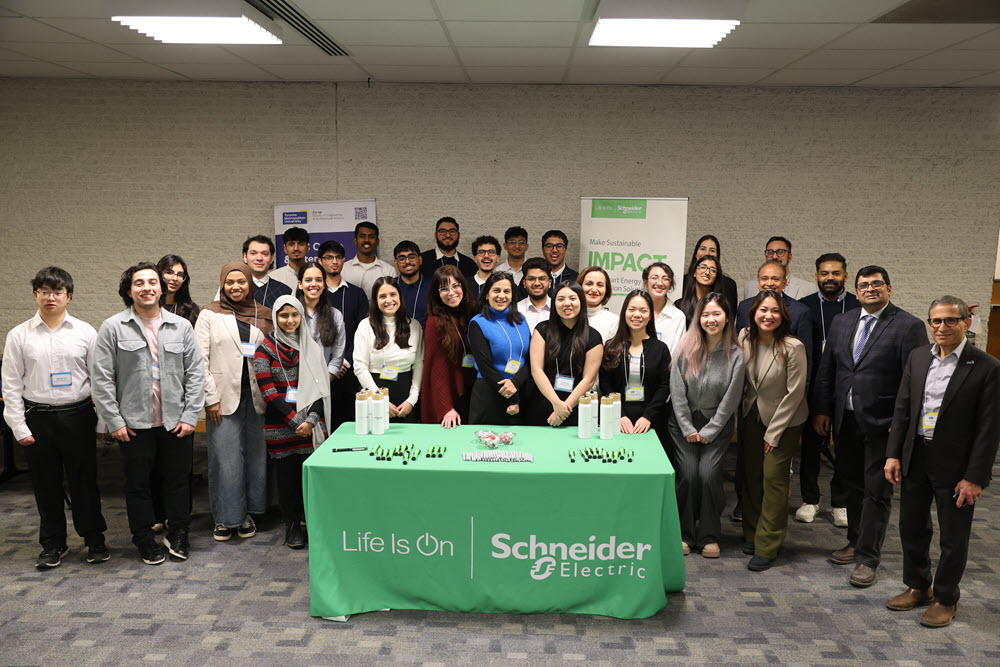
Last week, students from Toronto Metropolitan University’s Faculty of Engineering and Architectural Science (FEAS) showcased the results of a new collaboration with Schneider Electric (external link) : the Sustainability Accelerator Extracurricular Training program, a co-curricular, industry-designed sustainability initiative paired with hands-on, interdisciplinary capstone-style projects addressing real climate and energy challenges.
In partnership with the FEAS Co-op Office, the initiative represents a significant step forward in how FEAS works with industry to co-create curriculum content, mentor students through applied projects, and connect learning outcomes to future career pathways.
Designing sustainability education with industry
Rather than layering sustainability concepts onto existing coursework, Schneider Electric worked directly with FEAS to help design the learning experience from the ground up.
Schneider Electric’s sustainability and business development leaders created a six-module curriculum that helped students understand core sustainability concepts such as ESG principles and different types of emissions (Scopes 1, 2, and 3). Interdisciplinary student teams were then challenged to apply those frameworks to complex, real-world scenarios.
The program was designed not only as a learning experience, but as a new model for industry engagement and work-integrated learning.
“The goal was to give students not just knowledge, but the tools to understand where they can contribute and how,” said Pratap Revuru, Senior Director of Microgrid Solutions and Strategic Partnerships at Schneider Electric. “Sustainability is evolving quickly, and the next generation needs opportunities to apply their digital and engineering skills to real problems.”
Experiential learning that mirrors professional practice
Over the course of the program, students from multiple engineering disciplines worked in teams to develop solutions addressing energy efficiency, decarbonization, and climate risk mitigation — presenting not a single “right answer,” but multiple viable pathways forward.
“What impressed us most was the breadth and depth of the work,” Revuru noted. “The teams didn’t stop at one solution. They explored different scenarios, trade-offs, and approaches — exactly how sustainability challenges are tackled in practice”.
This approach closely reflects FEAS’s commitment to experiential learning as a core part of its academic mission. In his opening remarks, Associate Dean of Teaching and Outreach Dr. Medhat Shehata emphasized that co-curricular partnerships like this allow FEAS to introduce emerging technologies and industry practices faster than traditional curriculum updates alone.
“Our job is our students,” said Shehata. “We want them to graduate with the skills and tools to make a real societal impact. Co-curricular education lets us bring evolving areas like sustainability directly into their learning experience — now, not years from now”.
The impact of the program was felt directly by students, many of whom were engaging with sustainability concepts outside their core discipline for the first time.
Alan Rehani, who worked on the Building Management Systems Modernization project shared, “It was really enjoyable to work on something toward a real outcome. I didn’t expect this project to influence my academic choices, but it did. It helped me realize that sustainability is something I want to lean into more — even in how I’m thinking about my future coursework and my path as an engineer.”
A partnership with impact
Beyond the curriculum and project showcase, the partnership was intentionally designed as a multifaceted learning and talent-development model. In addition to hands-on training and mentorship, the program created new pathways for students to be considered for paid work-integrated learning opportunities with Schneider Electric through FEAS Co-op.
Rather than relying solely on formal interviews, Schneider Electric’s HR team and hiring managers used the program as an opportunity to observe students working in real project environments, gaining insight into their technical abilities, problem-solving approaches, collaboration skills, and professional readiness. For students, this offered a more authentic way to demonstrate their strengths and potential in a setting that mirrors professional practice.
Dean of FEAS Dr. Sri Krishnan, highlighted the broader significance of the collaboration, describing it as a model for how academic-industry partnerships can create exponential value.
“Partnerships don’t just add impact — they multiply it,” Krishnan said. “When industry and academia come together in a meaningful way, students gain lifelong skills, institutions advance their mission, and society benefits from better-prepared graduates ready to lead”.
Elevate FEAS in action
The Sustainability Accelerator reflects FEAS’s ELEVATE FEAS strategic priorities by embedding sustainability and experiential learning into the student experience while strengthening industry collaboration.
For Schneider Electric, the partnership demonstrates the value of engaging early with emerging talent. For FEAS, it reinforces a growing reputation for designing curriculum differently, with industry, interdisciplinarity, and societal impact at the centre.
As the program looks ahead to future iterations, both partners share a common goal: scaling a model that prepares students not just to enter the workforce, but to help shape a more sustainable future.