Dr. Patrick Neumann named International Ergonomics Association Fellow

Congratulations to Dr. Patrick Neumann who has been named a Fellow by the International Ergonomics Association, a federation of human factors and ergonomics societies and networks from across the globe. This achievement recognizes the numerous contributions he has made to the field of ergonomics over the past 25 years.
On a mission to help promote and embed human thinking within engineering, teaching practice and workplaces around the world, Neumann has hosted over 95 workshops, symposia and events, as well as published extensively on human factors and ergonomics. He has also introduced the world to novel concepts, such as phantom profits, which are widely referenced by academia and industry. Collectively, his work has helped to raise awareness of the challenges associated with workplace design and emphasized the importance of human factors in engineering design.
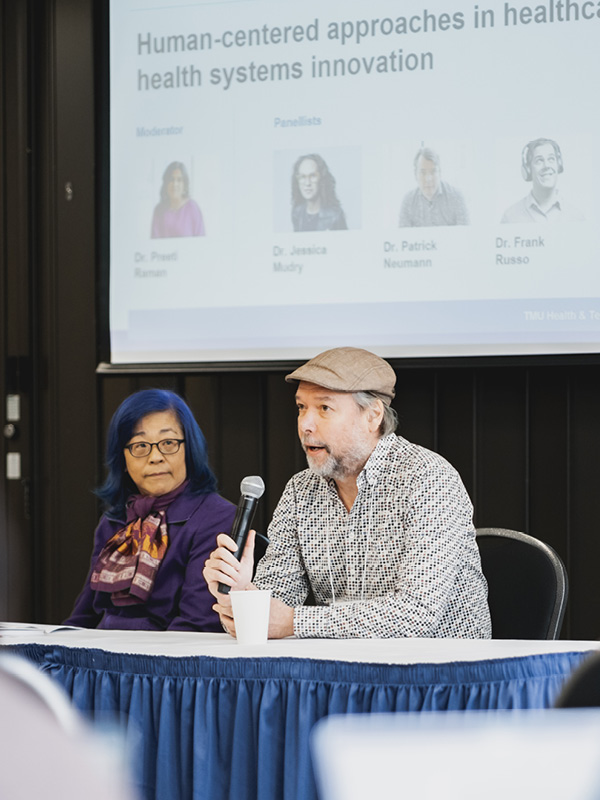
Dr. Patrick Neumann spoke on the “Human-centred approaches in health care and health systems innovation” panel at Toronto Metropolitan University’s Health & Technology Symposium.
Building on his research, Neumann has united students, researchers, and professionals to spur innovation and action. He co-founded the Better Work Better Care Coalition, an open network of researchers and professionals for the exchange of research and knowledge devoted to improving working conditions for healthcare workers. At Toronto Metropolitan University, he also founded and directs the Human Factors Engineering Lab, which develops novel tools, methodologies and simulations. For Neumann, the mission continues; advancing society’s understanding of how working conditions and the human experience impact an organization’s performance, profitability, and employee well-being.
“Congratulations to Professor Patrick Neumann on being recognized as a Fellow by the IEA. His contributions to our faculty, Toronto Metropolitan University and the broader research community have been instrumental in advancing human factors engineering and evolving workplaces around the world.”
Learn more about the Human Factors Engineering Lab.
Related reading: “The health-care crisis won’t be solved without addressing the elephant in the room: Staff workload (external link) ” published by The Conversation.