Leveraging community-arts for immigrant integration: Blog 3
Weaving New Narratives: My Evening At A Newcomer Artist Training
By: Karian Chen
May 27, 2025
What follows is a blog-style reflection on my recent visit February 18, 2025 to Mabelle Arts' Newcomer Artist Training workshop, part of their signature Welcome to the Neighbourhood program, where I participated as part of my current research project.
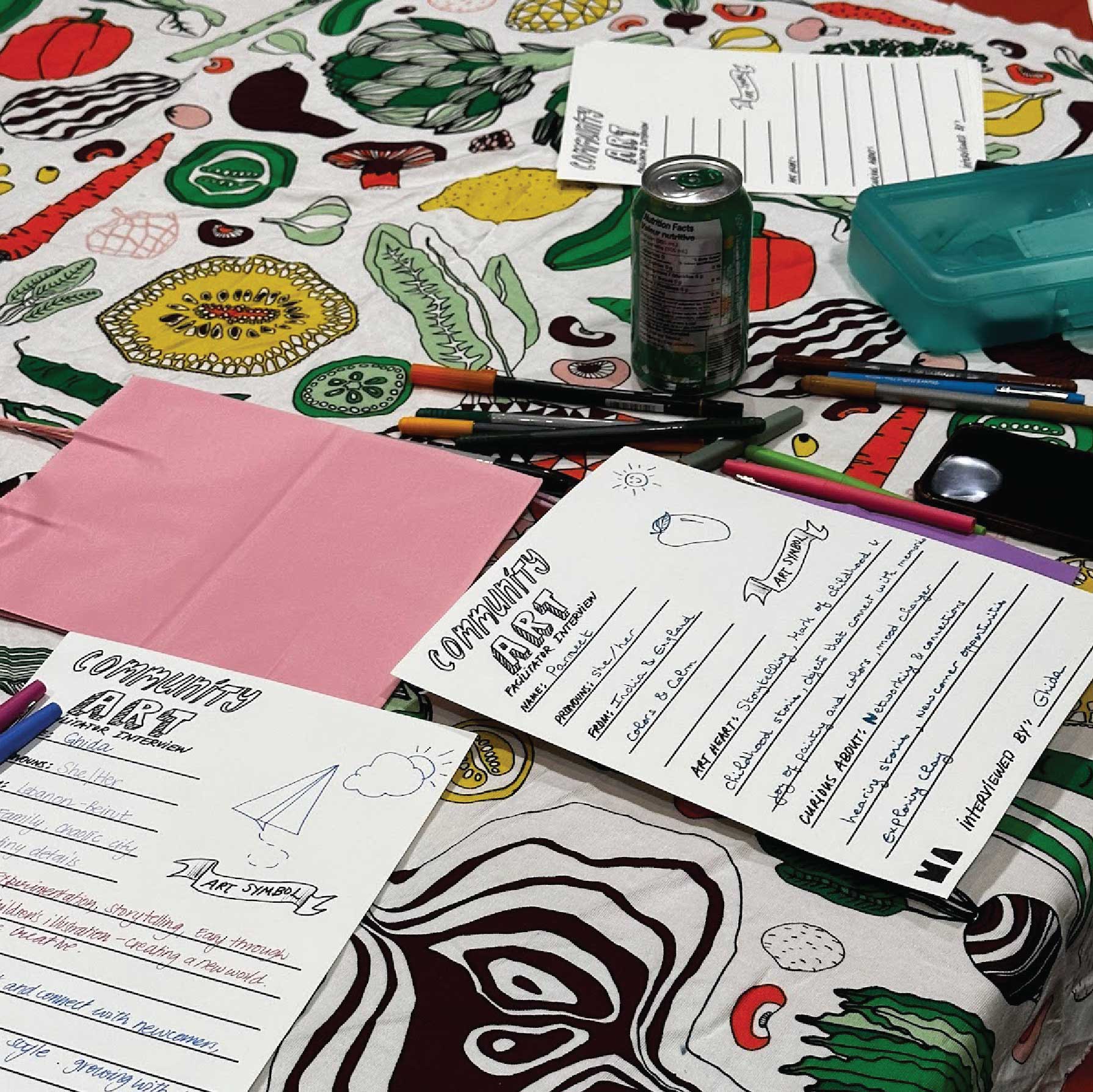
A glimpse of the vibrant patterned tablecloth that brightened the workshop space, with handwritten question cards and colorful pens.
The workshop started a bit late because of the weather, but honestly, I did not mind, as the care put into preparing the space told me we were in good hands for whatever lay ahead.
As I stepped inside, the transformation was immediate. Annie and her team had worked their magic again, turning an ordinary room into a creative haven. Each place at the table featured a thoughtful welcome gift—notebooks and vibrant pens—while patterned tablecloths splashed colour and excitement across the space. It reminded me of their December Crafternoon workshop, where they’d used the same technique: creating warmth through colour and texture, making strangers feel instantly at home.
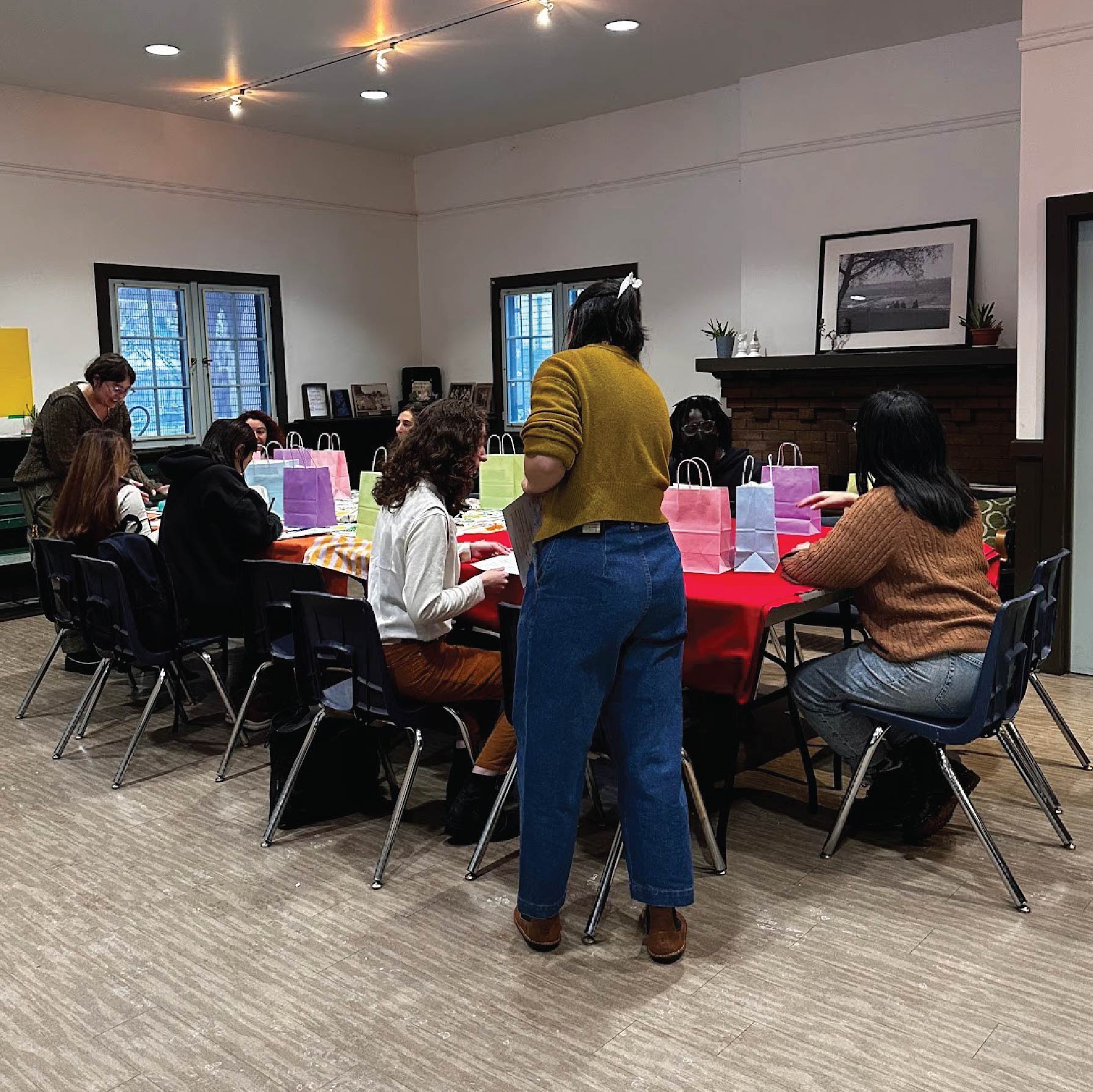
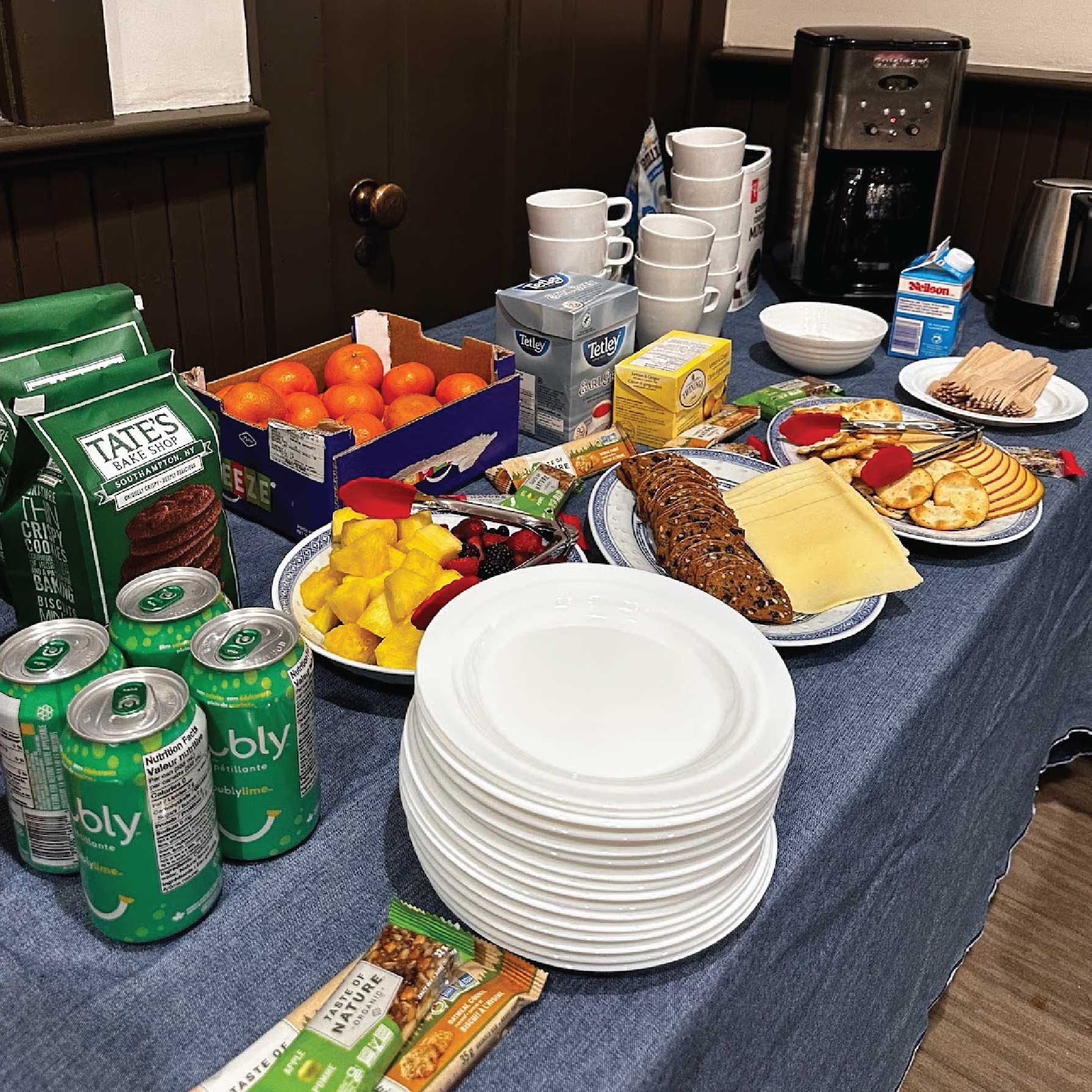
The inviting workshop setting where participants came together, with thoughtfully prepared tables and colour gift bags that helped transform a simple room into a creative community space; the abundant refreshments that nourished both body and conversation throughout the evening.
Annie’s opening words revealed something different about this gathering. This was not just another session in the community arts program that Mabelle Arts runs. Rather, as Annie describes it, it is the `jewel in the crown’ in the Immigration, Refugees and Citizenship Canada (IRCC) funded Welcome to the Neighborhood (WTTN) (external link) program; and it helps support the first of its kind training that uses community arts specifically for newcomer artists integration into the arts scene in the GTA. Some members of the National Film Board (NFB) team were present toothat evening, as NFB were partnering with Mabelle Arts on this project. For them, the objective of this partnership was to observe and document the newcomer artist training workshop, the camera following these newcomer artists, not just during this session, but also beyond, keeping track of their journeys as they continued to pursue their professional goals in the GTA and in Canada.
Instead of making us do those awkward circle introductions that I usually dread, Dani had us try something different. We formed a circle and took turns sharing unique fun facts about ourselves, with an interesting twist: whenever someone shared something you connected with, you stepped forward. What struck me was watching how the physical distance between us kept shrinking throughout the activity. Something about physically moving closer to people as you learn about them changed the energy of the room. It was not profound in some grand way, but it was effective—the room felt smaller and more intimate, somehow warmer by the end of it.
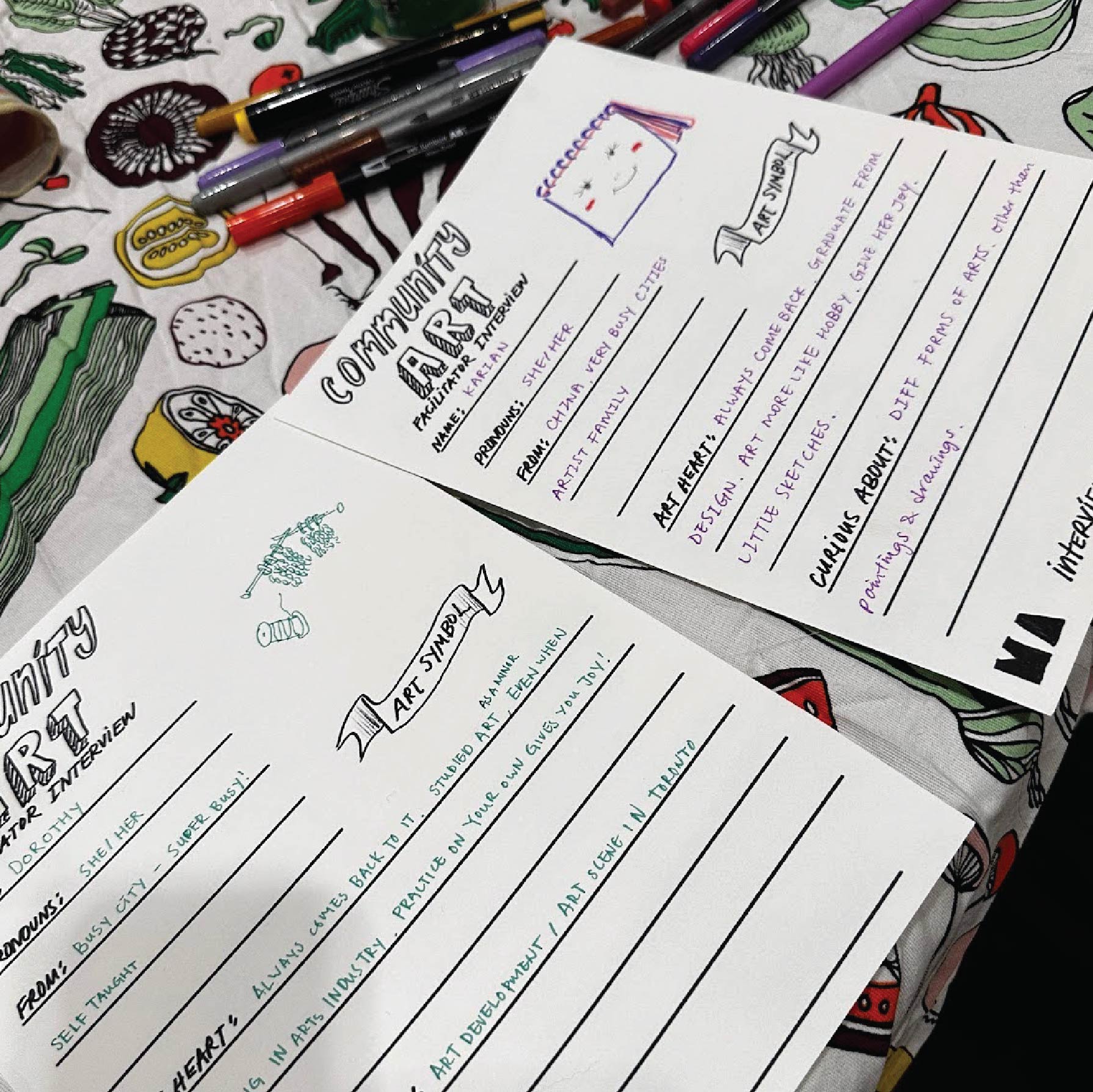
The decorated interview question cards that took the formal act of interviewing feel more playful.
Next came an interview activity where we paired up and got handwritten question cards to decorate. I partnered with a woman who also speaks Cantonese as her first language, and something interesting happened when we switched from English to Cantonese—the careful construction of English sentences fell away, and suddenly we were just two people sharing stories with a new level of ease and depth.
Instead of having to draw exact portraits of our partners (which would have made me nervous about my drawing skills), we just had to draw something that reminded us of them. This took away the pressure of trying to make “perfect” art, and opened the door to metaphor and feeling, which I appreciated.
When we came back together to introduce our partners to the group, I was surprised by the range of artistic backgrounds in the room—everything from traditional painting to filmmaking, textile art and sculpture, music and dance too. As Annie observed, there is something powerful about hearing your own story reflected back through someone else’s perception, especially in a room full of fellow artists who understand what it means to create.
The dinner break was not merely an intermission but an integral part of the community-building experience. The generous spread (with enthusiastic encouragement to take leftovers home) created an atmosphere of abundance and care. After mouthfuls of food, conversations flowed more freely, and laughter echoed through the room.
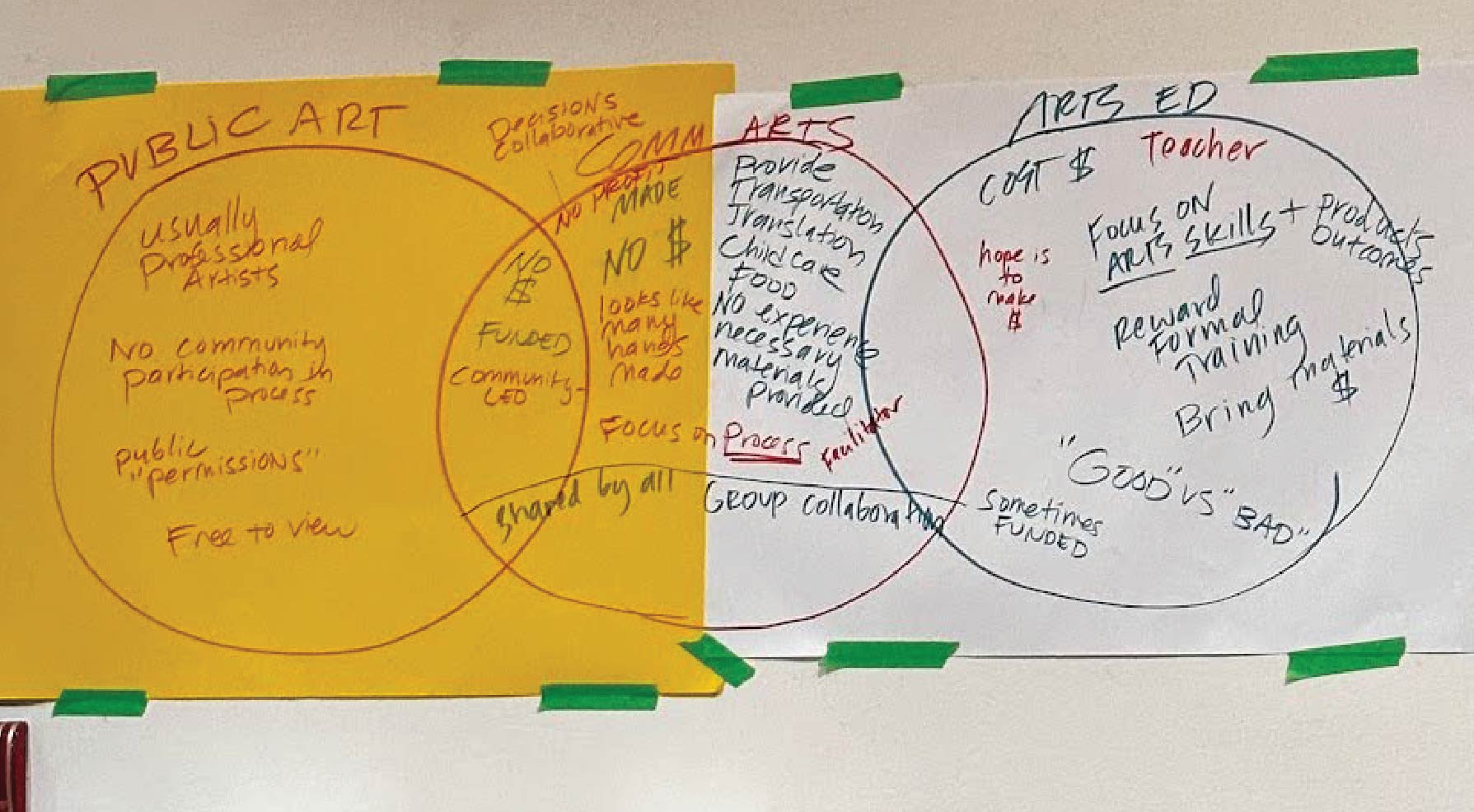
The Venn diagram that sparked rich discussions about the interconnections between public art, community arts, and arts education.
The second half of the workshop felt more like a discussion or seminar. Using a colourful Venn diagram taped to the wall, the facilitators, Annie and Dani, invited us to explore the intersections between public art, community arts, and arts education. Everyone was encouraged to share their thoughts to fill in the blank spaces.
One of the participants shared how funeral rituals in her African culture function as community art, with families coming together to decorate tombstones as acts of remembrance, celebration, and mourning. Across the circle, another participant’s eyes widened in recognition as she described similar practices in Mexican culture. It was a beautiful moment of cross-cultural connections too—people realizing they’d been practicing some form of community arts all along, simply under different names and contexts.
Another interesting aspect for me was learning about the political side of community arts. Some participants shared stories from their home countries where community art, like communal art walls (and graffitti), became more than just creative expressions during times of political tension. It became a pathway for people to fight for freedom and social justice, speaking out despite censorship. These stories made me think about the role of community arts in society in ways I had not considered before.
What I became aware of most starkly by the end of the workshop was how much the room itself had transformed! When we first gathered, there was the typical reserve of strangers—cautious smiles, careful distance, measured words. By evening’s end, that reserve had melted away. It showed how quickly a sense of community had developed during just the course of a few hours.
This workshop felt so different from the Crafternoon session I attended in December (see Finding Home Through Thread and Needle: A Visit to MABELLE Arts Crafternoon Workshop). Crafternoon was more like a casual community hangout—people came to explore and create without any particular goals. This Newcomer Artist Training workshop had a different energy and purpose. These artists came with specific intentions—they wanted to understand Toronto’s art scene, explore job prospects, and figure out how to establish themselves here. Many had practiced art professionally in their home countries; they arrived with clear identities as artists and creators, and they carried deep reflections on their craft which they freely shared.
Annie also shared something else I found interesting - that this workshop was also designed to teach participants the how-to of facilitating workshops in community arts. We were encouraged to pay attention to how she and Dani led activities, almost like an informal training in facilitation. We were learning not just by participating, but by observing how they created a safe, creative space where everyone felt not only seen and heard, but they also felt comfortable sharing their stories and their perspectives.
Walking home after the workshop, I found myself thinking back about the nourishing space I had just left, and how such environments are so important in a big city like Toronto. For newcomers especially, finding your place (and your voice) can be challenging. But for a few hours, I saw a group of strangers connect through art and stories, creating something meaningful together that had not existed before we all showed up, a temporary community that left permanent impressions.