How to Design an Entrepreneurship Program for Migrants: A Practical Guide
How to Design an Entrepreneurship Program for Migrants
A Practical Guide

TORONTO, ONTARIO
A poverty-fighting, migrant-empowering model arrives in Canada, and Toronto entrepreneurs are already putting it to work
For an immigrant new to a country like Canada, it only takes one person to make a difference. It can be a moment of encouragement, a new connection, or an unexpected encounter that opens doors that once seemed impossible to unlock.
Shatvahi Ramesh, one of the 28 graduates of Enterprise Bridge’s first cohort in Toronto, says that push led her to start her own business, Thethani and Co., a mobile tea and snacks stall. “They helped me really feel like my idea is worth pursuing,” she says, referring to one of her conversations with her mentor.
When University of Notre Dame professor of entrepreneurship and social innovation Michael Morris first spoke with Bridging Divides postdoctoral researcher Anil Dhakal about introducing the Urban Poverty and Business Initiative (UPBI) in Toronto, Dhakal felt an instant connection to the project. The UPBI, founded and directed by Morris, leverages university resources to help low-income and disadvantaged individuals start and grow sustainable businesses. Using a six-pillar model, the initiative includes a structured 80-step pathway, guiding participants through training and mentoring while addressing social problems like poverty through the process.
With a background in international development and poverty alleviation, and a deep appreciation for community building, Dhakal often noticed a disconnect between academic research and project implementation. “The UPBI provided the rare opportunity to support communities through direct development initiatives, while also continuing to drive meaningful research,” he says.
"The UPBI provided the rare opportunity to support communities through direct development initiatives, while also continuing to drive meaningful research."
Coordinated by the University of Notre Dame, the UPBI is now supporting entrepreneurs in 59 cities across the globe through training, mentorship and access to capital to drive local economic mobility. Inspired by the upcoming FIFA World Cup 26™, and as part of its commitment to economic empowerment, The Coca‑Cola Company supported the UPBI as it expanded its work through local institutions such as Enterprise Bridge in Toronto.
For Morris, introducing the program within a university setting meant embedding it in an environment where academic and community strengths could intersect. Tapping into Toronto’s diverse communities also added to the appeal, he says, given immigrants’ unique backgrounds and needs, and what can be learned from their lived experiences. “It’s a rich opportunity for research,” he says.
At Toronto Metropolitan University, the UPBI was launched under the name of Enterprise Bridge. Morris recognizes the value in partnering with a research program focused on migration, a clear demonstration that the model can be adapted beyond traditional business school settings.
Step 1: Start with a plan, and put it motion
Dhakal began planning the launch of Enterprise Bridge in May 2025. The structure was clear and intensive: a nine-month program beginning in the Fall, with six bootcamp sessions delivered over six weeks, followed by a mentorship phase and a student consultation phase. Each bootcamp session was designed to be immersive, combining a two-hour workshop with sessions featuring both a guest speaker and a guest entrepreneur.
Workshops covered key stages of the entrepreneurial journey, from ideation to execution, financing, securing resources, marketing, and other essential business fundamentals. Participants also heard from guest speakers across sectors such as government, financial institutions, and local businesses, who offered specialized insights. Guest entrepreneurs shared their personal journeys and day-to-day experiences.
In a cohort where two-thirds of participants were women, individuals came from diverse backgrounds and were at different stages of establishing their businesses. Ventures ranged from community-focused initiatives such as art studios and online tutoring to product-based businesses like stuffed dates and organic candles.
Many were also balancing entrepreneurship alongside full-time jobs, family responsibilities, and other commitments. For Dhakal, what stood out was each participant’s determination. “They have kids, they have challenges,” he says, “but they share a strong collective desire to build truly sustainable business ventures.”
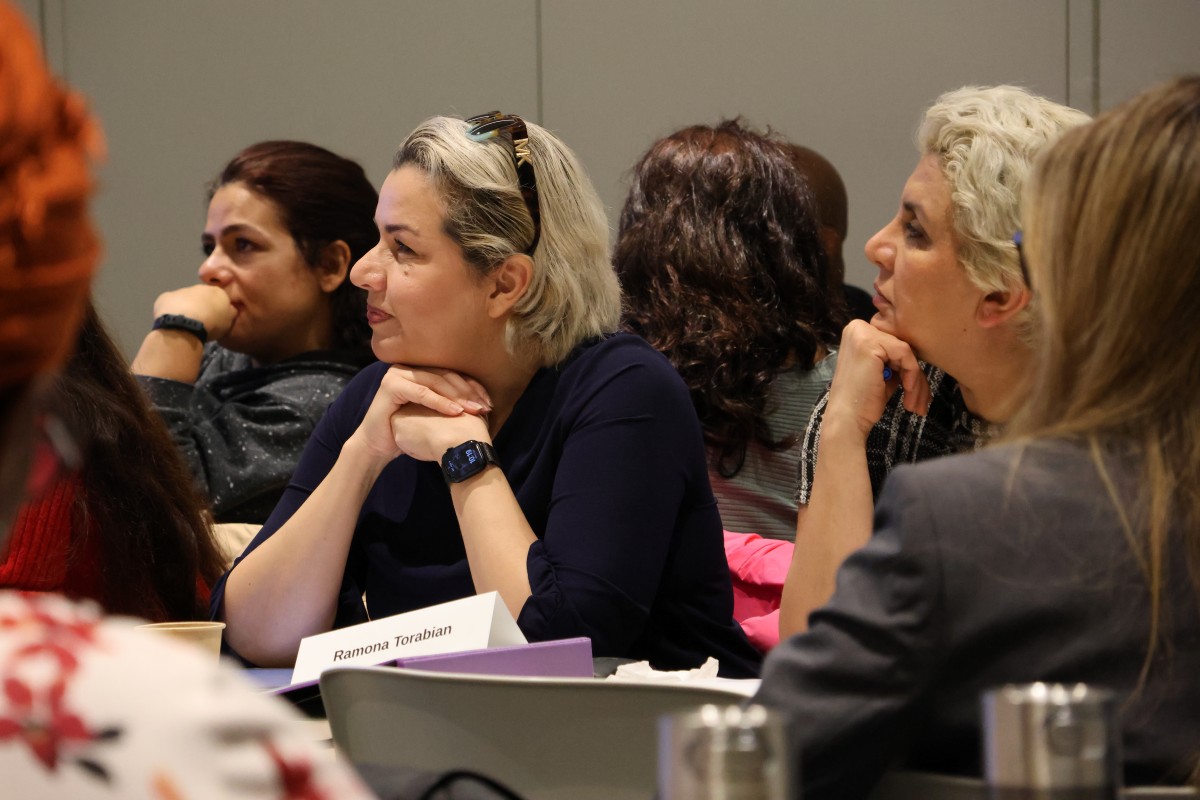
The first edition of Enterprise Bridge counted 28 active participants, who joined six weekly bootcamp lessons at Toronto Metropolitan University. Two-thirds of participants were women.
Step 2: Make mentorship the engine
For Morris, embedding mentorship and student consultation as core components of the program was a priority from the outset. The model was designed as a continuous journey rather than a series of one-off interventions. “It’s like a woven cloth,” he says. Grounded in the program’s 80-step framework, participants built on previous learning with mentors and student consultants guiding progress toward tangible outcomes.
Participants were connected with a pool of 12 mentors, each bringing their own expertise from sectors including finance, technology, non-profit, academia, and media. Among them were Levicel Calang, founder of the All Women Entrepreneurship Circuit (AWEC), and Akash Khullar, Business Banking Relationship Manager at BMO.
For Calang, the experience was empowering. “You share your knowledge,” she says. “But at the same time, you also learn from your mentees, you learn from their stories and struggles.” As an immigrant herself, she understands how overwhelming the entrepreneurial journey can be, and when mentorship makes the biggest difference.
“Inspiration is at the core of mentorship,” she says. “Learning about your mentor’s journey and the challenges they had to overcome makes you feel less alone. They need that support.”
"Inspiration is at the core of mentorship. Learning about your mentor’s journey and the challenges they had to overcome makes you feel less alone."
Khullar describes the experience as eye-opening. While he provided advice and guidance to participants, he is also someone who hopes to eventually open his own venture. Speaking directly with aspiring entrepreneurs, rather than established businesses, gave him insights into how many barriers exist, especially at the early stages of the journey. Despite those barriers, he saw that starting often comes down to “simply an idea.”
Calang also highlighted the value of knowledge sharing across sectors, pointing to the synergies that emerge through these partnerships. “We are very grassroots level,” she says, emphasizing the direct and personal connections non-profits build with the communities they serve. “We connect with them in terms of what their actual needs are.”
This layered understanding, she suggests, offers researchers a multi-dimensional lens. The exchange flows both ways. Non-profits often lack the resources to conduct large-scale studies, while research findings offer critical insights, especially when applying for funding. “This is where collaboration comes into play,” she says.
For Morris, the consultation process also offered students an opportunity to gain real insight into business ownership. “When a student is sitting there listening to entrepreneurs who have overcome all kinds of obstacles, that’s a reality check,” he says
Step 3: Define what success actually means
This Spring, participants are being matched with student consultants from universities and the wider community, who will provide guidance as they move into the next stage of their journeys. Dhakal will conduct a qualitative study on the structural constraints, including systemic barriers, that shape immigrant entrepreneurship, while also examining how university-led programs act as supportive resources.
Existing research suggests immigrants are more likely than Canadian-born individuals to pursue entrepreneurship, often in response to labour market barriers, with many turning to self-employment out of necessity. Despite this, Dhakal notes that there is a gap in the literature that explains what entrepreneurship can do for migrant integration more broadly.
Entrepreneurship can embed individuals in the social fabric of their communities in ways that other forms of employment often do not. As a result, the study moves beyond narrow definitions of success and considers broader measures of impact, including social connection, confidence, and long-term sustainability for participants and for the communities they are part of.
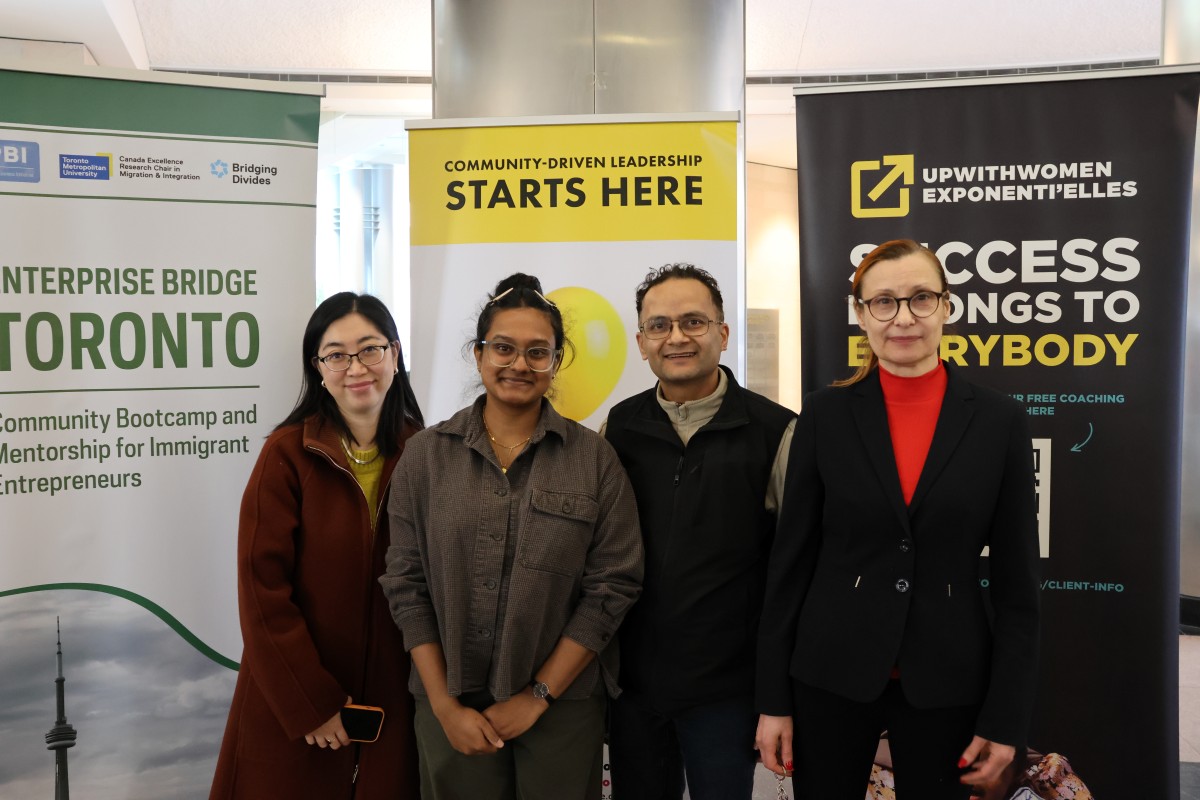
Representatives of Enterprise Bridge at an International Women's Day event hosted in Toronto in March 2026.
