From Student Projects to Startup Potential
From Student Projects to Startup Potential
Can these student ideas turn migrant challenges into buildable solutions?
STUDENT-LED INNOVATION
Over eight weeks, a group of students across four Canadian universities set out to get out of their classrooms and build something practical. Not a paper or a pitch deck, but a working solution to challenges they, or people like them, were already navigating in real life. By the end of the second edition of Build a Bridge, some of those solutions existed as usable prototypes, tested concepts, and in a few cases, early versions of something with the potential to go much further.
Fifty-seven students from Toronto Metropolitan University, Concordia University, the University of Alberta, and the University of British Columbia took part in a tightly structured program of workshops, roundtables, and mentorship. They worked across key research areas: mental health and wellbeing, labour and employment, place and infrastructure, and citizenship and participation. They learned how to identify and define a problem, and then design implementable solutions that respond to it using AI tools, user feedback, and real-world constraints.
From the beginning, Build a Bridge is not positioned as an isolated academic exercise. Students move through the program with input from mentors in entrepreneurship, immigration studies, and AI research and engineering, and at Toronto Metropolitan University, the partnership with the Office of Zone Learning and Strategic Initiatives connects their work to a wider ecosystem of incubators and venture-building support, following the principle that ideas should not stall at the prototype stage simply because students run out of runway.
Sidhant Sakhuja, a business development and commercialization manager at the Ontario Centre of Innovation (OCI), immediately recognized that ambition. “You can usually tell when something is still conceptual and when it’s starting to move into something real,” he says. “A few of these projects were already crossing that line.”
"Some of those ideas were really good. You can think of people who would use these tools right away."
Sakhuja spends his days speaking with founders, researchers, and early-stage teams, mapping where ideas might find funding, partnerships, or a path to market. He also came to Canada as an international student nearly a decade ago, which meant that the problems being tackled by Build a Bridge felt particularly real.
“I’ve gone through that process myself,” he says. “So when I saw what they were working on, it wasn’t just interesting… it was familiar.”
Sakhuja’s role in Build a Bridge was to read through and evaluate the submitted projects. He remembers musing on the practical implications of a platform to connect retiring small business owners with newcomers ready to take over viable enterprises, and feeling excited about the idea of a game-based VR simulation of a newcomer’s first 30 days in the country, where every decision carries trade-offs between finances, legal status, social capital, and mental health.
“Some of those ideas were really good. What stood out is that they were solving real, immediate gaps,” Sakhuja says. “You can think of people who would use these tools right away.”
And then the kicker, not just how implementable the projects felt, but how far into the developing stage some of the work already was. “Some teams had prototypes, they had spoken to users, they had validated parts of the problem,” he says. “That’s not typical. Usually, at this stage, you’re still very early.”
"Ontario produces a lot of strong research, but we struggle to turn it into something that actually operates in the world."
Build a Bridge is one of those programs that are trying to intervene in the delicate spot where ideas crash into reality. Where, more often than not, things fall apart. “Ontario produces a lot of strong research,” Sakhuja says. “Where we struggle is turning that into something that actually operates in the world.” He talks about the need to support young ventures after the idea, when a project needs funding, technical development, legal structure, and time to become viable. Without that support, even the most promising concepts tend to stall.
Partnerships can provide some much needed infrastructural support at that stage. “When you bring in the right people early, such as incubators, funders, organizations that understand how to scale something, you change the trajectory of that project,” he says. “It doesn’t have to end as a student exercise.”
At Toronto Metropolitan University, that trajectory is something the program is actively trying to shape, in part by working more closely with internal partners like Zone Learning, and in part by building relationships with external actors who can carry ideas forward. The goal is to produce exceptional student work that can continue to evolve beyond the program itself.
For Zachary Rose, director for strategic initiatives at Magnet, that ambition resonates with a broader challenge he sees across the systems he works in. “What I found interesting across the projects is that they were all, in different ways, trying to solve problems of connection,” he says. “Connecting people to services, to opportunities, to resources that are technically available but not always accessible.”
At Magnet, the focus is on the future of work, which often means looking at how education systems, employment systems, and community services intersect, or fail to. From that vantage point, the issue is rarely that support does not exist, but it’s often fragmented. “There are a lot of good things happening,” Rose says. “But they don’t always link up in a way that makes sense for the person trying to navigate them.”
It’s also good to force different parts of the system into the same room. “We don’t operate as one system,” he says. “Postsecondary education, community organizations, employment services, they’re all structured separately, funded separately, and often working on different timelines.” Collaboration is not automatic and needs to be built deliberately, sometimes against the grain of how institutions are set up to function.
“Any initiative that brings those pieces together is doing important work,” Rose says. “Because that’s how you start to create something more coherent.”
"If even a few of these projects can move forward, you’re not just solving a problem, you’re creating something that can employ people and have a real economic and social impact."
As technological change accelerates, AI tools are reshaping how people access information, how services are delivered, and how skills are developed, often faster than institutions can adapt. We slip back and forth through those institutions more and more fluidly. “The idea that you move through education once and then you’re done is just not how things work anymore,” he says. “Learning, work, and reskilling are all blending together.”
In that environment it’s more important than ever to build those connections, between students and practitioners, between research and application, between sectors that do not usually collaborate. “If even a few of these projects can move forward, you’re not just solving a problem,” Sakhuja says. “You’re creating something that can employ people, that can grow, that can have a real economic and social impact.”
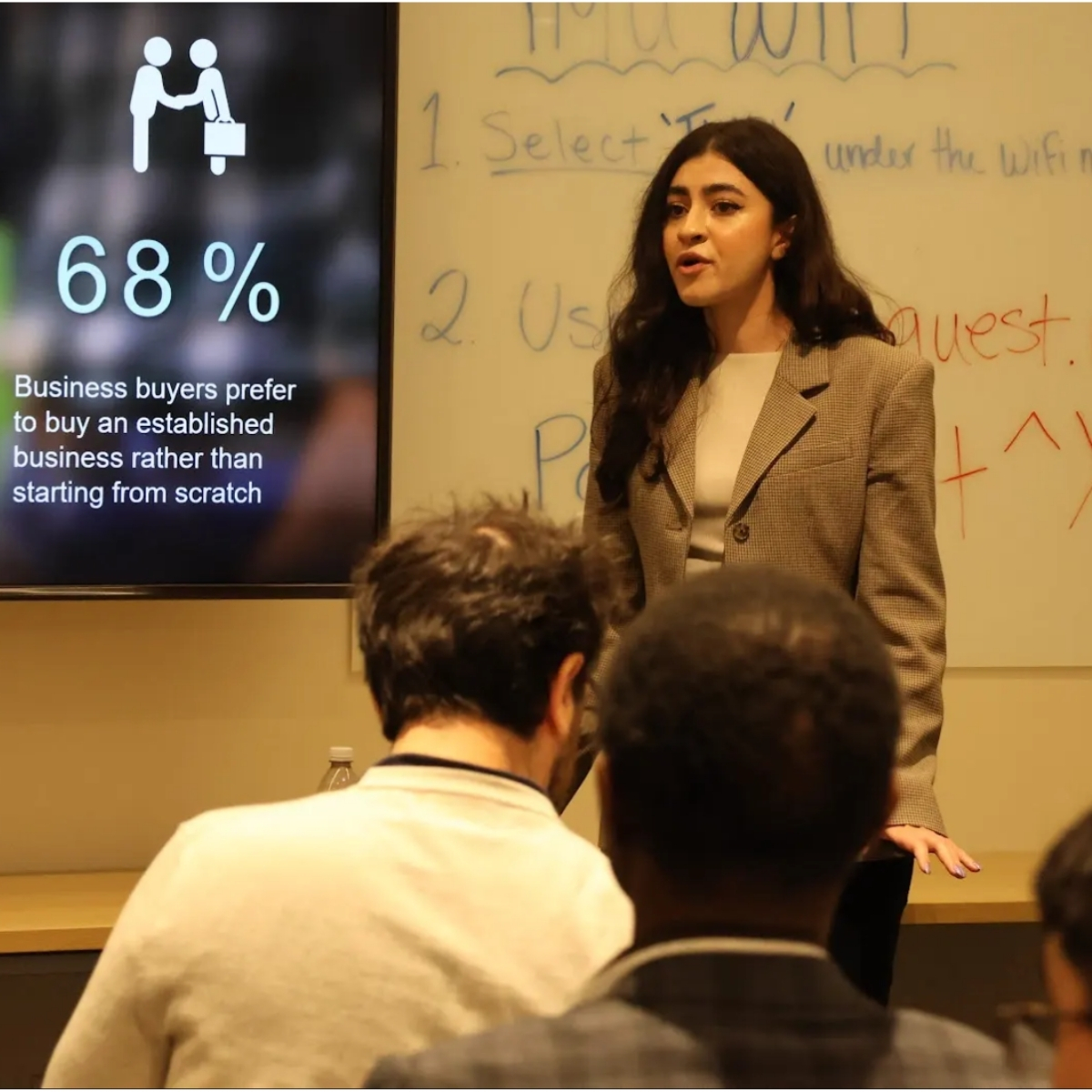
The competition has produced three winners, who received their prizes at an in-person award ceremony and showcase hosted in Toronto. And the projects were definitely award-worthy. The more consequential outcome, however, may lie in the connections formed across institutions, sectors, and experiences, and in the recognition that moving from idea to impact is not a single step, but a system that has to be built around it. As Rose puts it: “None of us are operating in isolation anymore and none of us are finished learning."
