Sitting Down with the SVZ's Spring/Summer 2025 Cohort
Introducing the five new startups at the SVZ, tackling issues ranging from helping children through therapeutic play to creating unique solutions to reduce carbon emissions.
By: Aqsa Rehman
June 10th, 2025
This week, we wrapped up our incubation programming with our Spring/Summer 2025 cohort! Our current cohort has a diverse set of problems and solutions, and we sat down with them to talk about their progress, their SVZ incubation experience so far, and where they hope to go from here. Our five newest members are:
Organic Play, founded by Irma Canut Gasperin and Constanza Rojas Vertiz Canut, an inclusive early learning venture that integrates play-based education and therapeutic support for children with developmental, learning, and sensory needs.
Seafoam, founded by Chloe Doesburg and Amy Yang, a seaweed-based building insulation that replaces high-GHG-emitting conventional alternatives, turning one of the planet's most carbon-intensive industries into a major climate solution.
Project Cahta, founded by Ishaan Takrani, Jazmyne Mohamed, Venujan Suthakaran, and Fahmida Parvage, a sustainable fishing method that reduces waste in the form of bycatch, minimizing disruption to the seafloor and mitigating mass carbon emissions.
elerGreen, founded by Hui Huang Hoe, a patented electrochemical reactor that recovers valuable products from waste and creates renewable electricity.
PhonoLogic, founded by Stephen Robins, an AI powered literacy platform for students with reading challenges, designed to help teachers deliver structured reading instruction with ease and precision.
Aqsa, SVZ: Hi everyone! To begin, what problem is your startup solving?
Chloe: We're really focused on climate and the emissions associated with the manufacturing of building materials which accounts for 13% of total global emissions. If we can find ways to replace high emitting products with actual carbon negative or carbon storing building products, we can have a massive climate impact.
Ishaan, Project CAHTA: The problem we are trying to solve is, ultimately, carbon emissions. Traditional bottom trawling essentially scrapes a giant net with heavy metal gear across the sea floor, which disrupts a lot of sediment that's very rich in carbon.
Hui Huang: The problems we are solving include things like circular economy, and then pollution and carbon emissions, as well as climate change. The elerGreen reactor turns chemical and manufacturing plants from burning fossil fuels into usable renewable electricity.
If we can find ways to replace high emitting products with actual carbon negative or carbon storing building products, we can have a massive climate impact.
SVZ: What is the most rewarding part of your work?
Hui Huang: What I really enjoy doing with this social venture is that it allows me to take like my design, and turn it into reality, to assess whether it works or not. And I would say it's more of a journey that takes my design, of the novel continuous like electrolyzer, from sketches to engineering drawings, and then to the small reactor, and then to ultimately, like the full size reactors. It's a very satisfying process.
Venujan: As an engineering student, I do like problem solving. So we initially entered as a hackathon participant, and we thought the idea was great. The incubators pushed it. And I'm like, ‘Well, I enjoy problem solving and this is a big problem’. There's a lot to learn, so why not just go head first into it? Here we are now.
Chloe: I think the most rewarding part is meeting tons of other people that are working on other exciting things, especially in the climate space. I feel like it's really cooperative and collaborative. We're all working on versions of the same problem. We're all in this together.
SVZ: How would you describe the process of starting a social venture and what advice would you give to TMU students who are aspiring entrepreneurs?
Stephen, PhonoLogic: The process is difficult and time consuming, but worth it! If you have any aspiration to start a social venture, I would say to fall in love with the problem, validate that it is a real problem, and be open to pivoting. Ideas are cheap, execution determines what solutions become tangible. Listen to mentors and understand what the market is saying about your venture.
Irma: I think that firstly since we came to a different country, everything was different. Second, we consider ourselves very proficient in what we do, but only in that. So talking about a business model, talking about further developing; we needed the support for that.
Constanza, Organic Play: How do you explain playing to somebody? And then adding therapeutic play on top. Finding the right language has been really challenging. For TMU students, I would say, use your resources. The library has been extremely, extremely helpful.
Ishaan: I know a lot of people are out there saying I have this idea, I don't know what to do or where to go to pursue it. They should definitely go and reach out to different incubators, whichever suits them. Just try it because it might end up being something really big.
Hui Huang: I would suggest the first thing is to learn continuously. Be open to learn new things and be open to DIY a lot of things. And then, when you go about pitching or reaching out to prospective customers, you need to know how to talk to people. It's ultimately about the relationship with people and society on top of the technical side.
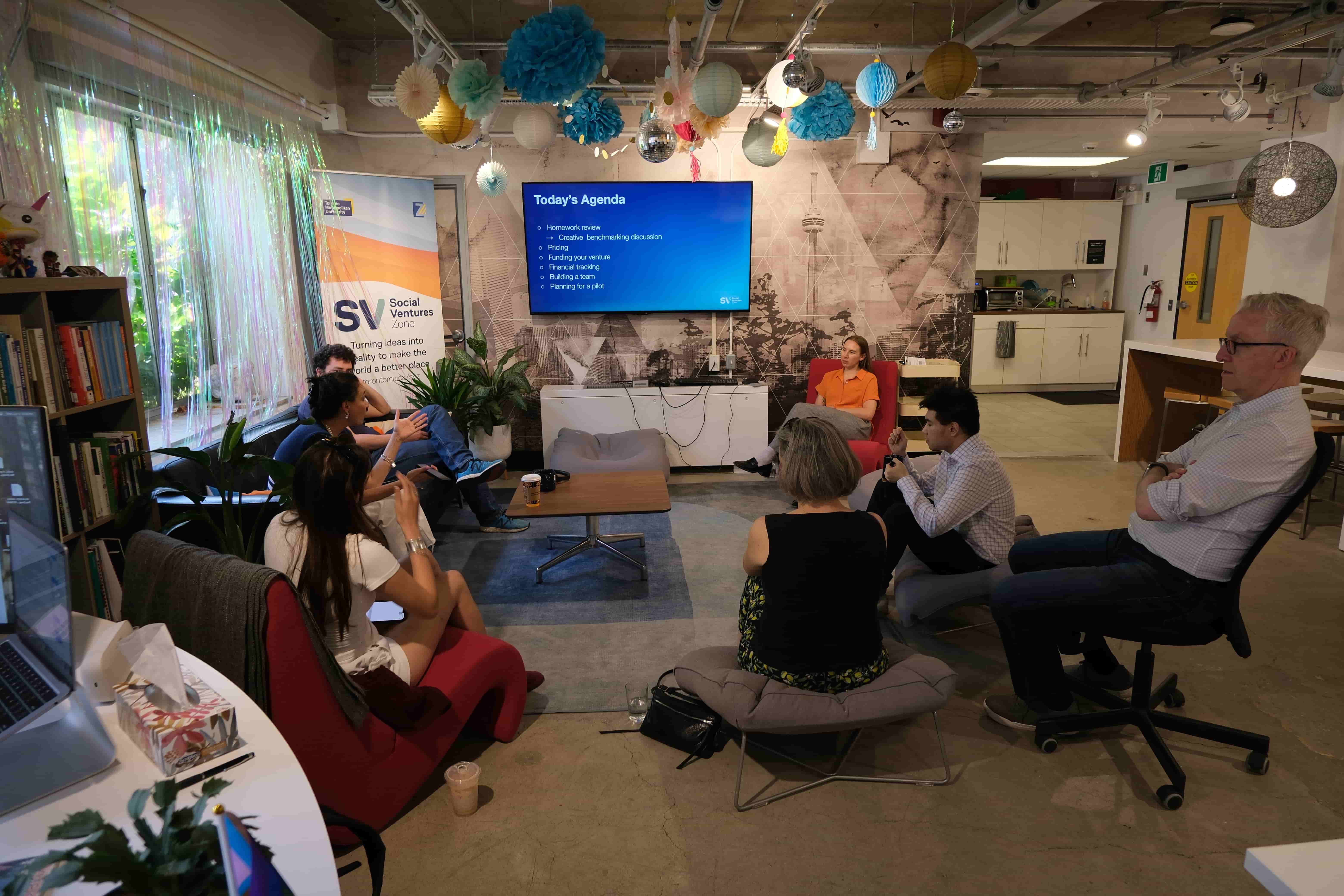
SVZ: How has the Social Ventures Zone affected your startup’s journey?
Hui Huang: The Social Ventures Zone deepens the understanding of the interaction and relationship with people and society. On the other hand, as the others have just mentioned, it helps us better communicate our venture to others, and our idea to others.
Constanza: We've also been able to exchange ideas and have lots of conversations that have helped us - We'll spend hours explaining and then we'll have a conversation with someone, they'll spit it back in two sentences that are extremely easy to understand. So that exchange of ideas has been really helpful.
Ishaan: When it comes to the Social Ventures Zone, there are many things that have helped us a lot. Mainly, I find that the connections we can make with other founders who may be working on similar goals, can provide us with advice or help with building our startup. Creative benchmarking is one thing specifically that we learned about from the SVZ that we find will be really helpful.
Stephen: I'll double down with the networking and the purpose. And I've learned as much in the Social Ventures Zone in the past five weeks that we've been here as I have in any MBA course. I think that because it's a Social Ventures Zone, we place so much importance on value, not just monetarily.
The Social Ventures Zone deepens the understanding of the interaction and relationship with people and society.
SVZ: And lastly, what achievements has your startup accomplished and how can the community connect with your work?
Irma: Our current achievements: We're here. That's our current achievement. For us, it was also really an achievement that we are three quarters into completing our written materials for My Inclusivity, which is part of the programming that Organic Play is very proud of.
Constanza: We have Instagram (external link) and Tiktok (external link) , @organic_play, and a webpage that you can contact.
Chloe: I feel like being part of this program, that's huge. That's definitely going to help move our company forward. One of our big things that's in process right now is prototyping. So we've created our initial prototypes. We have 40 of those, and we've recently got a little bit of funding to hire a material scientist to help us take those to the next level. And in terms of how people can find us or connect with us, find us on Instagram (external link) or the web. We're always happy to connect with people, people who are interested in startups that want to work in the climate space or decarbonization, construction, seaweed, any of those things, just reach out through our website, and we're happy to chat.
Ishaan: One of the achievements that we're most proud of is, well, first of all, getting into the Social Ventures Zone. Being able to take up those opportunities. We've also received quite a bit in funding from various programs. In terms of how we can be found or reached, we do have a profile on LinkedIn (external link) and a website (external link) .
Hui Huang: So in terms of achievement, as I mentioned before, it's ultimately more of a journey. And as recent news, the patent just got granted in Malaysia, the country that I was born in, and then throughout this journey, I’ve got lots of prizes, funding and support, which I would like to thank everyone for. You can find elerGreen easily by searching elerGreen online which links to our website and various publications.
Stephen: We don't have websites or Instagram or any of that because we're so early stage. The biggest achievement to date is we finished the MVP today. Now we are in the point of refining and getting it stress tested, which will happen over the next couple months.
SVZ: Thank you all so much!