Water

Toronto Metropolitan University is committed to employing technologies and encouraging behaviours that minimize water waste. We measure our water usage and work to reduce water consumption through environmentally sustainable practices.
TMU’s Sustainability Office tracks water consumption through the analysis of monthly utility bills. Water consumption decreased by approximately 3% in 2021/2022 and 53% since the 2019/2020 academic year. The spike in water consumption in 2019/2020 was the result of issues with our campus steam distribution network and the condensate return system, which have since been fixed. Following a dip in water consumption in 2020/2021 due to the COVID-19 pandemic, campus water consumption levels are now returning to pre-COVID levels.
Annual water consumption
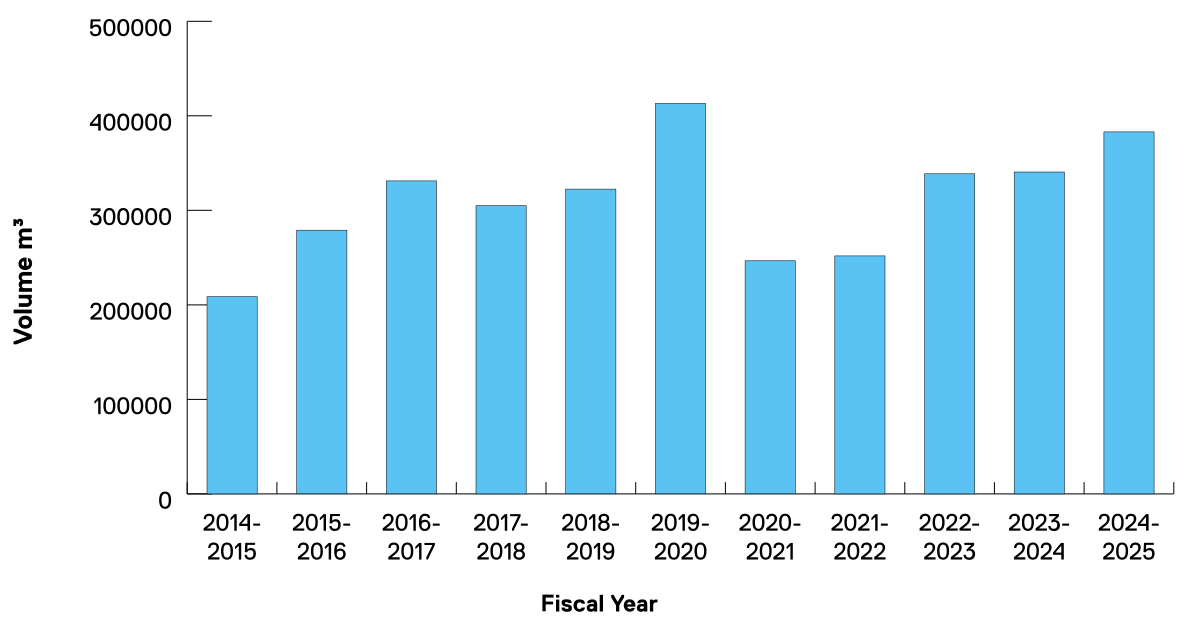
This bar graph shows TMU's annual water consumption from 2014 to 2022 measured in m3 (cubic metres).
| Fiscal Year | Water Consumption (Volume - m3) |
|---|---|
| 2014/2015 | 208,738 |
| 2015/2016 | 278,950 |
| 2016/2017 | 331,118 |
| 2017/2018 | 305,023 |
| 2018/2019 | 322,424 |
| 2019/2020 | 413,134 |
| 2020-2021 | 246,563 |
| 2021-2022 | 251,824 |
| 2022-2023 | 338,684 |
| 2023-2024 | 340,622 |
| 2024-2025 | 383,049 |
Water-efficient landscaping
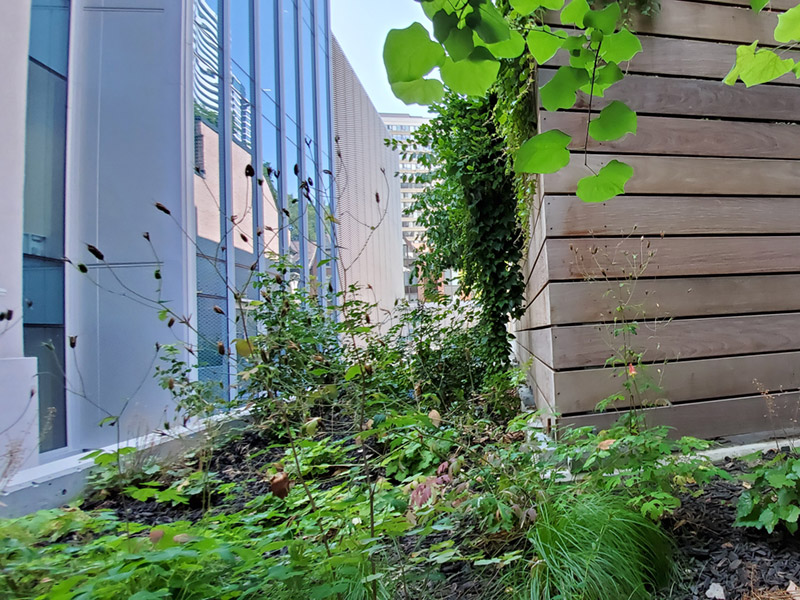
Stormwater management is an important part of Facilities’ sustainability action plan which is accomplished by designing water efficient landscaping. By managing the stormwater locally, TMU helps the City of Toronto (external link) with their management, which translates into significant environmental benefits. Vegetated landscaping and roofs help with stormwater management by reducing the runoff and absorbing most of it, before it gets to the city sewers. Vegetated roofs exist on the Centre for Urban Innovation (CUI), DCC, George Vari Engineering and Computing Centre (ENG) and SLC.
The DCC and CUI buildings also include stormwater capture that collects rainwater and stores it in a cistern. The accumulated rainwater is the primary source of irrigation for the CUI and DCC green roofs.
Water efficient landscaping also contributes to reducing heat island effects and buildings’ cooling requirements.
In the case of the Campus Core Revitalization project, the landscaping uses underground cells that are an integrated tree and stormwater system. They capture and retain stormwater in a matrix that emulates a tree-root structure. This creates a bioretention system that facilitates natural filtration, storage and recharge of stormwater runoff that enters the system through permeable pavers or drainage systems.
The cells can hold significant amounts of uncompacted soil while still providing the structural support required for the surfaces above (they are strong enough to support a roadway). The expanded soil volumes within the structural framework create conditions that are very similar to those of a heavy growth forest, which is particularly beneficial to urban trees which otherwise are often planted in concrete boxes that limit their root expansion.
Read more about Silva Cells and how they work (external link) .
Protecting our waterways and preventing pollution
TMU has a number of processes in place designed to prevent polluted water from entering the municipal water system and damaging our waterways.
- Infrastructure protections: Facilities Management and Development completes annual testing of all campus backflow preventers to ensure potable water is not contaminated. The university has 39 premise isolation devices that fall under the City of Toronto Backflow Prevention Program; results of annual testing are submitted to the City.
- Incident and spill response: Environmental Health and Safety oversees protocols to prevent and respond to pollution caused by accidents and incidents on campus. This includes chemical storage and handling requirements, spill prevention and cleanup procedures and incident reporting and response systems designed to minimize risk to the water system.
Sustainable water extraction
TMU does not directly extract water from aquifers, lakes or rivers. All water used on campus is supplied by the municipal system, which follows provincial regulations to ensure sustainable withdrawal and treatment of water resources.
TMU supports this sustainability framework by monitoring water consumption, implementing conservation measures across campus and employing drought-tolerant landscaping and efficient building systems that reduce reliance on freshwater withdrawals and minimize the use of city-treated potable water.
Additional TMU initiatives
Urban Farm at TMU
The Urban Farm at TMU atop the ENG building and DCC’s roof also helps with capturing rainwater and reducing stormwater runoff by nature of design and function. Plus they produce organic vegetables that are sold to the community!
Urban Water Research Centre
A multi-disciplinary collective of over 40 experts working on water capture strategies to ensure the development of resilient sustainable cities.