Undergraduate

A World-Class Interior Design Education in Downtown Toronto
Immerse yourself in one of the world's leading accredited interior design programs. Based in the heart of Toronto, TMU blends rigorous academic training with hands-on, studio-based learning. From residential and retail environments to hospitality, workplace, and healthcare spaces, you’ll explore every dimension of interior design—with a core focus on safety, human wellness, inclusion, and sustainable practice.
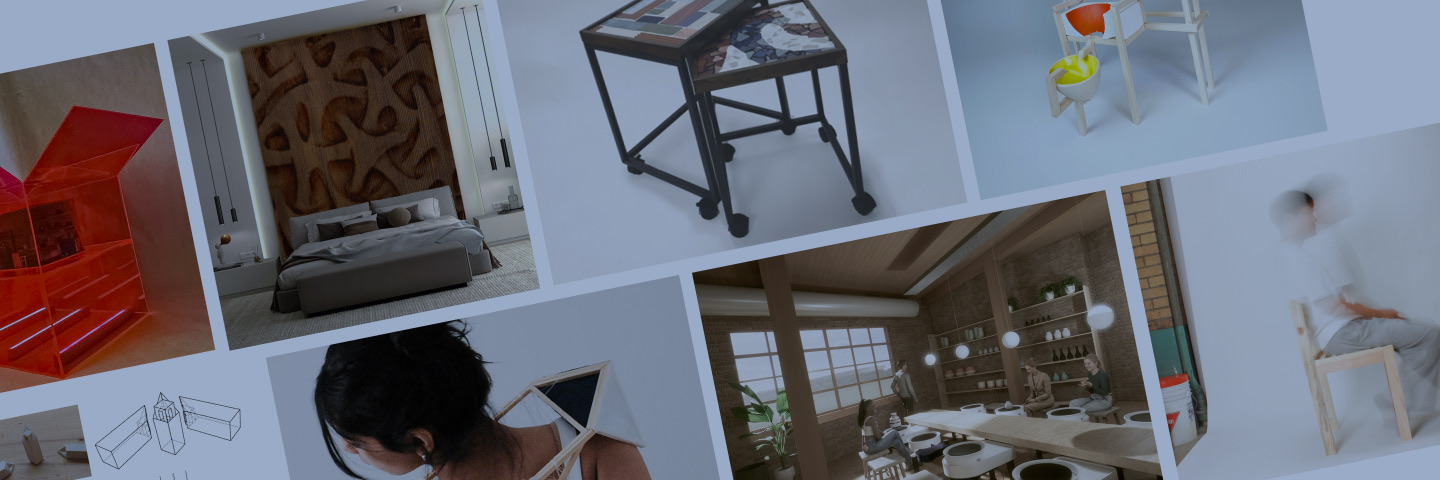
Our curriculum emphasizes three-dimensional spatial design, backed by state-of-the-art facilities that bring your ideas to life. Develop advanced technical skills in digital fabrication, 3D rendering, and emerging design technologies. Students have direct access to a dedicated woodworking shop, vacuum-forming technology, a 3-Axis CNC router, and a fully equipped ceramics and casting studio for experimental, conceptual design.

Degree Earned
Bachelor of Fine Arts (BFA) in Interior Design
Format & Duration
4-Year Full-Time Accredited Undergraduate Degree
Experiential Learning
Mandatory Internship • Optional Co-op (starting after Year 2) • Global Learning Opportunities
Licensure Pathways
Provides clear, direct pathways toward professional licensure
Admissions
Grades Plus Program (Evaluates both Academic and Non-Academic Requirements)

About Interior Design
The accredited Interior Design program at Toronto Metropolitan University prepares graduates and future industry leaders for professional careers in interior design and related fields. Accredited by the Council for Interior Design Accreditation (CIDA) since 1982 and maintaining continuous good standing, the program provides clear pathways to licensure, enabling students to enter the field with confidence.
Many alumni go on to achieve professional licensure and assume leadership positions in global, national, and regional associations, including the Association of Registered Interior Designers of Ontario (ARIDO), Interior Designers of Canada (IDC), and CIDA.
Did You Know? In Ontario, "Interior Designer" is a protected title granted by ARIDO to qualified candidates who meet specific licensure requirements.
Curriculum Structure
- Year 1 | Common Foundation: Establishes a baseline in design theory, fundamental knowledge, and technical skills while building self-directed study habits under faculty guidance.
- Year 2 | Core Professional Practice: Introduces specialized interior design coursework alongside supporting developmental studies. Optional co-op placements and internships begin after Year 2.
- Years 3 & 4 | Advanced Studios & Specialization: Exposes students to advanced practice and research-led studios, enabling them to gain broad design experience or focus on a specific area of interest.
- Design Studios: The backbone of the curriculum, where students synthesize technical skills and theoretical knowledge to solve complex spatial problems.
- Liberal Arts & History: Courses in humanities, social sciences, and design theory build intellectual depth and address the legal, social, and ethical responsibilities of professional practice.
- Design Communication: Comprehensive training in professional visualization techniques, written communication, and oral presentation.
- Technology & Systems: In-depth coverage of building regulations, interior construction, material finishes, building services, sustainable practices, universal design, and environmental health.
- Work-Integrated Learning: Internships and co-op options provide hands-on industry experience prior to graduation.
- Prepare students for industry leadership and advanced post-graduate study.
- Cultivate broad expertise in interior environments alongside complementary design disciplines.
- Build high-level competencies in fundamental design, visual communication, and fabrication.
- Instill a critical understanding of the history of interior design and its theoretical frameworks.
- Anchor all learning in social justice, sustainability, and emerging professional practices.
Student Attrition and Retention
- 94.7% of students admitted in the fall of 2023 returned in the fall of 2024, resulting in a 5.3% attrition rate.
- 79.0% of students admitted in the fall of 2022 returned in the fall of 2024, resulting in a two-year attrition rate of 21.0%.
- 82.0% of students admitted in the fall of 2021 returned in the fall of 2024, resulting in a three-year attrition rate of 18.0%.
Graduation Rates (MCU Methodology):
- 2017 cohort, graduated by 2024: 76.9%.
Acceptance into Graduate Programs:
- 29% of 2024 graduates applied to grad school, and 60% were accepted.
Job Placement Rates:
Approximately 88.4% of students who graduated in 2021 were employed in interior design or a related profession after two years.
Students are required to complete a 400-hour internship before graduation. During this time, job placement is 100%.
The Interior Design program offers an optional co-op stream. Students need to apply for the co-op stream in the summer after their first year. Then they will go through work term search preparation and the actual search during their second year, to start their first work term in the Fall of their third year. Students in the co-op stream are required to complete at least three of the four scheduled work terms, each of which must include at least 12 weeks of full-time employment, for a total of 420 hours (12 x 35 hours/week). For details, refer to the "How Co-op Works" page on the Career, Co-op and Student Success Centre website.
*Statistics are from https://www.torontomu.ca/university-planning/data-statistics/key-statistics/. These numbers were published in 2024 or 2025 and are the most current available.
Explore Your Journey
Career Pathways
- Interior Designer
- Exhibit Design
- Set Design
- Sustainability Consultant
Employers
Employers range from national to international firms.
- AKB
- Bjarke Ingels Group: BIG
- Dialog
- Snohetta
- Studio Munge
- Mason Studios
- OMA
- Yabu Pushelberg