Advances in machine learning could expedite diagnosis and treatment of chronic lung disease
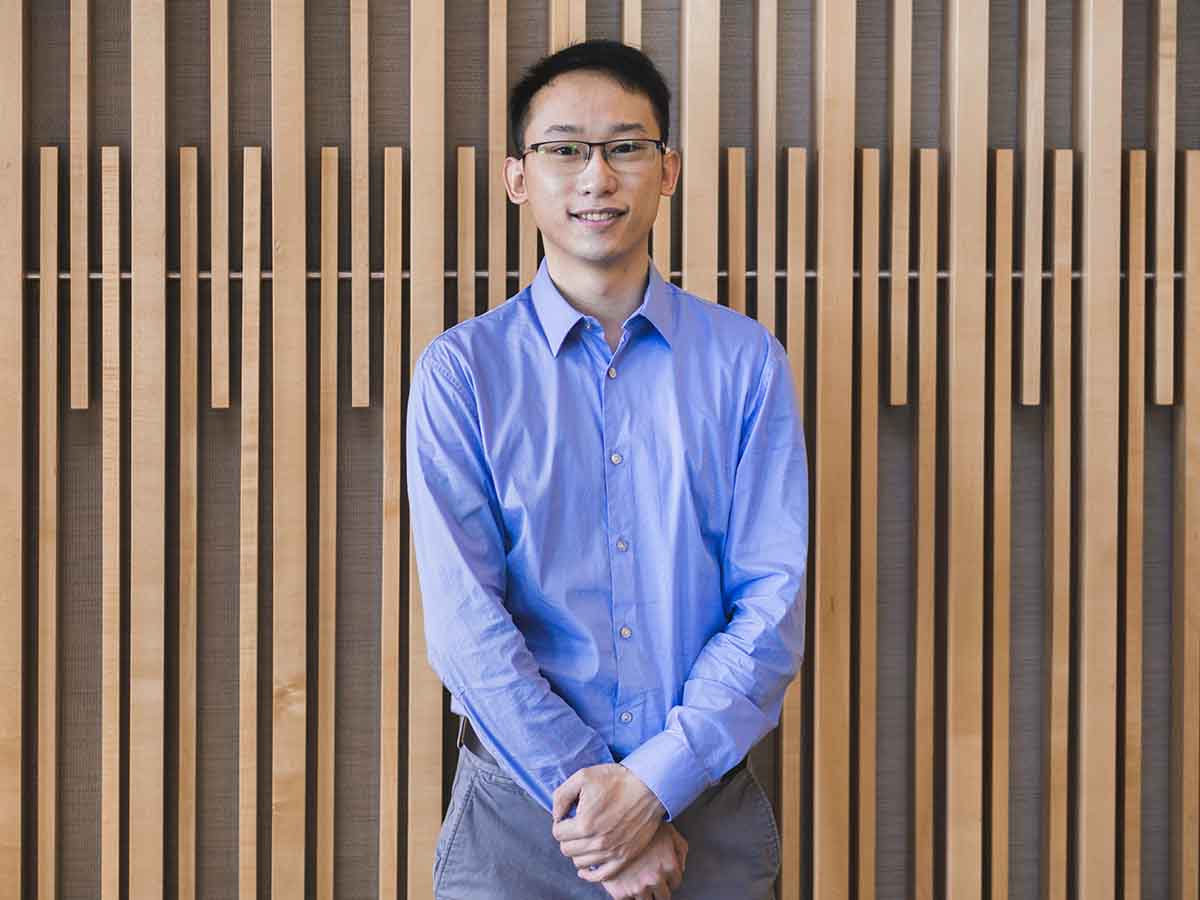
Ryan Au, MSc (Physics '21)
Chronic obstructive pulmonary disease (COPD) is the third leading cause of death worldwide (external link) . It’s irreversible, incurable and makes breathing increasingly difficult over time. 1.6 million Canadians are already diagnosed, yet just as many have COPD and don’t even know it* (external link) . Early detection is important, and artificial intelligence is making the task easier.
When fed large quantities of medical images of both diseased and healthy lungs, computers can spot patterns that are difficult — if not impossible — for human eyes to detect. The learnings are then used to build machine learning models to help identify if a patient has COPD and its severity.
Radiomics is one analytical technique that extracts quantitative insights from medical images. It’s not currently used in clinic, however, in part due to the limitations of image pre-processing. This important step helps enhance the quality of images, remove noisy data or otherwise improve readability for computers.
Image pre-processing methods abound. Until now, no one has investigated whether any single technique provides superior results for classifying COPD through radiomics analysis — or if one is just as good as the next. Ryerson master’s graduate Ryan Au (external link) (Physics ‘21) found the answer. Working under Dr. Miranda Kirby, Canada Research Chair in Quantitative Imaging, their paper was published in Physics in Medicine & Biology (external link) .
“There’s so much information that can be extracted by radiomics, but results can be hard to interpret,” says Au. “My job was to consolidate all commonly used image pre-processing methods and see which worked best on CT images of lungs before applying radiomics analysis. It’s not a flashy topic, but it’s important because it could help standardize practices for machine learning — and ultimately lead to quicker, earlier and more accurate diagnosis and treatment of lung disease.”
‘Seeing’ texture in the lungs
Radiomics analysis can capture all kinds of quantitative information about bodily tissues from medical images — volume, shape surface, density, etc. Au’s research focused specifically on texture.
“Texture in the lung can be seen in different spatial relationships between voxels (or volumetric pixels). These are like the tiny squares of coloured pixels in a 2D photo, except voxels represent cubes in a 3D grid,” Au explains.
“Each voxel has a unique intensity. Black is represented by a low number, like zero. White would be a large number, like 353, and different shades of grey in between. We determine how many times black voxels appear next to white, light grey, dark grey, etc., and then we measure the patterns that reveal the degree of airflow limitation in COPD patients.”
Au assessed three common pre-processing techniques that aim to increase readability of CT images — binning, edgmentation and thresholding. By creating a pre-processing pipeline, Au ran the images through a set of options and workflows — such as removing certain airway structures or not, resampling the images to a uniform voxel dimension or not — and then applied one (or none) of the three techniques. In total, Au experimented with 16 different combinations.
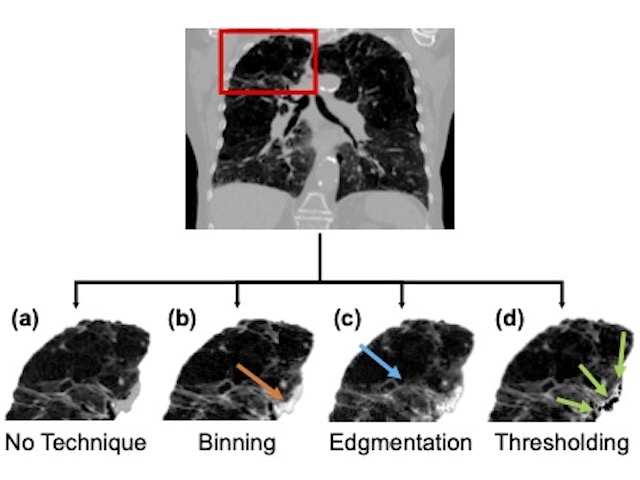
Fig. 1: Original CT scan of lung (top), with sample area of lung to be pre-processed enclosed in red box and shown below.
Image pre-processing techniques and texture differences identified: (A) No technique. (B) Binning shows more blurriness. (C) Edgementation shows clear demarcations between diseased and healthy lung tissue. (D) Thresholding shows removed areas not representative of COPD.
Choice of image pre-processing matters
Au’s research revealed that various image pre-processing methods did, indeed, result in significant differences in texture-based radiomics feature extraction.
“We got the best results when the images were first resampled to a uniform dimension, and then pre-processed using edgmentation or thresholding,” says Au. “Machine learning models based on these two combinations performed the best in classifying the severity of patients’ airflow limitations.”
Further complementary research is needed, but Au is optimistic.
“Our results provide the foundation on how radiomics analysis can potentially be implemented in the clinic. Standardizing image pre-processing is an important step in supporting more robust machine learning models for COPD diagnosis, decision-making and prediction of future outcomes. This is why I enjoy imaging research in physics; I get to apply the technical side for the clinic and hopefully contribute to improving the patient experience.”
Funding and support for the research was funded by the Natural Sciences and Engineering Research Council of Canada (NSERC), the Parker B. Francis Fellowship Program and the Canada Research Chair Program (Tier II).