Mike Moore: On scaling the steep path into medical physics career success
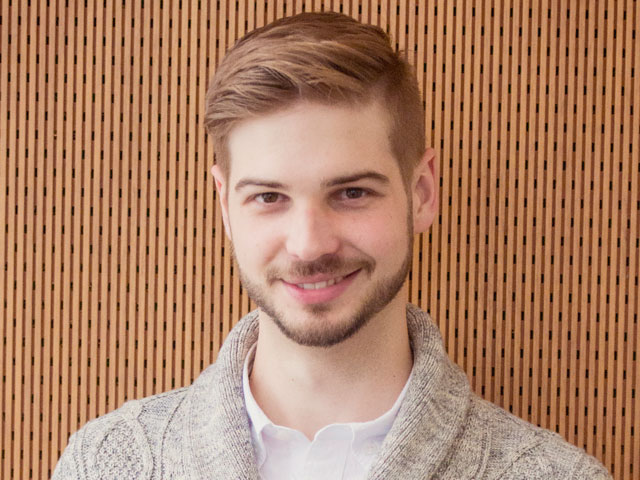
Mike Moore, Biomedical Physics ‘18
Talk with Mike Moore (external link) (Biomedical Physics ‘18) and you quickly sense the picture of well-rounded PhD success — energetic, accomplished, intelligent, friendly, well-spoken. Few would ever guess that the physics alumnus always grappled with imposter syndrome.
But after 13 years of planning, focus and hard work, Moore prevailed. He’s completed the lengthy qualification path and landed a position as Medical Physicist at Niagara Health (external link) in a highly competitive Canadian job market. He recently sat down with us to share insightful reflections, tips and encouragement for others travelling a similar path.
You’re very open about struggles with self-confidence. How did you manage?
Imposter syndrome is real! I had good marks, but didn’t always believe in myself. So, when I first came to Ryerson, I remember being scared of everything. A friend gave me some good advice, and I decided to just start saying ‘yes’ to every opportunity that came my way. The natural inclination is to pass when things feel uncomfortable, but it was by pushing my own boundaries that I grew the most.
It’s also good to surround yourself with people who might seem intimidating at first — and then learn from them! Sometimes, you’ll feel like you’re not the smartest person in the room, but that’s ok. Coming to terms with that was life changing.
Each step along your path was a transition. How did you evolve from undergraduate to PhD to resident?
During undergrad, you’re in absorbing mode — taking in lots of new information, theory, books. But in graduate school, you’re expected to actually contribute new findings to the body of scientific knowledge. That was daunting. I thought: ‘other people have already thought of everything, what more can I possibly contribute?’ But I enjoyed the challenge and creativity in asking ‘what happens if I do xyz?’, and then designing experiments to test it out.
After graduation, I was a resident in the radiation oncology physics program at Grand River Hospital in Kitchener-Waterloo. That’s when I got to see firsthand how everything I learned in class got applied to patients in clinic, which was really neat!
What’s it like now working as a medical physicist?
Working full-time in the clinic is another major step forward. It’s one thing to be a resident talking with a senior physicist about what to do if scenario ‘x’ happens. But being the medical physicist yourself, you’re responsible for coming up with the answers. You get lots of questions, calls from staff, consults with doctors. You never know what’s going to happen each day. A machine could stop working, you need to ensure safe performance, etc. It’s all real. The risks are higher, and your work can have a direct, positive impact on people.
How did your time at Ryerson prepare you for success?
My experience at Ryerson was fantastic. The CAMPEP program was a huge advantage. It’s the only one in Toronto, and I was in the first cohort. It can give you a leg up for some of the modules you’ll face in residency.
Communication skills are another thing Ryerson does well in preparing students. You may have good ideas, but if you can’t translate and communicate them to a non-expert, you might have problems in the real working world. During my PhD, we had a mandatory science communication course to practice honing those skills, and I also got to attend and present at conferences and competitions.
I also appreciated working with Dr. Michael Kolios. He was everything you could hope for in a supervisor. The whole ecosystem at Ryerson fosters opportunities to grow, thrive and collaborate. My research focused on photoacoustics (combining laser with ultrasound) to ‘listen’ for signals produced by individual cells. One application was early detection of cancer cells in blood samples. I’m very happy in the clinic, but Ryerson opened my eyes to scientific creativity, and I’d love to continue with some research; especially with the exciting synergies I see between photoacoustics and radiation oncology.
What advice would you give to students?
So much is about who you know at the right time. During my undergrad at Waterloo, I had two co-op placements at Grand River Hospital. So, when I applied for residency there, I already knew people. Same with my current job. I reached out to a fellow alumnus, Raphael Jakubovic, near the end of my residency and heard that they might be looking to fill a role at Niagara Health in the near future.
Get all your ducks in a row early on. Even during undergrad, reach out to a cancer centre. Let them know you’re interested. Any medical physicist would be more than happy to chat with you about the field. Build your networking and communication skills. Seize your opportunities!