Alumna Success: Ping Gong talks Mayo Clinic and career in research
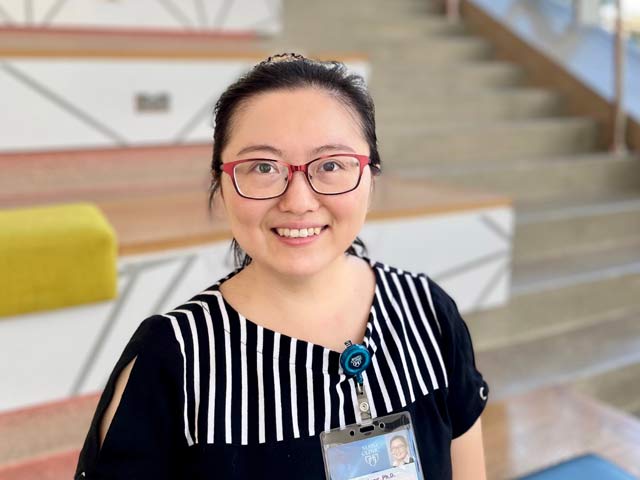
Ping Gong, Biomedical Physics ’15
Ryerson alumna Ping Gong (external link) (Biomedical Physics ’15) is living the dream. After earning her PhD in just three years, the hard-working graduate was offered a position at the renowned Mayo Clinic (external link) — home to some of the best medical experts in the world. Since then, Gong has been researching ultrasound imaging at the centre’s Minneapolis campus and steadily translating her innovations from bench to bedside.
Career Focus: Full-Time Research
Medical physics students often aim for a career in clinical work. Gong struck a different path. Building on a background in engineering, she knew early on that her passion was in research and development.
“My undergraduate degree was in biomedical engineering. But it wasn’t until my Master’s program in electrical and computer engineering that I began exploring ultrasound technology and discovered my real interest,” says Gong. “It was during my PhD at Ryerson that I really got to really expertise in it. Now as a full-time research engineer, I get to use my knowledge to benefit patients, and see my technology developments applied in the real world. It’s definitely the career I wanted.”
Working Life at Mayo Clinic
Gong began her journey at Mayo Clinic in 2016 as a Research Fellow. Moving steadily up the ranks, her latest promotion was to Assistant Professor in 2020.
“Mayo is a non-profit, academic medical center. So, it has a graduate school, but a small student body,” Gong explains. “Teaching duties make up only 5-10% of my work — generally through guest lectures and seminars for medical students. Beyond that, my work is mostly spent doing research.”
For Gong, Mayo has the advantage of an integrated research-clinical environment: “Researchers here have so many great opportunities to interact with different people. You can easily chat with doctors about the latest clinical needs, get the industry angle from engineers, and then combine both into a research project. Once you’ve developed the new technology, it’s easy to conduct clinical trials right on campus.”
New Developments in Imaging Quality
During her PhD, Gong worked on improving ultrasound image quality under the supervision of professors Yuan Xu and Michael Kolios. Now at Mayo Clinic, Gong has a lot of research on the go.
She holds several grants from the National Institute of Health, the world’s largest public funder of biomedical research. Some of her technologies are now licensed by commercial companies — including one ultrasound technology to quantify the amount of fat in patients with fatty liver disease.
She’s now working on using microbubbles to create image contrast between blood and bodily tissue for coronary heart disease.
“In some patients, such as those with a high body mass index, it can be difficult to visualize the border between tissue and heart ventricles,” she explains. “Microbubbles help create better contrast in ultrasound images, but with one catch: the bubbles may burst under high acoustic pressure. So, I’m working on a new transmission design to keep the bubbles intact within the required acoustic range.”
Gong is also working on technology that can capture information within the body’s tiny microvessels (arterioles, capillaries, and venules) for use as biomarkers in diagnosing cancer.
Medical Physics: Reflections and Outlook
Like numerous Ryerson physics alumni, Gong recognizes the impact of the graduate program on her career success.
“PhD life can have all kinds of challenges and difficulties, so it’s important to stay positive,” she says frankly. “I appreciate how supportive and encouraging the entire department was. The coursework was also very diverse, and the training from my supervisors helped a lot — so many opportunities to conduct research, write first-author publications, and attend international conferences.”
Looking ahead, Gong sees no shortage of opportunities for next-generation medical physics students.
“There will be a continued high demand for people with a medical physics background. The key is to find your interests and goals and then work hard towards that. In my case, I wanted to bridge the gap between research and clinical engineering. Now, as a researcher, the most exciting thing is seeing my work benefiting patients and improving their outcomes. It’s very satisfying!”