Physics Graduate Alumni Success: Reyhaneh Nosrati, PhD (Biomedical Physics ’19)
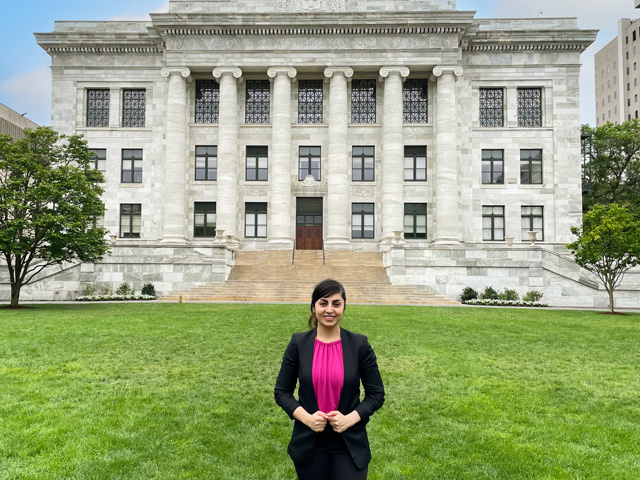
Reyhaneh Nosrati, PhD (Biomedical Physics ’19)
When Reyhaneh Nosrati immigrated to Canada in 2012, she came with limited English proficiency and, as she describes it “not a great undergraduate GPA” — but also a deep interest in physics and medicine. Shortly after, she began an academic journey that has since become an outstanding success story in the Department of Physics.
After graduating with A+ GPA for both her CAMPEP-accredited master’s degree and PhD in Biomedical Physics at Ryerson, Nosrati entered Diagnostic Imaging Medical Physics Residency at Harvard Medical School.
She just finished, and was sought after for therapy residencies and job offers at several prestigious university hospitals, including Stanford, Mayo Clinic, Duke, Johns Hopkins and Harvard. But she withdrew all of her applications after being awarded one of Canada’s prestigious Banting Postdoctoral Fellowships. We recently caught up with the busy alumna for a chat.
Q: You’re very candid about your early struggles as a graduate student. How did you overcome them?
I’d only been in Canada for eight months before starting my MSc. I had to take an IELTS English language proficiency test, and retake some undergrad courses to build my foundation. But I was very motivated and optimistic. Professor Vladislav Toronov took me on as a Master student and gave me so many opportunities. Not everyone publishes during their master’s, but I wrote four papers and presented them at several international conferences! I was awarded two PhD scholarships (OGS, NSERC-CGS-D3).
Q: How did Ryerson set you up for success?
Ryerson gave me the chance to prove myself. The course work, instructors, research facilities and support were all high quality. That helped me build a solid background in physics, and as a result, I had a lot more confidence than students from other universities. In my 5.5 years at Ryerson, I gave over 20 conference presentations. All that practice improved my communication skills tremendously. It wouldn’t have been possible without the support from Ryerson and my supervisors.
Q: Your PhD research garnered interest among big industry names. What was that innovation?
Under the supervision of Dr. Greg Stanisz at Sunnybrook Hospital and Dr. Ana Pejović-Milić at Ryerson, I developed a novel Magnetic Resonance guided Radiation Therapy technique for prostate brachytherapy in which the radiation source (metallic seeds) are implanted into the prostate gland.
Treatment planning traditionally requires both MRI and computed tomography (CT) to visualize soft tissue and the implanted metallic seeds. I developed an MRI image processing algorithm to map the magnetic susceptibility of the imagining volume and visualize the metallic seeds without using CT. With this MRI-only workflow, we can see clearly soft tissues and metallic seeds with excellent contrast, all in one imaging session, with no unnecessary radiation from CT, no extra cost, and only a few extra minutes of MRI scan time.
Q: You just finished your residency at Harvard. What was it like training in the ivy league?
At first, it was like ‘Wow, I’m really going to Harvard!’ I was very excited but also stressed out. But when I got here, everyone was really nice, welcoming and easy to work with. In addition to extensive clinical training at different hospitals, I received intense research training, earned the trust of my collaborators, and soon started working on clinical research projects with different groups. I learned so much from the world class imaging scientists at radiology departments of Harvard teaching hospitals, especially at Boston Children’s Hospital.
Although the therapeutic medical physics program is generally more popular, probably due to the job market, I chose the diagnostic imaging residency. Imaging physics is more diverse and you get to learn about every single modality in depth. You can then easily identify clinical needs and opportunities to apply your imaging knowledge to improve both diagnosis and therapeutic procedures. I was in a multi-institutional joint program between four Harvard teaching hospitals but based at Boston Children’s. I did clinical rotations at all of them, with access to the state-of-the-art imaging equipment,image acquisition and post-processing techniques.
Q: Congratulations on your Banting Fellowship! What will you be working on?
Under the supervision of Drs. Georges El Fakhri and Matt Palmer, I’ll receive extensive training in nuclear medicine and research at Massachusetts General Hospital (MGH), which has the largest hospital-based research program in the U.S. My project focuses on hybrid imaging of cancer: positron emission tomography–magnetic resonance spectroscopic imaging (PET/MRSI) to image and plan radiotherapy treatment for glioblastoma, the most aggressive and lethal type of brain cancer. I’ll work with radiologists, engineers, imaging scientists and therapeutic physicists to develop a novel approach based on distinct metabolic properties of cancerous tissues, using PET/MRSI to improve the visibility of the gross tumor volume for radiotherapy treatment planning.
PET/MR is a relatively new hybrid imaging modality. I believe only five scanners exist in Canada. This fellowship represents a huge opportunity to learn about every aspect of this imaging technique, and would definitely open new doors for me in Canada.
Q: What do you foresee for the medical physics field?
A good outlook. It won’t go away any time soon. Artificial intelligence and machine learning may eventually take over many sub-specialities in medicine, but I doubt it’ll replace the role of medical physicists any time soon, especially in diagnostic imaging. We know how the system works from image acquisition to reconstruction so are able to problem solve and improve the diagnosis process. Diagnostic imaging is the basis of almost all medical diagnostics and an essential part of therapeutic medical physics. I think multidisciplinary training programs will soon exist, with both imaging and radiotherapy components to clinically train physicists with a deep understanding of every aspect of medical physics.
Q: What are your plans for your future?
I would love to be a professor and clinical scientist, but I’m open to other possibilities. After this fellowship, I’ll have a solid background in imaging, nuclear medicine and hopefully therapy. Very few have all three, and Canada has only a handful of clinical imaging medical physicists. Long-term, I plan to return to Canada, where opportunity began for me, and where I earned it all. My family is also there. So, I want to return and pay it back.