Semiotics
Semiotics & Culture Speaker Series
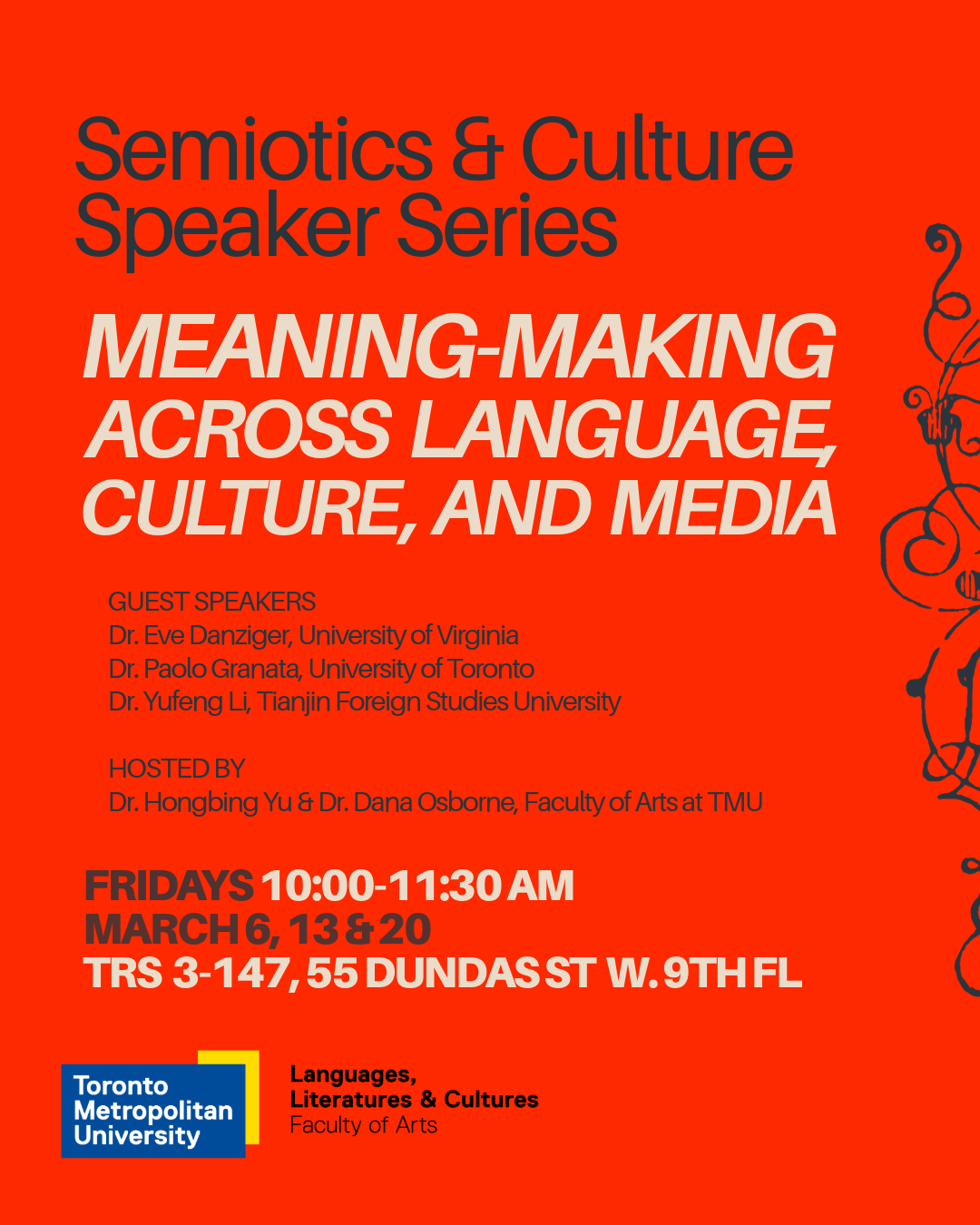
Languages, Literatures and Literatures' very own Dr. Hongbing Yu and Dr. Dana Osborne are launching a brand new speaker series. Join us throughout March at the Semiotics & Culture Speakers Series!
This year's theme is "Meaning-making across language, culture, and media". The three-part speaker series is presented with the kind support of the Faculty of Arts Events and Outreach Fund and the department.
Date: Fridays in March
Time: 10-11:30am
Location: TRS 3-147
Light refreshments will be served.
March 6, 2026
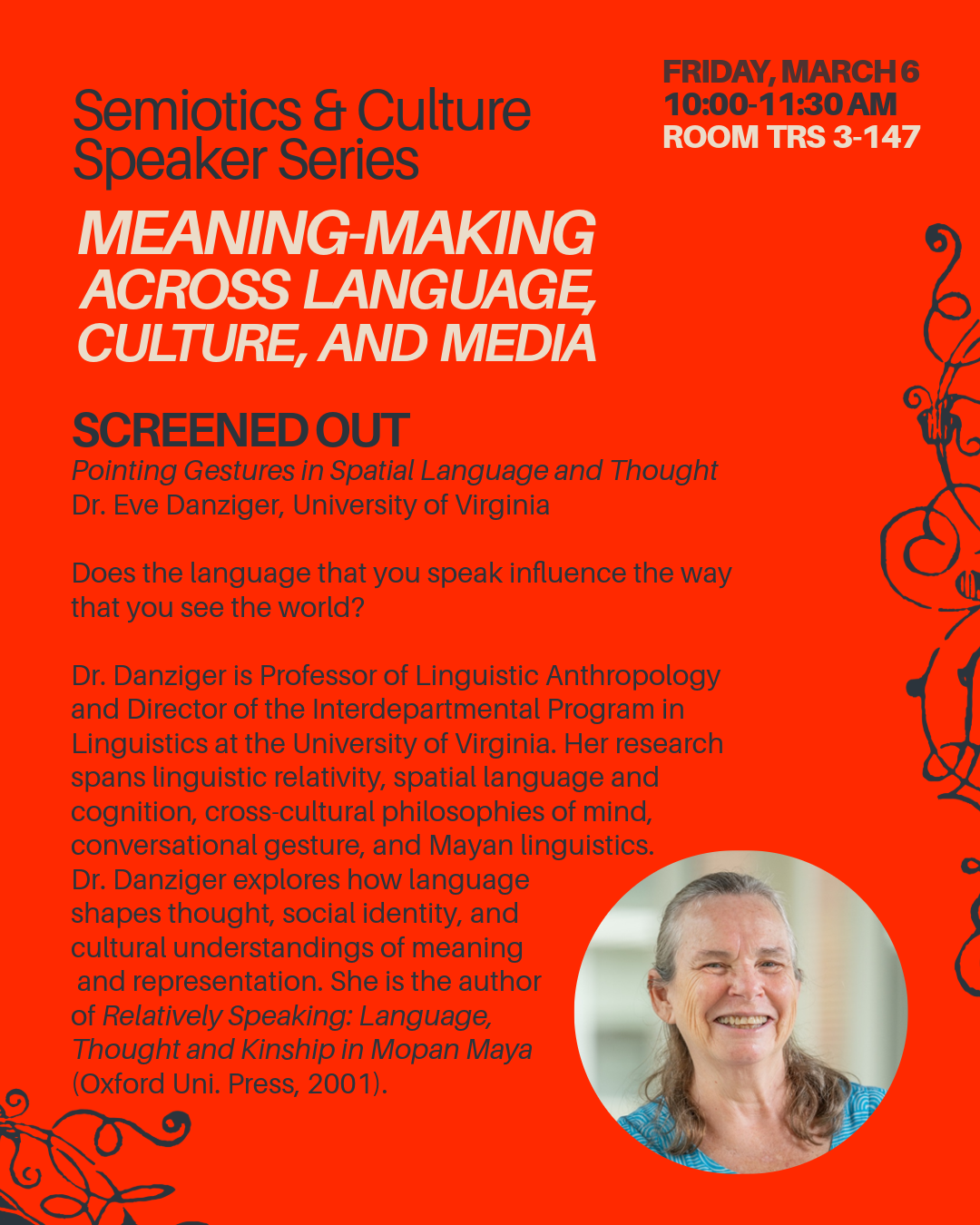
Abstract: Does the language that you speak influence the way that you see the world? Since the 1990s, “neo-Whorfian” work on this possibility (Lucy 1996, Danziger 2001) has proceeded by showing co-variation of preferences in speech and in non-speech problem-solving across different language populations. In this avenue of research, particularly influential findings have come from speech forms like “north” and “left” that are used to talk about locations in space (Pederson et al 1998, Levinson 2003). The present paper looks closely at a striking example of coordinated speech and gesture repair in a Mopan (Mayan) text from Eastern Central America, to show that it is not only lexical forms like “left” and “north” which participate in Whorfian alternations when talking about space, but also deictic forms like “here” and “this”. The fact that linguistic deixis has up to now been excluded from neo-Whorfian study of spatial language should be understood as a lapse of completeness in data collection, rather than well-motivated by analysis.
March 13, 2026
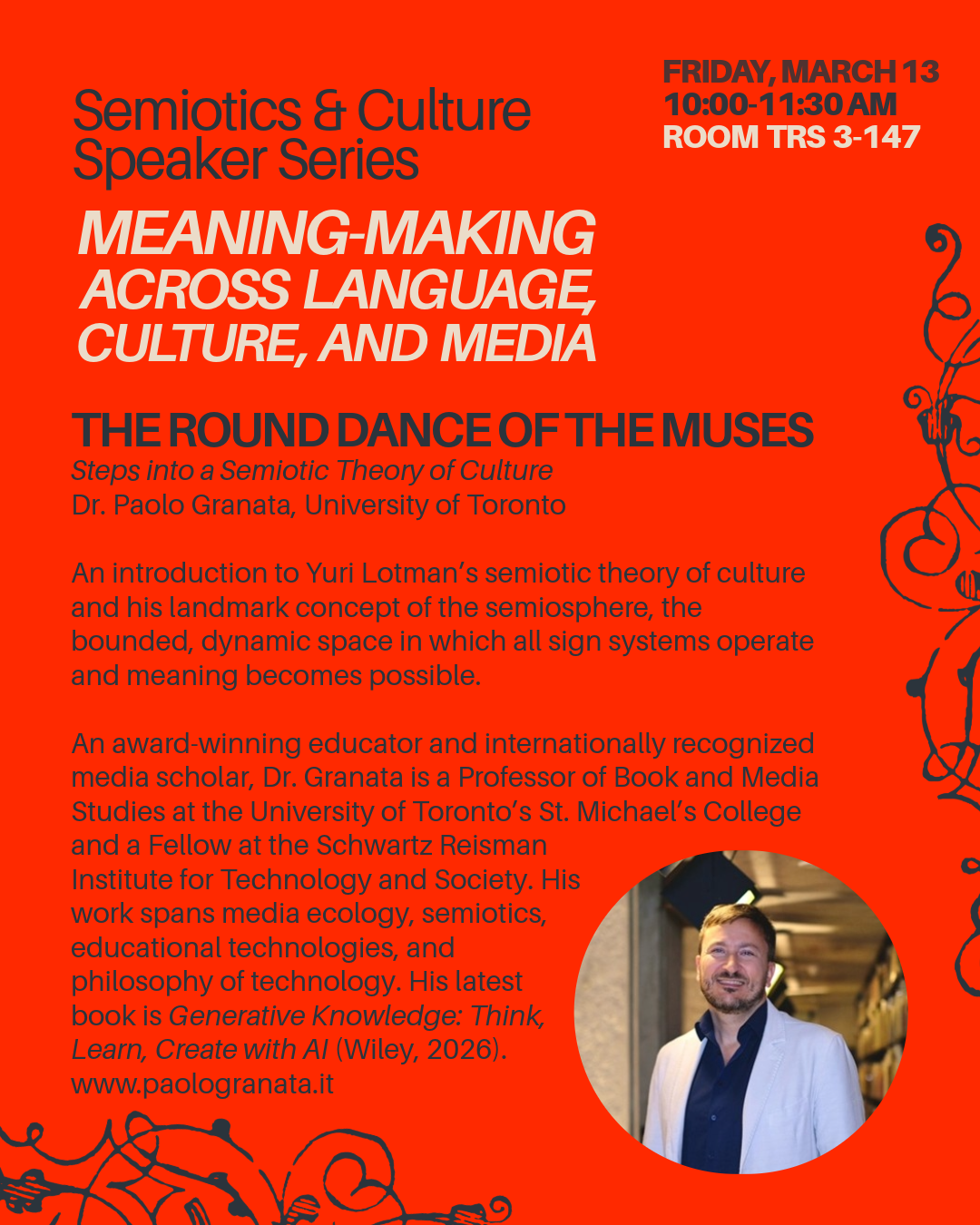
Abstract: This talk will introduce Yuri Lotman’s semiotic theory of culture and his landmark concept of the semiosphere, the bounded, dynamic space in which all sign systems operate and meaning becomes possible. Drawing on media ecology and cultural semiotics, Granata will show how Lotman’s framework illuminates the structure of our contemporary semantic environment, shaped increasingly by digital media and artificial intelligence. Students will gain new conceptual tools for analyzing how cultures produce, transmit, and contest meaning across texts, images, and artificial systems.
March 20, 2026
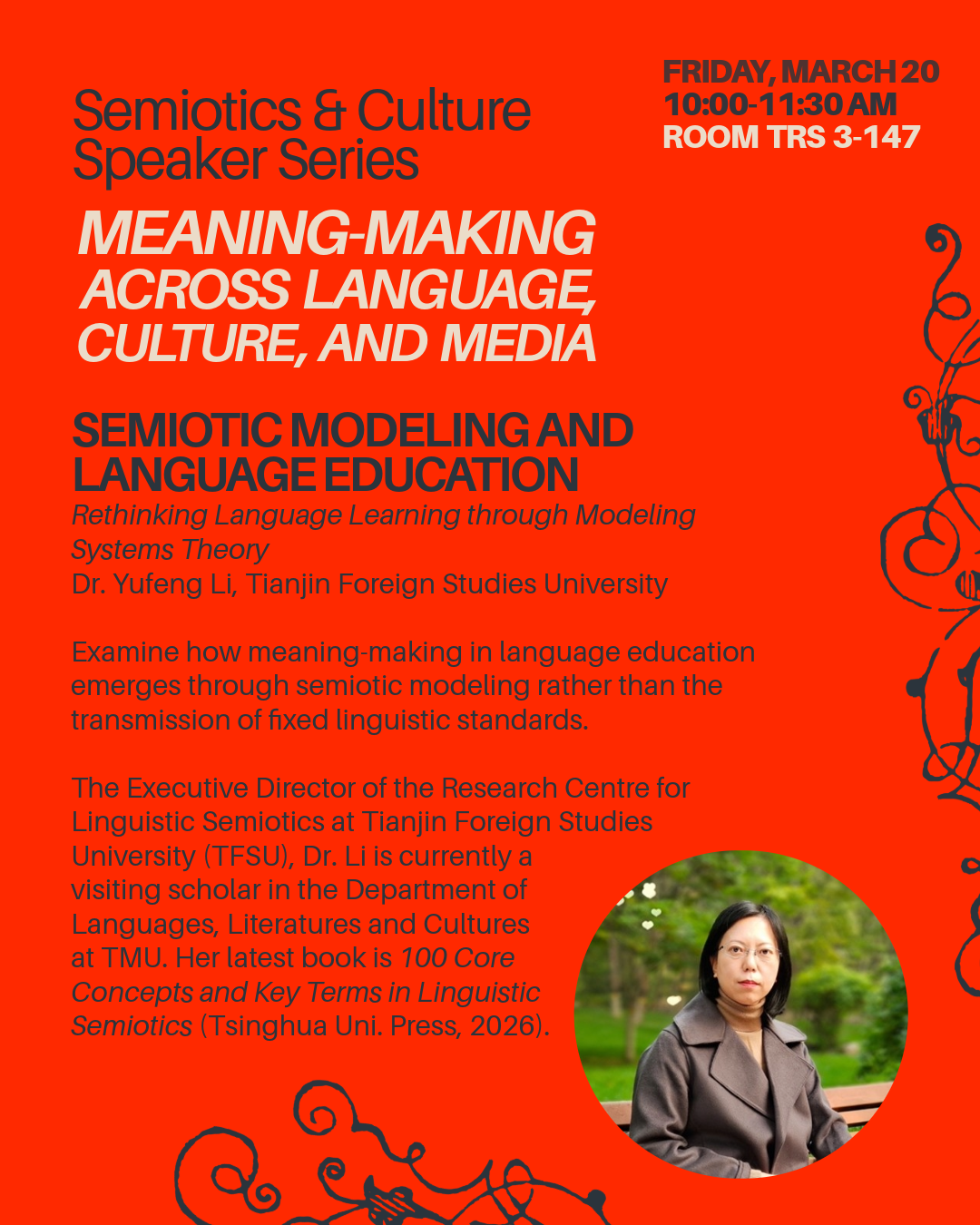
Abstract: Drawing on Thomas A. Sebeok’s modeling systems theory, this talk examines how meaning-making in language education emerges through semiotic modeling rather than the transmission of fixed linguistic standards. It challenges text-driven paradigms that treat textbooks as static repositories of knowledge, instead conceptualizing them as representational models that mediate cultural, social, and experiential meaning. Focusing on English language textbooks, the talk explores how semiotic modeling enables the regeneration of meaning across multiple cultural and interpretive levels. From this perspective, learning becomes a process of exploration, interpretation, and growth rather than mere acquisition. The analysis argues that textbooks can construct diverse orders of cultural signification that foster learners’ flexibility, social responsibility, and capacity for meaning negotiation. The talk concludes by advocating a modeling-based curriculum that frames language education as a collaborative semiotic process involving learners, educators, and cultural contexts.