Student team takes third in global space design competition.

Subsurface water ice, caves, and dunes are some of the many complexities that make surveying Mars for resources and finding sites for landing ambitious. This was the challenge proposed to undergraduate students around the world as part of the annual American Institute of Aeronautics and Astronautics (AIAA) Undergraduate Team Space Design Competition.
At Toronto Metropolitan University, aerospace engineering students in the AER-813 Space Systems Design Project class embraced the challenge, with one team developing a winning approach. Designed by a team of ten students, the ARES II Mars Orbiter project was awarded third place in the AIAA competition, and the Best Aerospace Capstone Award by the Faculty of Engineering and Architectural Science (FEAS).
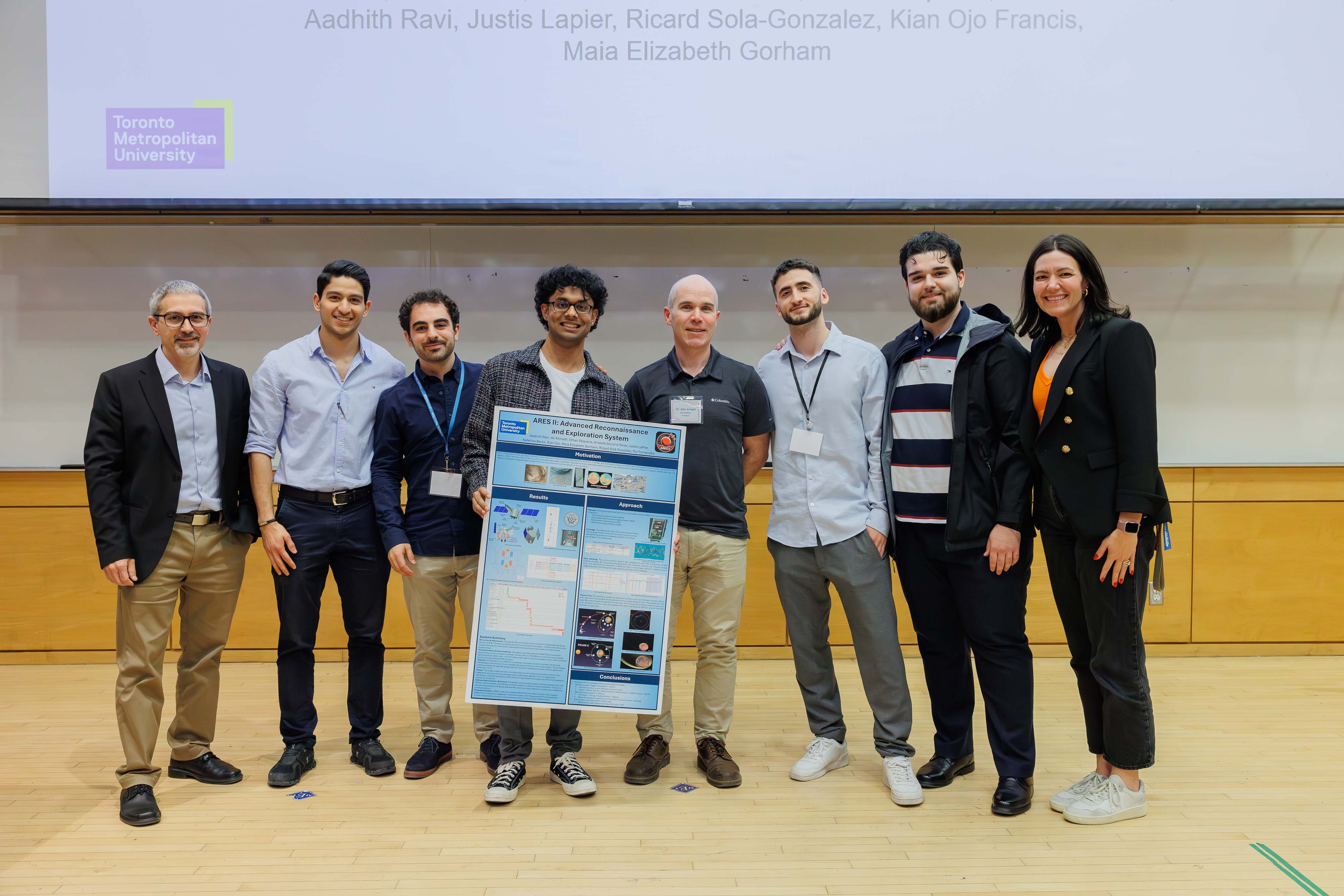
The ARES II team members receiving the Best Aerospace Capstone Award at the FEAS Engineering and Architectural Science Day. The full team includes Katerina Beros, Ali Ahmadi, Ernesto Socorro Perez, Ethan Sequeira, Rui Fernandez, Aadhith Ravi, Justis Lapier, Ricard Sola-Gonzalez, Kian Ojo Francis and Maia Elizabeth Gorham
The ARES II project team had to meet strict AIAA objectives, including providing scientific coverage of at least 75% of Mars by 2033 and being capable of collecting data until at least 2039. To achieve these mission objectives, the team designed an orbiter equipped with the scientific instruments needed to deliver the required resolution and coverage. They also planned a global data acquisition and return campaign to produce topography, hazard, and resource products. Simulations and analysis verified orbital maneuvers, instrument coverage, data return and communications, attitude accuracy, power and thermal performance, propulsion margins, and structural integrity. In short, the results demonstrated that ARES II is a mission-ready platform for the next generation of Mars exploration.
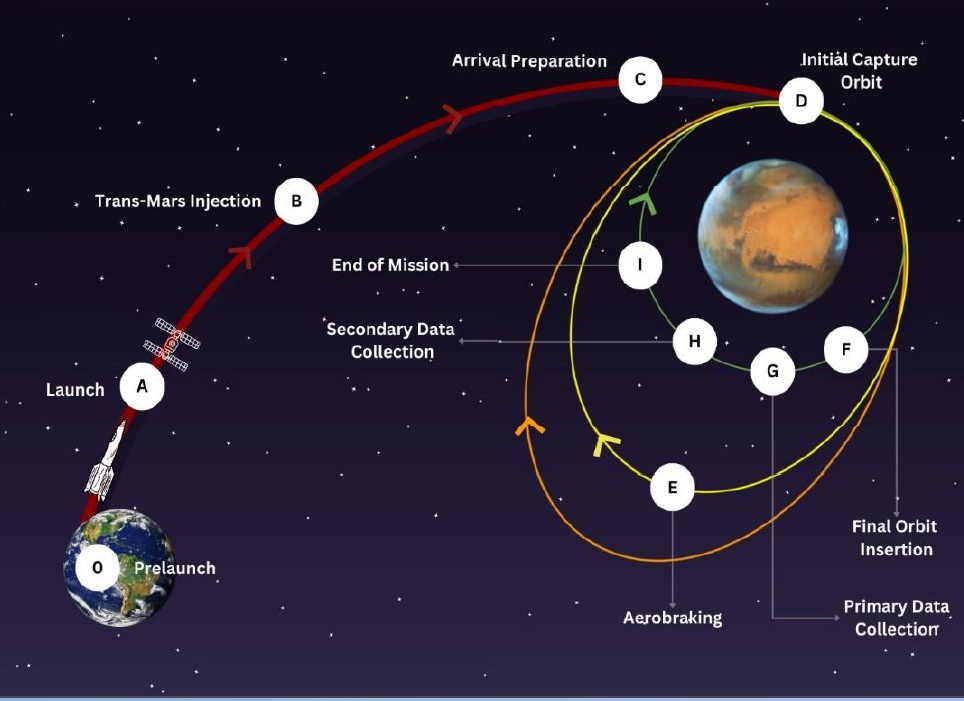
The ARES II mission plan: The satellite would be delivered into Mars orbit via a Hohmann transfer (Phase A-D), after which the satellite would decelerate to enter a highly elliptical orbit.
“The team was very clever in devising a mission plan that would adapt the instrument operations in response to the power available from their solar panels.”
Beyond the impressive technical feats, professor and supervisor John Enright commended the large team’s ability to collaborate. “It was great to see how the ARES II group delegated tasks and talked through disagreements,” he said. “These are vital skills which can be difficult to teach directly. The ARES II team did TMU proud.”
Next up, the team will travel to the 2026 AIAA SciTech Forum in January in Orlando, Florida to present their winning concept.
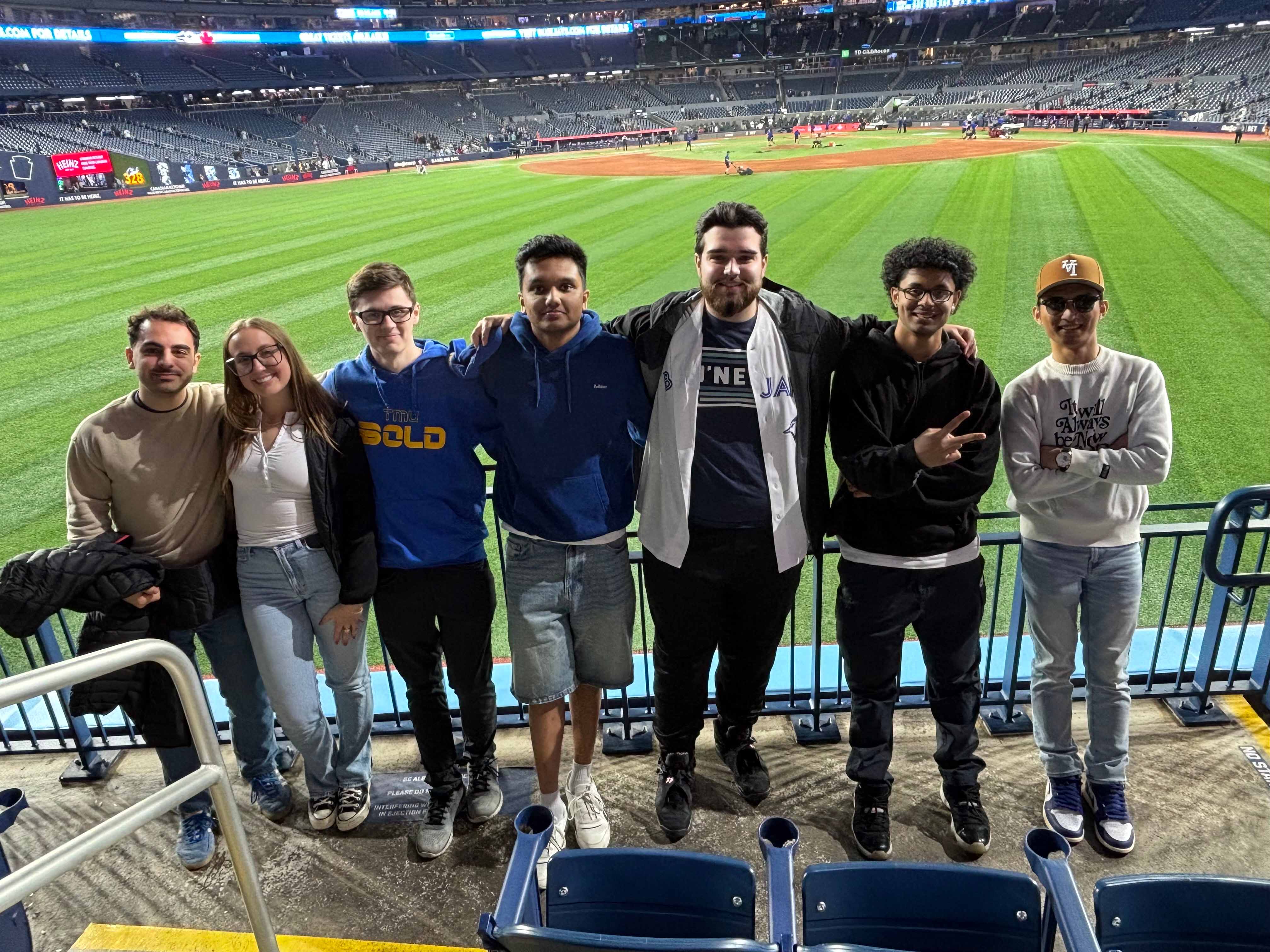
The ARES II project team bonding outside of the classroom at a Blue Jays game in Toronto.
The team shares a special thanks to professor Enright, and peers, Maria Barefoot and Cliff Chen.