Is “Artificial” Intelligence our good friend or our greatest adversary? TMU’s experts explain.
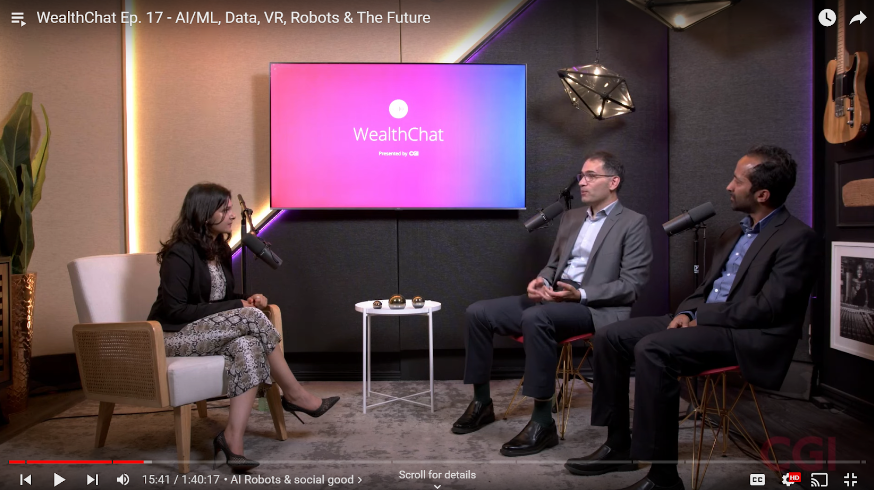
Last August, Faculty of Engineering and Architectural Science (FEAS) members and Artificial “Intelligence” researchers Dr. Ebrahim Bagheri and Dr. Naimul Khan sat down with Lubna Bibi, of CGI Global’s WealthChat podcast (external link) , to discuss the capacities, shortcomings, and risks of contemporary AI tools. Over the past couple of years, Generative AI programs, like ChatGPT and DALL-E, have wowed millions – even provoking concerns that they are becoming too intelligent. However, Bagheri and Khan encourage the public to think critically when engaging with AI software and its advertised abilities.
Drawing from their research, and the ever-growing body of AI knowledge, Bagheri and Khan explain that the adoption of AI tools is not in itself a value and that attempting to solve socio-economic problems with technology usually makes those problems worse. They explore the factors that have contributed to public hostility towards AI, such as the rapid pace of AI development, aggressive marketing by industry, and the inappropriate use of AI for prescriptive, rather than assistive purposes. Furthermore, they highlight that AI tools must be transparent for us to meaningfully consent to their use and that their opaqueness can conceal social biases that actively work against the best interests of their users.
Bagheri and Khan conclude that these problems can only be solved through interdisciplinary partnerships. In his Responsible Artificial Intelligence Lab at TMU, Bagheri and his colleagues are developing new methods of ethics training that are based on open dialogue, criticism, and collaboration between computer and social scientists. Khan works with healthcare professionals, and his TMU colleagues at the Creative School, to determine how AI and extended-reality technologies can improve outcomes for patients, and working conditions for practitioners, in Canada’s healthcare system.
- Watch the full episode (external link) of WealthChat on YouTube
- Listen on Spotify (external link) , Apple Podcasts (external link) , or wherever you find your podcasts.