Architectural science competition winners create innovative social agency-themed designs
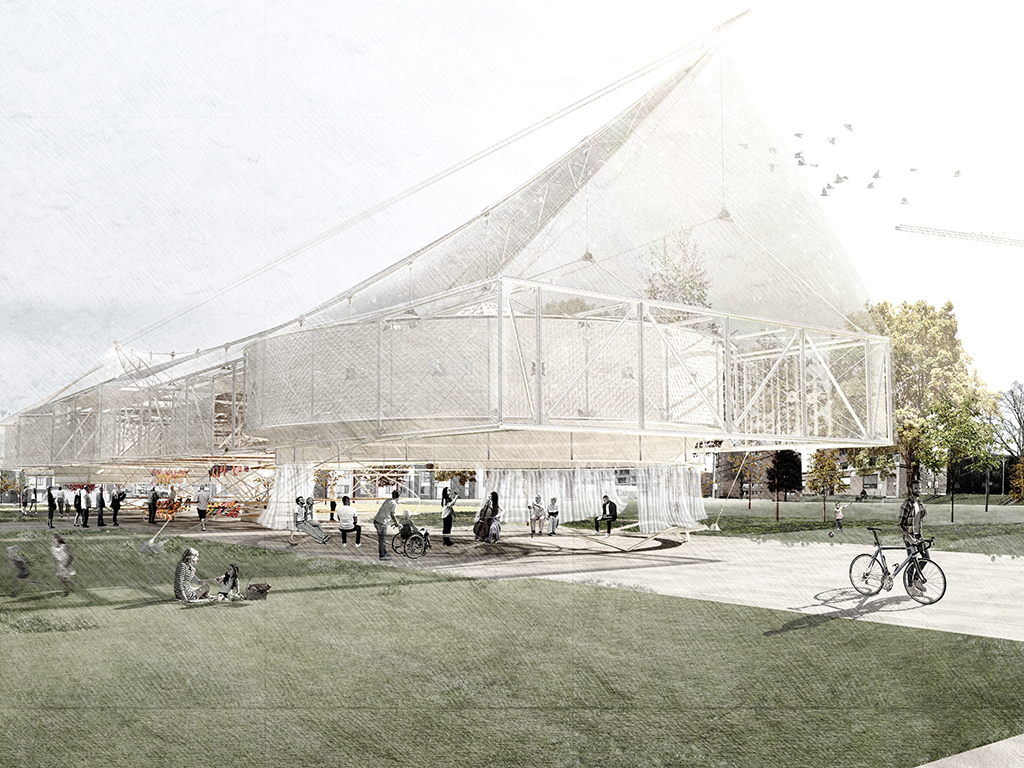
Thomas Gomez Ospina’s winning design competition entry “Clouds Over Regent Park.”
Despite the inability to collaborate in person due to COVID-19 pandemic restrictions, Department of Architectural Science (DAS) students and alumni gained valuable communication and abstract thinking skills while creating their winning competition designs remotely. From an ambitious steel structure to an unconventional “living” and “breathing” tower and a flexible housing-shortage solution, participants submitted innovative drawings with social impact recognized internationally and locally.
Clouds Over Regent Park
While working remotely as a full-time co-op student, fourth-year undergraduate student Thomas Gomez Ospina completed his winning design entry for the international ACSA 2021 Steel Design Student Competition (external link, opens in new window) . Chosen from more than 1,200 student entries worldwide, Ospina’s sophisticated proposal for a modular, suspended canopy entitled “Clouds Over Regent Park” won first place in the Open Steel Design category.
Ospina’s proposed canopy responds to community members’ needs through interactive, modular and kinetic design elements for activities such as food markets, performances, exhibitions and more. “The goal was to implement social agency as a design tool that empowers Regent Park’s members to come together and mend the divisive legacies of their difficult history,” he said.
“I received excellent mentorship from my faculty sponsor and supervisor, professor Vincent Hui,” said Ospina. “This, combined with FEAS’ encouragement to engage diverse communities and make positive change through innovation, motivated my ideas to impact the Regent Park community by experimenting with challenging design and structural methods.”
Thomas Gomez Ospina, fourth-year DAS student and winner at the ACSA 2021 Steel Design Student Competition
Living Water Tower: Vertical High Line on the Hudson River
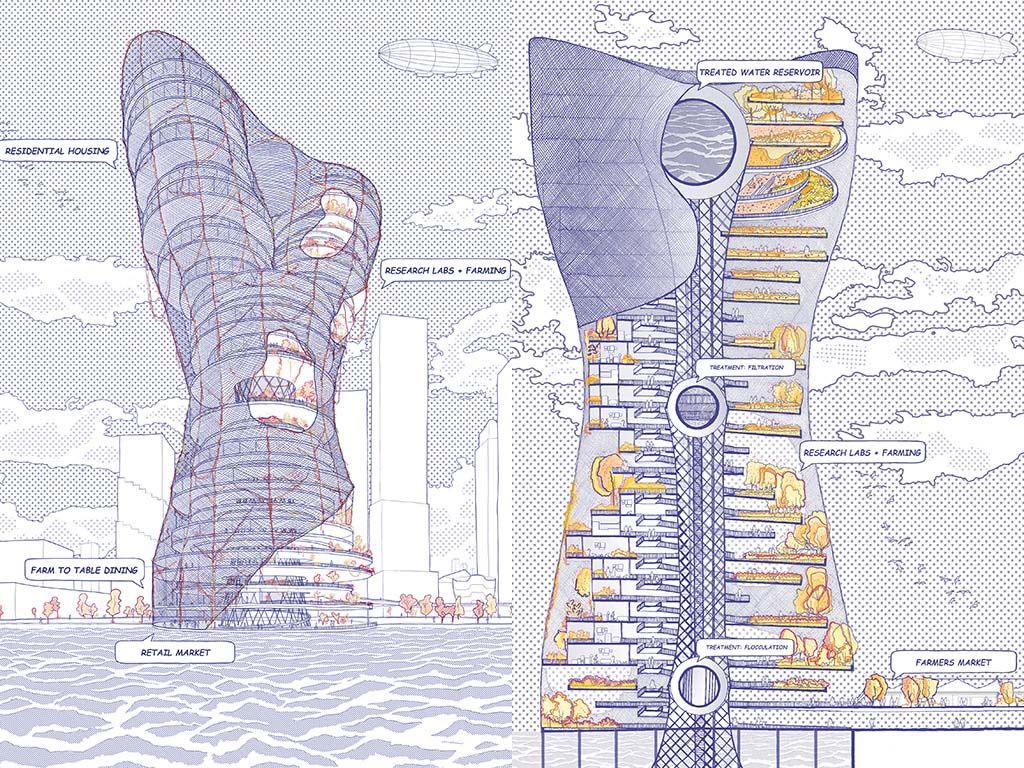
“Living Water Tower” drawings earned a grand prize in the 2021 Manhattan Wildscraper competition
With guidance from professor William Galloway, Master of Architectural Science students Nicola Caccavella, Kavita Garg, and Julianne Guevara created a grand prize-winning entry in the 2021 Manhattan Wildscraper competition (external link, opens in new window) . Their conceptual drawings of the “Living Water Tower,” located in New York’s Hudson Yards, depict a mixed-use, green skyscraper emphasizing filtration and purification processes of air and water. “This competition pushed us to design with biodiversity in mind, something all architects need in their careers now and in the future,” said Guevara.
According to Garg, Galloway’s inspiration, mentoring and support helped the team develop a well-informed design that considered user and design perspectives. “FEAS’ focus on the importance of innovative and imaginative design, and realistic and technical solutions, allowed our competition submission to shine,” said Guevara. “The MArch program helped me develop my communication skills and taught me the importance of conceptual and abstract thinking – two attributes I believe helped throughout this project,” said Caccavella.
Graduate students Kavita Garg, Nicola Caccavella and Julianne Guevara collaborated remotely on their winning design competition drawings
Grow-Line
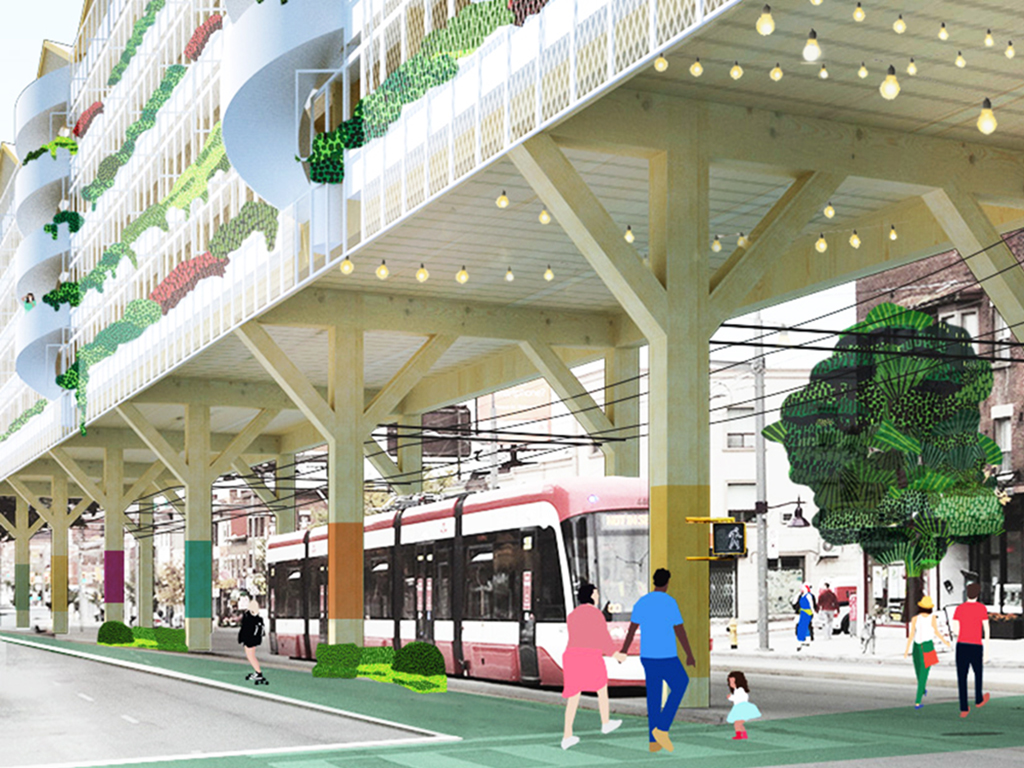
The “Grow-Line” design won an honourable mention at the Bee Breeders Toronto Affordable Housing Challenge
While they were DAS students, alumni Margot de Man, Architectural Science ‘14, Sarah Ives, Architectural Science ‘14, Ron Noble, Architectural Science (MArch) ’18, Mark Grimsrud, Architectural Science (MArch) ’ 14 and Newton Xian, Architectural Science ‘14, formed the ongoing design collective DBG Studio (Design Build Grow) (external link, opens in new window) . Under this umbrella and collaborating remotely across multiple countries, the team competed in the Bee Breeders Toronto Affordable Housing Competition (external link, opens in new window) and earned an honourable mention for their “Grow-Line” design.
This competition asked entrants to answer the question ‘What role can designers play in proposing solutions to Toronto’s housing crises?’ “Our concept supports a diverse group of people who don’t always live within a traditional nuclear family arrangement, with units that can grow within the linear infrastructure of the built form,” said the team.
The team continues to apply a robust methodology rooted in sustainability to design-build events, skills they learned through the DAS curriculum. “The university prepared us to think critically about affordability and taught us that our actions as architects are linked to environmental, political, social and economic contexts,” said the team.
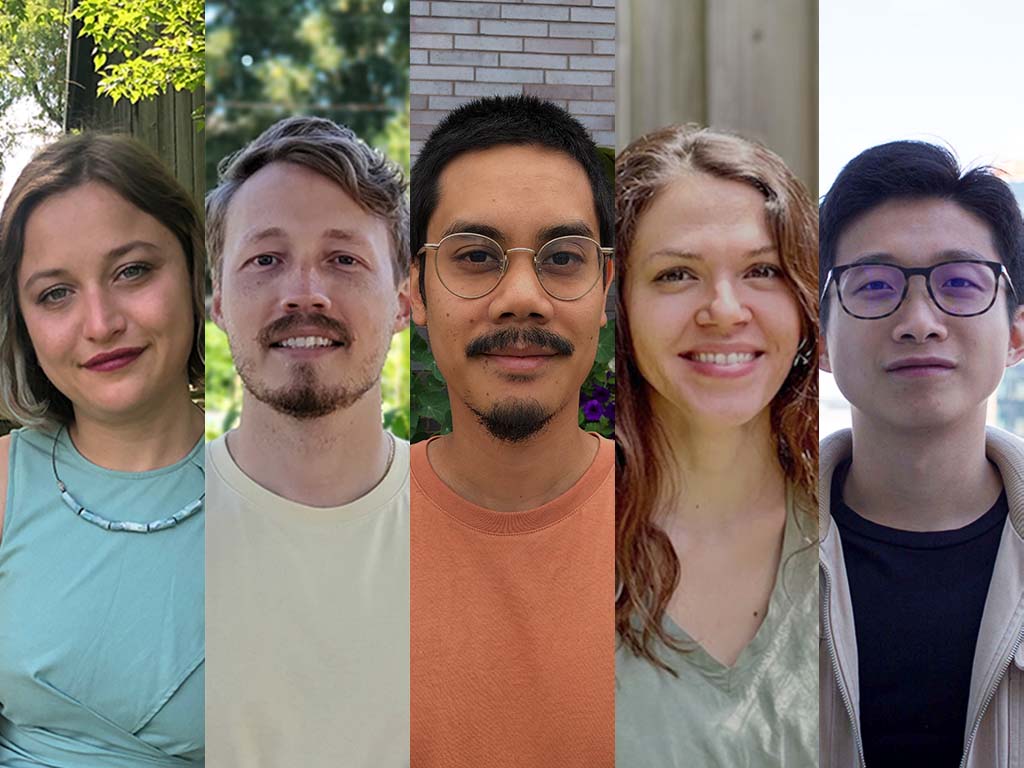
DAS alumni Margot de Man, Mark Grimsrud, Ron Noble, Sarah Ives and Newton Xian collaborated remotely across multiple countries