Environmental and Urban Sustainability - BA (Hons)
Full-time format1:
• 4 Year
• 5-Year Co-op
Part-time format:
N/A
Requirements:
Grades-Only
Grade range:
Low 70s
Faculty:
Faculty of Arts
Experiential learning1:
Co-op available

On this page
Is this degree for you?
Are you passionate about the environment? Understanding and managing our environment are among the defining challenges of today’s world. Governments at local, regional, provincial and national levels seek to research, understand and manage environmental issues.
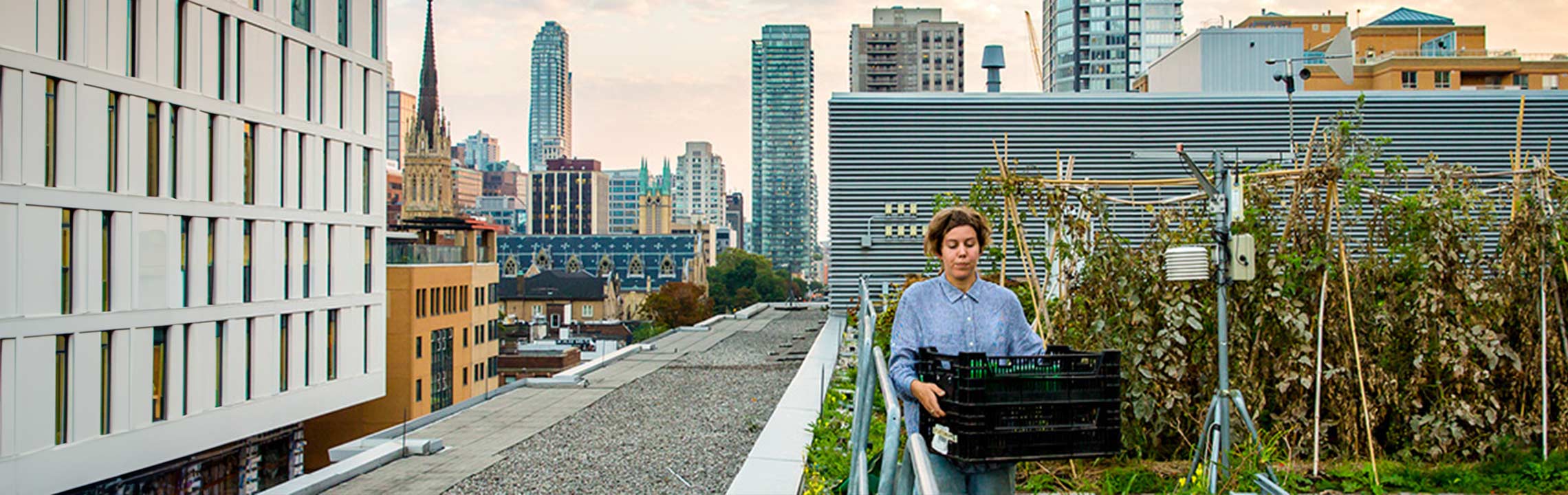
In the Environmental and Urban Sustainability1 degree program at Toronto Metropolitan University (TMU), you’ll explore how citizens, corporations and governments resist or embrace eco-friendly ideas and approaches. Whether studying on campus or choosing an international exchange, you’ll learn how to research and resolve environmental issues through fieldwork, consulting for external clients and investigating urban sustainability issues. You’ll also gain experience through an optional paid co-op.1
Experiential learning opportunities1: Co-op available
After graduation, your ability to interpret various environments, analyze people’s behaviour and critique sustainable initiatives will empower you to effect change.
The Environmental and Urban Sustainability1 program is one of 12 bachelor of arts programs that share a one-year foundation.2
The following is a preview of first-year courses based on the available current academic Undergraduate Calendar for this program.
1st & 2nd Semester
Career possibilities:
- Agricultural specialist
- Conservation officer
- Environmental consultant
- Policy advisor
- Sustainability officer
Employer possibilities:
- Government of Canada
- Microhabitat
- Toronto and Region Conservation Authority
- Unity Health Toronto
- WSP Global Inc.
Further education:
- Environmental Applied Science and Management (MASc)
- Geography
- Policy
- Urban Development (MPI)
New Frontiers in Research Fund grant supports research to inform a more sustainable and equitable future
A TMU researcher has secured a grant from the New Frontiers in Research Fund (NFRF), which supports research focused on post-pandemic recovery. The project, led by Geography professor Claus Rinner, will focus on how communities can be better engaged in decision-making during future emergencies and how governments can effectively communicate and build trust with local communities.
Read more: Faculty of Arts research will help inform future policymakers
This is a Grades-Only program. Admission decisions for Grades-Only programs are based on academic performance.
Academic requirements for full-time, 4-year program
To be considered for admission, Ontario high school students must meet the following requirements:
- Completion of the Ontario Secondary School Diploma (OSSD)
- Completion of 6 Grade 12 U or M courses with a minimum overall average of 70%
- Completion of the following required Grade 12 U course with a minimum grade of 70%:
- English/anglais (ENG4U/EAE4U preferred)
An overall average of 70% is required for consideration. Due to competition, the average needed for admission can fluctuate each year (it depends on the number of applications received and the number of spaces available). The grade range at the top of this page represents the average required in previous years.
Academic admission requirements for all other applicants are available on the admission requirements page. If you haven’t been educated in Ontario, you may be considered with the equivalent of the Ontario requirements. TMU reserves the right to determine equivalency at its sole discretion.
Tuition and fees range 2025-2026
For detailed fees info, visit tuition and fees by program and costs to expect.
Full-time format:
Ontario: $7,287 - $7,312
Out-of-province: $8,826 - $8,851
International: $36,818 - $36,843

Over $20M across all levels of study
We award more than $20M in awards, scholarships and bursaries throughout all years of study.
Find scholarships for you.
Explore financial assistance
Learn more about government financial aid programs like OSAP, out-of-province student loans and U.S. student loans.
Apply for financial assistance.

“Arts gave me the opportunity to learn all about the facets that contribute to healthy communities, which broadened my horizons on how I can contribute to a more sustainable future world.”
- Sarah Brigel, Environment and Urban Sustainability, Class of 2016
The Faculty of Arts programs combine a liberal arts education with something unique: Toronto Metropolitan University (TMU)'s brand of relevant, practical learning that's designed to make you a well-rounded, informed human being who is also highly employable
Faculty of Arts degree programs
Take a virtual tour
Sign up for emails
Notice of Collection: Toronto Metropolitan University collects and manages personal information under the authority of the (PDF file) University Act and in accordance with the Notice of Collection for recruitment and other related purposes.
Disclaimer:
While every effort is made to ensure accuracy on this site, in the event of a discrepancy, TMU's current Undergraduate Calendar is the official reference.