Engineering & Architectural Science Day 2025: Award Recipients
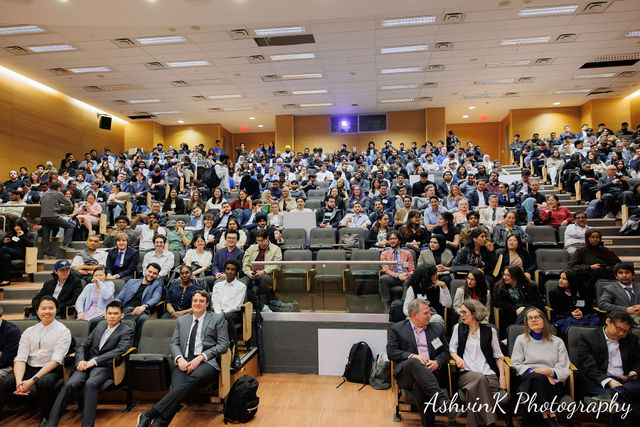
The FEAS Dean’s Office awarded one exceptional project from each undergraduate program (based on student teams who submitted for the award program).
Aerospace Engineering Award Winner
.jpg)
Project: ARES II: Advanced Reconnaissance and Exploration System
(Mars Exploration Surveyors to Enable Human Exploration)
Project summary:
ARES II addresses critical data gaps that limit human exploration of Mars. Current data lacks the resolution, coverage, and redundancy needed to identify safe landing sites, traverse paths, and resource-rich regions.
For altitude determination and control, the ARES II system combines star trackers, inertial measurement units (IMUs), reaction wheels, and attitude control thrusters to maintain precise orientation. Orbiting the satellite at 350 km from the surface of Mars, ARES II will use a suite of four types of sensors: Dual-Frequency Radar System (DFRS), Metropolitan Spectroscopy Imaging System (MSIS), Metropolitan Imaging Device (MID), and Metropolitan Altitude Sensor (MAS). These will enable ARES II to map 75% of Mars by 2033, characterizing slopes, roughness, hydrated minerals, subsurface water ice, caves, and sand dunes to support landing and long-term habitat planning. This suite of sensors and actuators will guarantee scientific accuracy, data collection consistency, and effective communications.
Team members:
Katerina Beros, Ali Ahmadi, Ernesto Socorro Perez, Ethan Sequeira, Rui Fernandez, Aadhith Ravi, Justis Lapier, Ricard Sola-Gonzalez, Kian Ojo Francis, Maia Elizabeth Gorham
Architectural Science Award Winner
.jpg)
Project: The Sandbox
(Readymade)
Project Summary:
In The Sandbox, Toronto’s Exchange Tower at 130 King St. W. is reimagined as a vibrant hub for family living, learning, and play. Honouring the site’s commercial history, the 36-story office tower’s existing connection to Toronto’s PATH network and its amenities is amplified and celebrated through a revitalized connection to the street and the integration of a family-focused residential program. The office-to-residential conversion takes advantage of the tower’s original cruciform floor plate, carving communal “sandboxes” into the volume to create shared outdoor spaces and bring natural light into the residences. This design results in a variety of vertical “neighbourhoods,” reimagining high-rise urban living.
A sequence of public spaces, from the street to the PATH and up to the rooftop plaza, incorporates recycled granite and glass, paying homage to the materials that define both the existing building and its neighbours in the financial district.
Team members:
Heba Al-Fayez
Biomedical Engineering Award Winner
.jpg)
Project: Low-Cost Patient Anatomy Specific Artery 3D Printed Model To Simulate Biplane Fluoroscopy For Interventional Neuroradiology Training
Project Summary:
The motivation for this project arises from the need to reduce radiation exposure during interventional neuroradiology training, which traditionally involves significant exposure to X-rays. By leveraging advancements in low-cost optical cameras and 3D printing, the project aims to develop a fluoroscopy simulator that provides a safe, radiation-free training environment. Using optically transparent 3D printed models, coupled with LED light sources and optical cameras to simulate x-ray sources and detectors, the simulator will offer realistic, cost-effective training for interventional neuroradiology procedures.
Team members:
Merjan Jabarkhil, Syeda Zubia Imam, Ayisha Azizi, Clement Solsona
Chemical Engineering Award Winner
.jpg)
Project: Sustainable Ethylene and Propylene Production Plant from Mixed Plastic Waste
Project summary:
As Ontario’s population continues to grow, so does the challenge of managing plastic waste. Traditional disposal methods such as landfilling and
incineration are no longer sustainable, either environmentally or economically. Our project addresses this pressing issue by transforming 70,000 kg of mixed plastic waste per day into high-demand chemical products like ethylene and propylene. These hydrocarbons are essential to a wide range of industries, from packaging to automotive manufacturing.
By turning waste into valuable raw materials, this solution not only reduces landfill dependency and pollution but also unlocks new revenue streams, supports circular economy principles, and positions Ontario as a leader in advanced recycling technologies. This project is about more than just waste reduction – it's about redefining plastic as a resource.
Team members:
Lopakumari Matroja, Prrunthaa Santhirakumaran, Janisha Mistry, Shanneil Grant-Miller
Civil Engineering Award Winner
.jpg)
Project: Utility Operations and Response Center
Project summary:
A utility operations and response center located in the seismic-prone Orleans, Ottawa, provided unique design challenges. Using an ETABS software simulation, the team found that an earthquake could result in a total of 1700kN of lateral force on the building. To mitigate the force, an expansion joint was considered to create two separate center of masses to allow for a simpler Lateral Force-Resisting System (LFRS) design. In the canopy section, the team faced a clearance requirement for truck access, which ruled out traditional cross-bracing. To solve this unique challenge, they used a truss frame system to provide lateral support in the east/west direction. Designs were also made from the superstructures member selections all the way to bolted connections and base plate connections for the foundation.
The team’s overall design solution addressed significant seismic demands, client restraints, and structural complexities, while maintaining constructability and cost efficiency.
Team members:
Nicholas Roua, Darko Simanic, Brandon Angumba, Yashar Baradaran-Seyed, Hamza Abdus-Samad, Michael Miceli
Computer Engineering Award Winner
.jpg)
Project: The Fluid Toy
Project summary:
Most aspiring game developers start with Unity due to its accessibility, but
unlike Unreal Engine, it lacks a built-in fluid simulation system, making dynamic fluids difficult and costly to implement. Graphics Processing Units (GPUs) are commonly used for fluid simulation, yet Central Processing Units (CPUs) – found in every computer – have untapped potential. The current Unity ecosystem offers a paid solution that runs on either the CPU or GPU, but not both simultaneously.
To address this, the team developed The Fluid Toy; a powerful yet accessible real-time fluid simulation engine designed to harness the full capabilities of both CPU and GPU processors. The Fluid Toy implements Smoothed Particle Hydrodynamics (SPH) fluid simulation, a fully particle-based method ideal for modeling complex, dynamic free-surface flows such as splashes and breaking waves.
The Fluid Toy is free to play and use, and scalable to all hardware. Built by gamers, for gamers, The Fluid Toy empowers indie developers to push performance limits and craft richer, more immersive gaming experiences.
Play The Fluid Toy (external link)
Team members:
Davis Cheung, JJ Marr, Cameron Tuffner-Lyons, Victor Do
Electrical Engineering Award Winner
.jpg)
Project: Power Forecasting: Forecasting the Power Demand of the Future
Project summary:
In today’s world, power is essential for all businesses to operate and perform everyday tasks. However, if the power generation does not match the consumption, there is a risk of blackouts. This engineering design project aims to provide a forecast of power consumption by a feeder in a distribution system using different machine learning models that can be accessed through a user-friendly graphical interface. To train and generate forecasts using their models, the team used residential power data from every Forward Sortation Area (FSA) in Ontario from the Independent Electricity System Operator (IESO) and weather data from Environment Canada.
Providing the same amount of power as is being consumed is a delicate balancing act that is easier when accurate forecasting models are integrated into the process. Through accurate forecasting, demand can meet the load, preventing a shortage of power and ensuring reliability.
Industrial Engineering Award Winner
.jpg)
Project: Design of an Improved Customs Brokerage System at Livingston International Inc.
Project summary:
The objective of this project was to improve the customs brokerage system at Livingston International Inc. by increasing the percentage of shipments processed within the two-hour commitment time, optimizing release customs analyst (RCA) utilization, and reducing queue delays due to rejected shipments and queue inefficiencies.
This team identified key issues contributing to inefficiencies in Livingston’s customs clearance process, including poor RCA resource allocation, queue cherry-picking, and high rejection rates. After testing different solutions in Arena, the final recommendation, Combination 5, includes RCA rescheduling, implementing a first-in, first-out (FIFO) queue system, and reducing the rejection rate by 10% through PGA validation tools. This combination offered the best balance of costs, TPH, and RCA utilization.
Team members:
Emma Young, Sarajo Rizcallah
Mechanical Engineering Award Winner
.jpg)
Project: Micro Rover Deployable Shelter for Lunar Night Survival
Project summary:
This project was driven by the surge in lunar exploration, exemplified by three commercial landings this year and a growing number of small spacecraft missions that reduce risk and foster innovation. The harsh lunar environment, particularly extreme cold, often limits small missions to a single lunar day. Consequently, this project addresses economic and scientific needs by extending surface operation lifetime, thus enhancing mission efficiency.
The LUSTRE (Lunar Survival Thermal Research Engineering) team’s innovative solution is a novel, lightweight, and compact deployable shelter that draws inspiration from the unfurling of a flower bud biomimicry, and is activated by shape-memory alloys (SMA). The project features a system comprising four sub-designs: a biomimicry-inspired deployable shelter, a thermal representation of a micro lunar rover, a precisely controlled method for programming SMA actuators, and a reliable two-stage deployment and ejection mechanism. The shelter is a multi-layered structure made from materials selected for their specific thermal properties, particularly emissivity and absorptivity. By mitigating radiative heat loss, the shelter could help enable survival through a lunar night.
Team members:
Hakkchaiyaa Anbarasan, Arhum Arif, Anam Mian, Vanessa Van Decker
View demonstration video:
The Social Impact Award
The Social Impact Award, presented by the Innovation Boost Zone and the FEAS Dean’s Office, recognizes projects that demonstrate the potential for positive impact on communities or industries, showcasing the students' ability to apply their skills to solve critical real-world problems.
Social Impact Award Winner
.jpg)
Project: Photo-Adaptive Blinds
Project summary:
Currently, over 40% of a building's annual energy consumption comes from residential and commercial spaces, with HVAC systems accounting for nearly 75% of this demand. Focusing on the building envelope, windows prove highly inefficient, wasting up to 30% of the energy produced for a home. That is wherein the summer sunlight coming in heats the space, making air conditioning systems work harder, and conversely, in the winter, where heat escapes through the glass, bearing additional load on heating systems.
To address this challenge, this mechanical and mechatronics engineering student team developed Photo-Adaptive Blinds, a smart window covering that automatically adjusts based on the external brightness and temperature inside a room. Designed for places with variable seasonal changes like Toronto, it opens to let in natural warmth during cold weather and closes to block extra heat depending on the optimal control effort to reduce the current HVAC load.
Team members:
Isa Hajiyev, Herman Tran, Hazma Dirie, Vishal Krishnakumar
Video presentation:
The Innovation Award
The Innovation Award, presented by the Innovation Boost Zone and the FEAS Dean’s Office, recognizes projects that demonstrate a groundbreaking application of technology or the creation of a truly unique and innovative technological solution.
Innovation Award Winner
.jpg)
Project: Microelectronics Wastewater Reclamation: A Near Zero-Liquid Discharge Plant (Chemical Engineering)
Project summary:
The objective of this project is to present a design of a wastewater purification process that is capable of reclaiming 50,000 tonnes per year of semiconductor wastewater (a sector of the microelectronics industry) to ultrapure water, while employing a near-zero liquid discharge model. The approach of a closed system is one not currently employed in the industry due to the diverse and complex contaminant profile.
This innovative approach aligns with the industry’s sustainability goals as well as the stringent environmental regulations surrounding industrial wastewater disposal. As the demand for integrated circuits increases, the demand for ultrapure water follows suit (Noman et al., 2024). The need for novel wastewater treatment technologies and processes is critical as the production process generates a significant amount of contaminants, including solvents, acids, heavy metals, and hazardous organics such as tetramethylammonium hydroxide. This process is able to increase water availability and redirect water to other sectors, such as residential and agricultural uses.
Team members:
Fatima Aziz, Azerin Chowdhury, Sheema Khan, Maxwell Steer