Fashion students co-curate Captive Labour exhibit
Under the supervision of Dr. Alison Matthews David, Camilla Leonelli Calzado, a fourth-year Fashion student and Sephra Lamothe, a MA Fashion student, have co-curated an exhibition detailing the history of Canada’s penitentiary system. The Captive Labour exhibition will showcase historical objects, archival texts and photos.
While assisting Fashion Professor Dr. Alison Matthews David with an upcoming book and exhibition at the Bata Shoe Museum, Lamothe and Calzado found their interest piqued by a donation to the Fashion Research Collection of tools used in shoemaking workshops at Kingston Penitentiary in the 1950s and 60s.
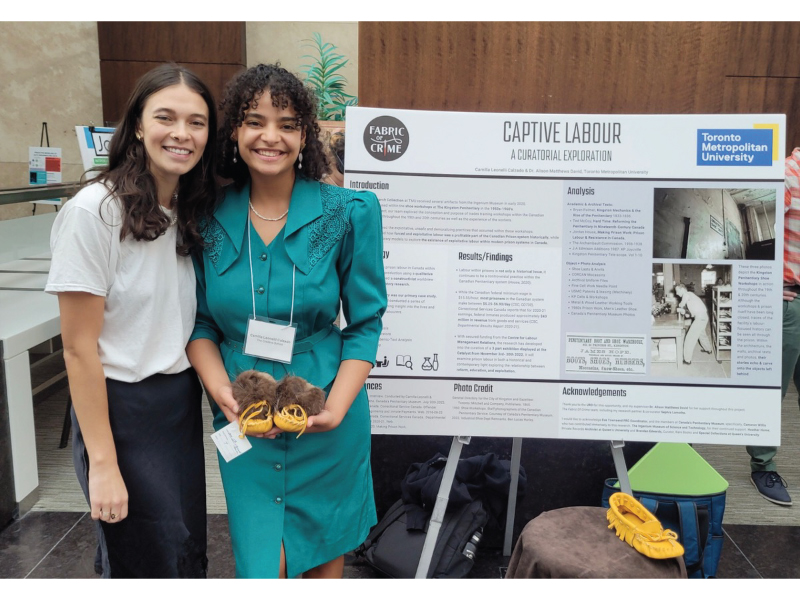
Fashion students and co-curators of the Captive Labour exhibit Camilla Leonelli Calzado and Sephra Lamothe
“While doing research with my co-curator Sephra Lamothe, we traced the origins of these objects back to The Kingston Penitentiary shoe workshops in the 1950’s-60s. There were a variety of tools including shoe lasts, channeling knives, wrenches and nails,” Calzado says. “We immediately felt that there was a story belonging to these objects and the labourers behind them.”
Analyzing these objects led Calzado and Lamothe to delve into the issue, examining historical tools, visiting museum collections and reviewing archival texts from the Kingston Penitentiary.
Throughout their research, the team uncovered that the characteristics of historical prison labour are not too different from their contemporary counterparts.
Lamothe explained how they were able to link the experiences faced by inmates historically to people incarcerated today, “We were able to purchase two pairs of moccasins which were crafted in Warkworth Institution, a medium security facility located just two hours East of Toronto. CORCAN, a subsidiary of Correctional Service Canada, sells goods produced within the Canadian Penitentiary system,” Lamothe said. “When we received the moccasins our intuition was confirmed. As part of our analysis I spoke with an employee who worked within the Leather Workshop at Warkworth who confirmed that an assembly line was used for the production of the moccasins.”
To further support their research, Lamothe explained that “Justine Woods, a PhD candidate and Sessional TMU Instructor who’s research centers Indigenous fashion technologies and garment-making, reviewed the moccasins to confirm the team's suspicions that non-traditional materials and practices were used. Woods confirmed that the materials and process of creation disregarded traditional practice based making.Through their analysis and research on the disputes raised by Indigenous Communities the team was able to determine that the selling of Indigenous cultural materials made in prisons is unethical.The use of an assembly line for production highlights that the focus of contemporary prison workshops is still production, not craftsmanship and/or skills training”
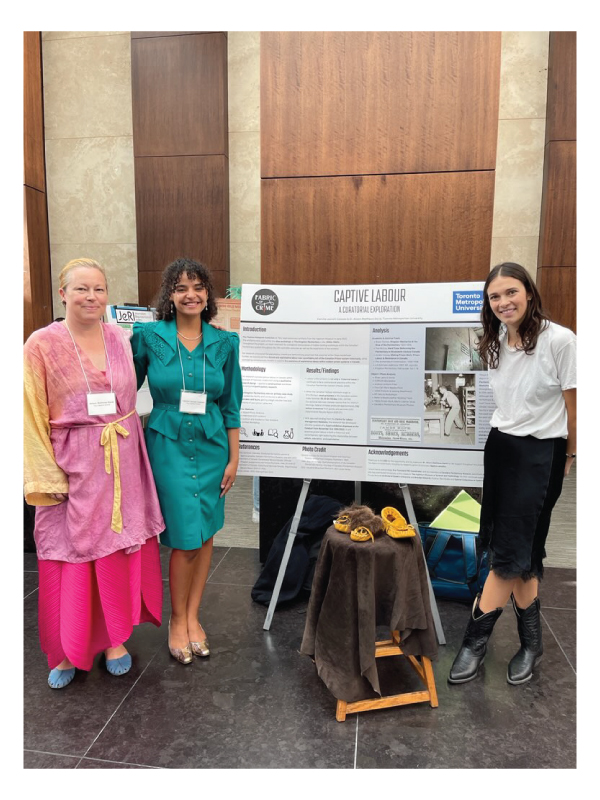
Fashion students Camilla Leonelli Calzado and Sephra Lamothe with their Professor Alison Matthews David
On-site exploration at the Kingston Penitentiary
To further guide and inform their academic research, Calzado and Lamothe contacted a representative from Canada’s n Penitentiary Museum who provided contextual information on the history of the Kingston Penitentiary, the workshops that operated within the prison and provided a private tour of the museum and Penitentiary grounds.
“While in Kingston, our team also had the opportunity to visit the archives and special & rare books collections. Here we scanned a variety of inmate newsletters, warden journals, inquiries, civilian reports, photos and even interview transcripts. This part of the trip really helped to put a face and voice to the realities that had been going on in these workshops,” Calzado explains.
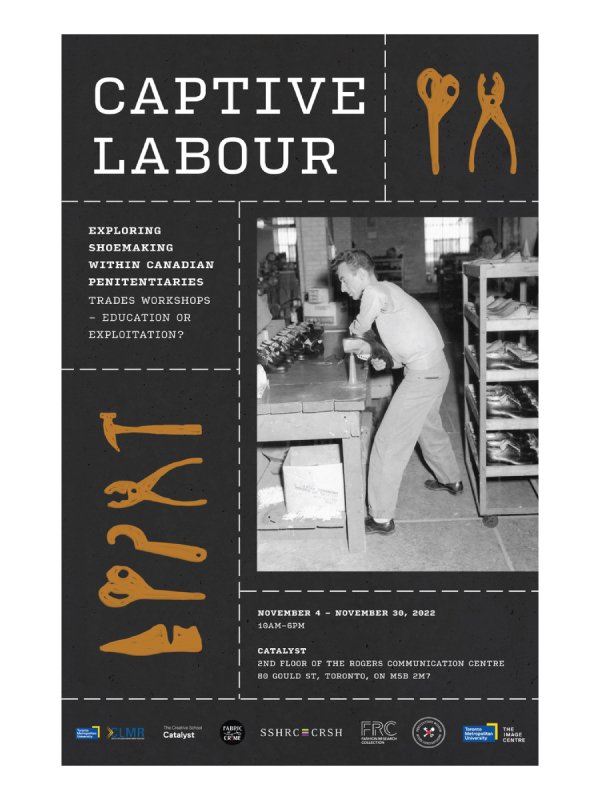
The Captive Labour exhibition launches on November 3 and will be open to the public November 4 to 30 at the Catalyst. There will also be a speaker event on November 22 featuring academics and guest lecturers
Through their site visit, Calzado said they learned a great deal of new information about the prison system that the team wasn’t previously aware of. One of these discoveries was the use of trades training as a way to exploit inmates.
“Under the guise of reformation and education, inmates were being put to work for over 10 hours a day in loud shops, performing assembly line labour, while severely under trained at the low wage of 10 to15 cents a day,” she says. “The most shocking part of our research was uncovering that prison labour still occurs within our Canadian system, and the standards really haven’t changed that much.”
To support this, Lamothe explained that “while the Federal minimum wage has increased to $15.50/hour the penitentiary wage remains staggeringly low with prisoners making a maximum of $6.90/day. Additionally, a percentage of inmates wages is often deducted for room/board & food depending on their income.”
Sharing the stories of inmates
Through the project, Calzado says that the team hopes that viewers can look at the exhibition and see that prisons have been built to eliminate individuality from each prisoner and that the system isn’t impartial.
“There are many reasons why people end up in prison and through our research we have found that in many cases a cycle of poverty and marginalization is part of the why. We hope that we can breathe life into the historical objects being displayed and share the stories of the shoe shop labourers,” she says. “Our aim is also to show that this is not a historical issue but an ongoing issue, and it’s happening right here in Canada.”
The upcoming Captive Labour exhibition at The Catalyst, will feature historical objects, photos, and modern-day displays. The exhibition launches on November 3rd and will be open to the public November 4th to 30th. There will also be a speaker event on November 22nd featuring a panel discussion with academics and guest lecturers.

The Creative School at Toronto Metropolitan University
The Creative School is a dynamic faculty that is making a difference in new, unexplored ways. Made up of Canada’s top professional schools and transdisciplinary hubs in media, communication, design and cultural industries, The Creative School offers students an unparalleled global experience in the heart of downtown Toronto.