Educate

One of our primary objectives is to ensure that the EDI lens is incorporated in education. Our faculty members intentionally design curriculums and programs to be representative of culturally diverse perspectives and fully inclusive to all prospective students. A key strength is our ability to stay current with emerging trends and issues, developing curriculums based on progressive and critical thought to equip our students as future change makers and leaders.
In this section:
From course conception to curriculum design, our faculty continue to identify ways to offer innovative and inclusive learning opportunities to current and prospective students. We actively listen to and champion the calls to action from equity-deserving communities, making decisions designed to close social gaps. In 2024-25, some key developments included offering STEM courses and bridging programs for racialized newcomer women and establishing more inclusive admission criteria.
The corporate trend of retreating from diversity, equity and inclusion (DEI) initiatives, is a worrying development in the business sector. Alison Kemper (Associate Professor, Entrepreneurship & Strategy) offered her expertise and analysis after decisions by Google and Home Depot to withdraw as sponsors from Toronto Pride 2025 reflected a broader, worrying shift in corporate approaches to social responsibility, which she argued is influenced by changing political climates and business considerations. Recent policy developments, Kemper says, include executive orders to regress on federal DEI programs and to increase legal scrutiny of corporate diversity initiatives. Read more on her analysis on the impacts of social and environmental issues on business strategies, and their rollbacks on the rights of sexual minorities and other marginalized groups.
Valentino, C. (2025). Diversity and merit: Two concepts that can and must coexist (external link, opens in new window) . International Association of Business Communicators. ( (PDF file) PDF version (opens in new window) )
Diversity and Merit: Two Concepts That Can and Must Coexist
By Caterina Valentino, Ph.D., MBA, MPA 30 June 2025
This article argues that Diversity, Equity, and Inclusion (DEI) and Merit, Excellence, and Intelligence (MEI) are not conflicting, but rather interconnected concepts essential for organizational success. The author, Caterina Valentino (Adjunct Professor, School of Health Services Management), suggests that the recent U.S. Supreme Court ruling on race-based college admissions has intensified the debate on this topic.
The article defines DEI as the removal of barriers and provision of support for marginalized individuals to ensure fair opportunities. In contrast, MEI is defined as the assessment of candidates based on standardized criteria for skills and performance.
The author challenges the notion that diversity is a natural byproduct of a merit-based system, pointing to the impact of unconscious bias in hiring and promotions. The article cites research indicating that resumes with ethnic-sounding names are less likely to receive callbacks and that affinity bias can affect interview outcomes.
The author emphasizes that DEI initiatives are deliberate actions aimed at confronting biases and broadening the definition of excellence. To effectively integrate DEI and MEI, the article suggests several practical strategies, including setting measurable goals, providing diversity training, and cultivating a culture of belonging.
The author proposes the unified concept of "DMEEI" (Diversity, Merit, Excellence, Equity, and Inclusion). This integrated approach is intended to convey that diverse perspectives and high standards are mutually reinforcing, ultimately leading to organizational excellence and preventing decline.
The MBA Canadian Experience Course Integrative Week featured an opening session from the TMU Diversity Institute on current trends in EDI and accessibility and the impact of diversity as a key to Canada's competitiveness. The session included a presentation and Q&A with Mohamed Elmi (Executive Director, Diversity Institute). Students who attended the week-long experiential course, were assessed on their reflections on these sessions. The course was developed to reflect current trends and developments in the business sector and topics related to diversity embed EDI as a core pillar in business.
As part of their ongoing commitment to inclusion, the Ted Rogers Sales Leadership Program (SLP) implemented a targeted outreach strategy during the 2024–25 recruitment cycle, actively encouraging women and underrepresented students to apply. The result was a cohort that better reflects the diversity of our student population.
Dr. Lucas Dufour, Associate Professor of Human Resources Management and Organizational Behaviour, developed various case studies related to sustainability and business management practices for the curriculums in courses taught in the Organizational Behaviour and Human Resources Management program (MHR405 Organizational Behaviour and MHR 721 Negotiation and Conflict Resolution). These case studies offered students with opportunities to build their experience applying equitable thought processes and conscientious decision-making in realistic business practices and in preparation for contemporary business trends.
For the third year in a row, approximately 40 students from the Information Technology Management (ITM) program participated in the Cybersecurity Training and Work Integrated Learning Program (CTWIL). The program, in partnership with the Information Communications Technology Council of Canada (ICTC), provides women and non-binary post-secondary education students with access to Microsoft training and certification examinations, along with a 16-week paid work-integrated learning placement in the cybersecurity sector. The selection processes commenced in Summer 2024, and students completed their training in Fall 2024, which was followed by their work placements in Winter 2025.
Disaggregate data and qualitative research are essential tools for building community initiatives, developing equitable projects and advocating for social and policy changes. Researchers and faculty members at the Ted Rogers School are committed to applying an intersectional lens in their work in order to produce equitable analysis. The following is a recent selection of journal articles and conference presentations centered around EDI-related areas of business research related to neurodiversity, race and identity in consumerism, the intersection of AI and EDI in hospitality and tourism education, gender equity, migration, Indigenous entrepreneurship and more.
Research in progress
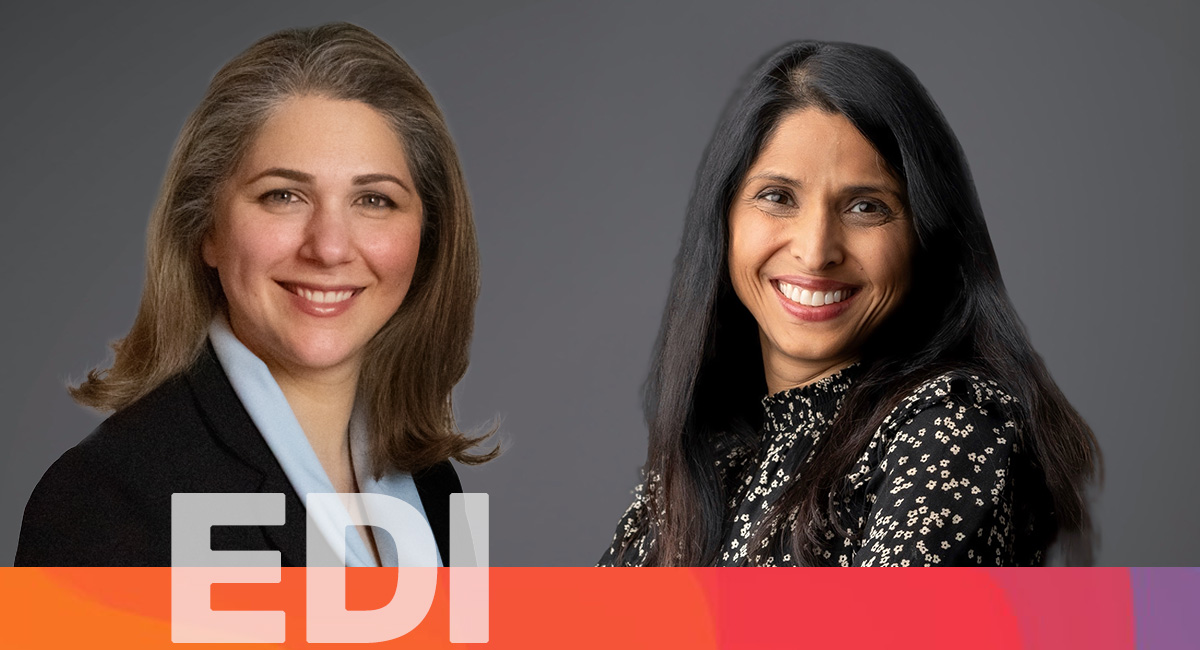
EDI in Cybersecurity
Dr. Rupa Banerjee (right), Professor, Human Resources Management and Organizational Behaviour, in partnership with Dr. Atefeh Mashatan, Associate Professor, Information Technology Management, is working on a collaborative research project on EDI in Cybersecurity. The research has produced two conference papers in Hawaii International Conference on System Sciences in January 2025. Another journal article, titled "We Take The Whip and Work: Matrix of Racialized and Gendered Work in Cybersecurity," is currently under review for publication.

Understanding Consumer Responses to Minority-Owned Businesses
Dr. Rishad Habib, Assistant Professor, Marketing Management, received a Social Sciences and Humanities Research Council of Canada Insight Grant to support her research project titled: “Understanding Consumer Responses to Minority-Owned Businesses.”

Poverty Premium in Algorithmic Capitalism: How Does AI Credit Scoring Disrupt Poor Consumers’ Access to Essential Services?
Dr. Mathieu Lajante, Associate Professor, Marketing Management and Dr. Jenna Jacobson, Associate Professor, Retail Management, have an ongoing research project funded by a Ted Rogers School of Management Research Advancement Grant ($15,000) entitled “Poverty Premium in Algorithmic Capitalism: How Does AI Credit Scoring Disrupt Poor Consumers’ Access to Essential Services?” Working with a diverse team of researchers at emoLab and the Retail Leadership Institute in Phase 1 of the research, Drs. Lajante and Jacobson have interviewed working-class Black Canadians to understand their experiences, impact and perspectives of AI on credit scoring. Research under review for publication.
Published research
Ted Rogers School faculty and researchers are driving innovation and thought leadership, keeping a pulse on emerging trends and shifts in EDI-related topics in business. The following is a recent selection of journal articles and conference presentations centered around EDI-related areas of research.

Reparative consumption: The role of racial identity and white guilt in consumer preferences (external link, opens in new window) .
Rishad Habib, Assistant Professor, Marketing Management
Habib, R., Ok, E., Aquino, K., Mookerjee, S., & Cornil, Y. (2025). Reparative consumption: The role of racial identity and white guilt in consumer preferences. Journal of Consumer Research, ucaf019. DOI: 10.1093/jcr/ucaf019.
Abstract: In light of recent social and political movements advocating for racial equity and calls for more research on interracial marketplace interactions, this research explores the role racial identity plays in the consumption domain. Specifically, we investigate the marketplace consequences of U.S.-based White consumers’ feelings about their own racial identity by measuring and manipulating white guilt, defined as the sense of guilt and remorse experienced by White consumers who hold their racial ingroup responsible for historical and ongoing racial injustices and perceive that Whites, as a racial group, benefit from unearned privileges. Consistent with the reparation-oriented action profile of guilt, six studies (all pre-registered, two with incentive-compatible designs) show that white guilt motivates reparative behaviors toward Black-owned businesses in various service contexts: Consumers with high white guilt express greater willingness to patronize and promote a business when it is Black-owned (vs. White-owned, family-owned, or when there is no information on ownership) and feel more moral for doing so, whereas this effect is non-existent, or sometimes reversed, for those low in white guilt. Our findings reveal the complex dynamics of race, identity, and intergroup relations in the marketplace, and demonstrate a contemporary exception to ingroup favoritism among some White consumers.
 Transforming HTM education: ChatGPT as a catalyst for DEIB (external link, opens in new window)
Eugene Chan, Associate Professor, Marketing Management | Dimensions Faculty Lead
Chan, E. Y. (2024). Transforming HTM education: ChatGPT as a catalyst for DEIB. Journal of Hospitality & Tourism Education, 36(4), 410–418. DOI: 10.1080/10963758.2024.2428613
Abstract: In the ever-evolving landscape of hospitality and tourism management (HTM) education, the imperative to foster diversity, equity, inclusion, and belonging (DEIB) has gained prominence. This commentary explores the potential of Chat Generative Pre-Trained Transformer (ChatGPT), an artificial intelligence tool, as a transformative catalyst for DEIB in HTM classrooms, using Social Identity Theory (SIT) as a conceptual framework. I delve into practical applications, including personalized learning, language support, and cultural sensitivity, to engage students from diverse backgrounds. While highlighting its benefits, I also address ethical considerations and the importance of mitigating biases. Drawing from case studies and best practices, this article underscores ChatGPT’s role in enhancing inclusivity, with an emphasis on feedback mechanisms and continuous improvement. By embracing AI technology responsibly, HTM educators can redefine the educational experience, promoting a more equitable and diverse workforce in the hospitality and tourism industry.
Maintaining hotels’ COVID protocols post-pandemic to enhance service for guests with autism: An opportunity for increased accessible tourism (external link, opens in new window)
- Wayne Smith, Professor, Hospitality and Tourism Management | Director, Institute for Hospitality and Tourism Research
- Julie Kellershohn, Assistant Professor, Hospitality and Tourism Management
- Karen Peesker, Associate Professor, Hospitality and Tourism Management | Co-Founder & Director, Ted Rogers Sales Leadership Program
Smith. W. W., Peesker, K., Guttentag, D., & Kellershohn, J. (2024). Maintaining hotels’ COVID protocols post-pandemic to enhance service for guests with autism: An opportunity for increased accessible tourism. In U. Shukla & S. Kulshreshtha (Eds.), Post-COVID tourism and hospitality dynamics. Routledge.
Abstract: Autism spectrum disorder (ASD) is an increasingly prevalent neurodevelopmental condition, and individuals with ASD and their families face myriad barriers in their lives. Research has categorized such barriers as relating to social safety and physical safety in a leisure setting, and barriers of both types are common in hotels. Nevertheless, many of the protocols that hotels introduced to promote health and safety during the COVID-19 pandemic (e.g., online check-in, reduced capacity public spaces, and wayfinding signage) have inadvertently created a hotel experience that mitigates many of the challenges that hotels pose for guests with ASD and their families. This chapter details how various protocol modifications have fostered a hotel design that is more ASD-friendly in terms of both social and physical safety. It is suggested that hotels take advantage of such circumstances by finding ways to maintain these protocols post-pandemic to facilitate tourism opportunities for individuals with ASD and their families, giving the hotels a potentially lucrative competitive advantage.

Xiaohua (Howard) Lin, Professor, Global Management Studies | Director, Canada-China Institute for Business & Development
Lin, X. (2025, Apr. 02). Indigenous entrepreneurship [Keynote]. 19th Northern Ontario Business Case Competition, Algoma University, Ontario, Canada.

Wayne Smith, Professor, Hospitality and Tourism Management | Director, Institute for Hospitality and Tourism Research
Smith, W. W. (2024, Dec.). Expanding accessible tourism, making hotels more accessible for people with autism [Keynote]. 2025 Synergy, Institute of Engineering & Technology, Radaur, India.
Smith, W. W., & Hazenberg, E. (2024, Oct.). Industry engagement with research & education [Workshop]. TourismHR Canada Labour Forum 2024, Ottawa, Canada.

Oliver N. Okafor, Associate Professor, Accounting & Finance | Director, PMDip & CPAO Centre
Okafor, O. N. (2024, Dec. 13). Integrating immigrants into the accounting profession. CPA-Ivey Centre for Accounting, London, Canada.
Okafor, O. N. (2024, Oct. 31). Strategic management in a complex business landscape: Insights from a financial perspective. 2024 ICCC Toronto Equal Slice Program, Virtual.
Okafor, O. N. (2024, Oct. 04). Integrating immigrants into the accounting profession [Keynote]. Accounting for Impact Summit by CPA Ontario, Schulich, and Smith School of Business, Toronto, Canada.

Atefeh Mashatan, Associate Professor, Information Technology Management | Canada Research Chair | Founding Director, Cybersecurity Research Lab
Mashatan, A., & Mohanna, F. (2024, Sep. 23). Embracing yourself: Breaking free from perfectionism. Women Executive Network (WXN) Monday Mojo, Virtual.
Mashatan, A., & Mohanna, F. (2024, Sep. 16). The elusive work/life balance: Strategies for women leaders in integrating career and family/ethnicity. Women Executive Network (WXN) Monday Mojo, Virtual.
Mashatan, A., & Mohanna, F. (2024, Sep. 09). Recognizing gender biases and addressing them. Women Executive Network (WXN) Monday Mojo, Virtual.